
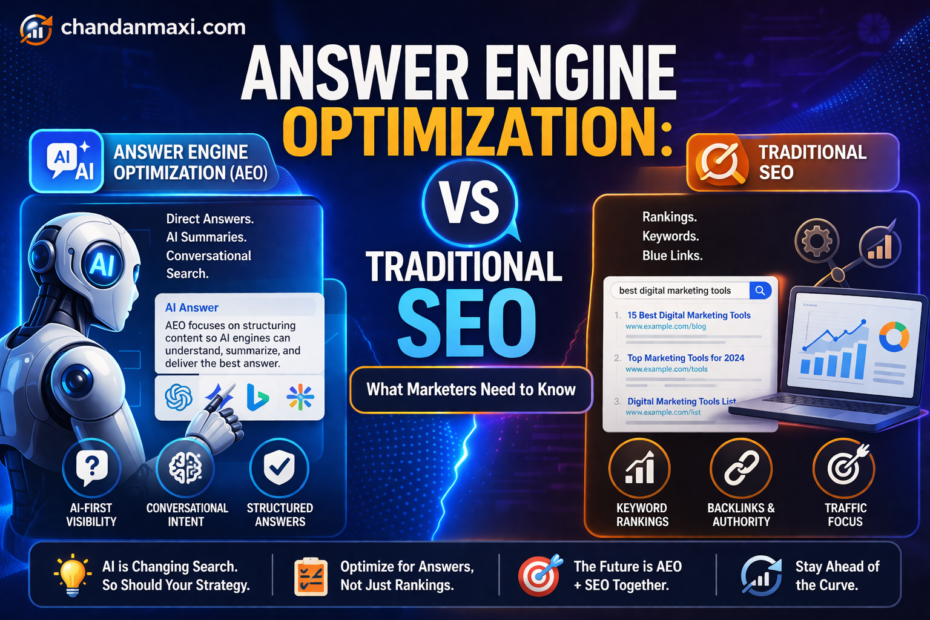
Answer engine optimization vs. traditional SEO can feel like two worlds colliding, but smart marketers treat them as complementary strategies. In short, traditional SEO focuses on optimizing for search engines and users today, while answer engine optimization zeroes in on how to surface crisp, concise answers for voice and featured snippets. The best approach blends both, shaping content that ranks, satisfies intent, and gets read aloud clearly by voice assistants.
Quick Summary
- Traditional SEO = keyword-focused, on-page signals, and technical health for web rankings
- Answer engine optimization (AEO) = optimizing for concise, direct answers, voice search, and featured snippets
- Both rely on user intent, quality signals, and structured data; they are most powerful when used together
- Voice search and AI-powered answers push for clearer, question-first content and structured formatting
- Practical steps: map questions to content, structure answers, test with snippets, and optimize for speed
What marketers need to know: AEO vs. traditional SEO
Let’s cut to the chase. Traditional SEO is about building trust signals over time—backlinks, robust content, technical health, and clear navigational paths. Answer engine optimization is about delivering the exact answers users are asking for, often in short, digestible formats that can be read aloud by voice assistants or shown as featured snippets. The goal is the same—drive qualified traffic—but the methods and emphasis differ. The strongest campaigns don’t choose one; they weave both together so your content ranks well and gets picked up by voice and AI assistants.
How traditional SEO works in practice
Think of traditional SEO as a marathon runner. You build a sturdy foundation with fast-loading pages, clean code, keyword-rich but natural content, internal linking, and a robust site structure. You earn authority with relevant, high-quality backlinks, social signals (even if they are indirect), and a content library that answers a broad range of user intents. You optimize meta tags, headings, image alt text, schema markup, and overall user experience to improve rankings in search results, often for longer-tail queries and commercial intents.
How answer engine optimization works in practice
AEO is more like sprinting with a clever shortcut. It’s not about stuffing keywords; it’s about answering questions directly and succinctly so that search engines can present you in rich, easy-to-consume formats—snippets, cards, or voice responses. AEO thrives on:
- Explicit question-first content: “What is X? How to Y? Why does Z matter?”
- Structured data and concise, readable formatting that helps search engines extract exact answers
- Clear, bullet-point lists, step-by-step procedures, and short paragraphs
- Optimizing for voice search by using natural language, everyday phrasing, and direct answers
- Creating dedicated FAQ pages, how-tos, and problem-solution content that maps to common questions
Key differences at a glance
Here’s a quick way to think about it:
- Intent focus: Traditional SEO targets broader intents and ranking signals; AEO targets direct answers for short-form consumption
- Format: Traditional SEO leans on long-form content, in-depth guides; AEO thrives on bullets, steps, and crisp paragraphs
- Delivery: Traditional SEO often sits in standard search results; AEO excels in featured snippets and voice answers
- Measurement: Traditional SEO looks at rankings, traffic, conversions; AEO adds voice reach, snippet visibility, and question-based traffic
Real-world benefits of embracing both
Imagine you run an online kitchenware store. A traditional SEO approach makes sure your category pages rank for “nonstick pans,” “cast iron skillets,” and “best frying pans.” An AEO approach makes sure your content answers questions like “What is the difference between a nonstick and a ceramic pan?” and “How to season a cast iron skillet?” When a user asks those questions via voice search or a featured snippet, your brand appears as the authoritative answer, driving clicks and trust.
Step-by-step Guide
Below is a practical, action-oriented roadmap to integrate AEO with traditional SEO. It’s designed to be used in real campaigns, not just as theory.
Step 1: Map questions to content and search intent
Start with a content audit. List your products, services, and topics. For each, map potential user questions and how those questions align with intent (informational, navigational, transactional). Create a matrix that pairs questions with existing content and gaps you need to fill.
Step 2: Create question-first content templates
Develop templates that start with the question as a header, followed by a concise answer (2–4 sentences), then a step-by-step guide, and a short summary. Use bullet lists, numbered steps, and a clear CTA. This structure is ideal for featured snippets and voice results.
Step 3: Optimize for snippets and voice
To improve your odds of earning a snippet, format content with: concise answers, bolded key terms, step-by-step lists, and FAQs. Use schema markup for FAQ and HowTo pages. Keep language natural and conversational, yet precise enough for voice assistants to repeat accurately.
Step 4: Build a robust FAQ hub
Create a central FAQ hub that answers the most common questions across your topics. Each question should be a separate block with a crisp answer, then a link to deeper content if the user wants more detail. This is a powerful place to capture voice search queries and FAQ-rich snippets.
Step 5: Structure data and schema correctly
Use structured data to help engines understand the content. Implement FAQPage, HowTo, and Article schemas where relevant. Validate with Google’s Rich Results Test and schema tools. This ensures your content is eligible for rich snippets and voice features.
Step 6: Optimize on-page elements for clarity
Title tags, meta descriptions, H1s, and subheaders should reflect the question-first approach. Keep meta descriptions crisp and actionable. Use descriptive alt text for images. Ensure fast load times and mobile-friendly design, because performance signals still matter for snippet eligibility and user satisfaction.
Step 7: Implement a robust internal linking strategy
Link from general topics to specific Q&A pages. Use descriptive anchor text that mirrors user questions. Internal links help search engines see topical relevance and pass authority to pages most likely to win snippets.
Step 8: Measure impact with the right metrics
Track rankings for target questions, snippet visibility, voice search impressions, and click-through rates from featured snippets. Combine this with traditional metrics like organic traffic, time on page, and conversions. If a page earns a snippet but doesn’t convert, revisit the user journey and CTAs.
Step 9: Optimize continuously with A/B testing
Test headline phrasing, snippet answers, and the order of steps in HowTo content. Small tweaks to wording or formatting can improve click-throughs and comprehension. Keep testing long enough to see meaningful patterns.
Step 10: Expand with breadth and depth
As you capture snippets in several topics, broaden coverage to related questions and long-tail variations. A richer content library increases your overall authority and the likelihood of ranking in multiple snippet positions.
Pro Tips
- Think in questions, not keywords. People speak differently when asking a question than when they search on a keyboard.
- Place the direct answer in the first paragraph of each Q&A block. Then expand with context.
- Use short, scannable paragraphs and bullet lists to improve readability for both users and search engines.
- When in doubt, favor clarity over cleverness. Snippets reward directness.
- Consistency matters. Publish a steady stream of question-focused content to build a library the engines trust.
Common Mistakes
- Overloading pages with keywords instead of delivering clear answers
- Ignoring structured data or misusing schema markup
- Forgetting mobile performance, which hurts voice search and snippet eligibility
- Focusing only on rankings rather than user intent and experience
- Neglecting internal linking and content coherence across the site
Best Tools
Tools can help you plan, execute, and measure AEO and traditional SEO effectively. Here’s a practical toolkit you can lean on:
- Keyword and intent mapping: Ahrefs, Semrush, or Moz for keyword data and competitive insights
- Content planning and topic clustering: Frase, Surfer SEO, or Clearscope to optimize for topics and user intent
- Structured data and schema: Google’s Structured Data Testing Tool, Rich Results Test, or Schema.org validators
- Content quality and readability: Hemingway, Grammarly, or ProWritingAid for clear, natural language
- Technical health: Google PageSpeed Insights, Lighthouse, and GTmetrix to keep performance snappy
- Voice search and snippets research: Answer the Public, AlsoAsked, and Bing’s People Also Ask insights
Internal Linking
Smart internal linking helps spread authority and guides users through your information architecture. Here are two natural placements for internal links:
Learn more about keyword strategy in our detailed post on how to build a resilient SEO keyword map.
For practical content formats, check out our guide on structuring content for featured snippets.
FAQ
1. What is answer engine optimization (AEO) and why does it matter?
AEO is about crafting content that delivers direct, concise answers to user questions, often in formats that appear as featured snippets or voice responses. It matters because it helps your content be found in voice search and quick-answer contexts, boosting visibility and credibility.
2. How is AEO different from traditional SEO?
Traditional SEO focuses on ranking pages through depth, relevance, and authority, often via long-form content and backlink building. AEO emphasizes delivering precise, easy-to-scan answers and using structured data to surface those answers in snippets and voice results.
3. Can you do AEO and traditional SEO at the same time?
Absolutely. In fact, the best strategies blend both. Create question-first, snippet-friendly content while maintaining robust technical SEO, authoritative content, and solid internal linking. The synergy often yields better rankings and more voice-activated visibility.
4. What content formats work best for AEO?
Short, direct answers (2–4 sentences), bulleted or numbered step-by-step guides, FAQ-style blocks, How-To content with clear procedures, and concise product comparisons. Use dedicated FAQ pages and HowTo schemas to improve snippet eligibility.
5. How can I measure the impact of AEO?
Track snippet visibility, voice search impressions, and click-through rate from featured snippets, alongside traditional metrics like organic traffic, rankings, and conversions. Look for pages that consistently earn snippets and compare their performance over time.
Featured Snippet Paragraph
Answer engine optimization focuses on delivering crisp, direct responses to user questions in formats that search engines can quickly extract, like bullet-point lists or short paragraphs. It complements traditional SEO by boosting visibility in snippets and voice results, helping users get answers fast while guiding them toward deeper content on your site.
Snippet: Quick Steps
- Identify top questions your audience asks in search and voice queries
- Create question-first pages with concise answers and clear steps
- Mark up with FAQ or HowTo schema to improve eligibility for rich results
- Structure content for readability: short paragraphs, bullets, and numbered steps
- Test, measure, and iterate to grow snippet reach and traffic
Voice Search Optimization: Simple Wins
Voice search is a growing channel, and it rewards content that speaks clearly. Use everyday language, answer questions directly, and structure content so that it can be read aloud in a single breath. Keep answers brief, and provide a natural transition to more in-depth content on your site for users who want to dive deeper.
Content Examples: Real-World Scenarios
Scenario A: An ecommerce brand selling kitchen gadgets wants to rank for “how to care for stainless steel pans.” Traditional SEO would optimize product pages and category hubs. AEO would publish a HowTo guide with a step-by-step care routine, bullets for each action, and a concise answer at the top. The result? A snippet that answers the question directly and drives users to the full guide for more details.
Scenario B: A SaaS company wants to attract startups looking for onboarding help. They publish FAQ pages answering common questions like “How does onboarding work in XX?” and “What is the fastest way to get started?” The content earns featured snippets and positions the brand as a helpful authority in voice searches and quick reads, complementing deeper product guides.
Technical Considerations for AEO and SEO
- Speed is non-negotiable. Fast pages improve user satisfaction and snippet eligibility.
- Mobile-first indexing means your content must read well on small screens and speak naturally in short bursts.
- Structured data helps engines understand exact meaning and context, enabling rich results.
- Clear topical authority signals come from thorough internal linking and consistently high-quality content across related topics.
- Accessibility and readability make it easier for users to consume content quickly, especially when listening via voice.
How to Align Teams for AEO and SEO Success
The best results come when content, product, and marketing teams work in rhythm. Here are practical tips to align efforts:
- Hold quarterly topic-sprint sessions focused on question-driven content that could earn snippets.
- Set shared OKRs around snippet impressions, voice search visibility, and traditional traffic growth.
- Collaborate with product for HowTo and troubleshooting content that matches user pain points.
- Share monthly dashboards that track both snippet metrics and classic SEO KPIs.
Content Formats to Consider Now
- How-To guides with step-by-step instructions
- FAQ pages addressing common customer questions
- Comparison pages that help buyers choose between options
- Short-form answer blocks at the top of longer guides
- Product knowledge bases with crisp, action-focused content
Conclusion
Blending answer engine optimization with traditional SEO isn’t about picking sides. It’s about building a content strategy that serves real human questions quickly and clearly, while still delivering long-term value, authority, and conversion potential. When done well, your content not only ranks well in standard search results but also becomes a preferred source for voice assistants and featured snippets. The result is more visibility, more trust, and a smoother path from first touch to conversion.
Our Social Presence:
Website- https://chandanmaxi.com/
Website – https://www.bedforsell.com/
Facebook link – https://www.facebook.com/Chandanmaxi/
Instagram link – https://www.instagram.com/chandanmaxig/
Youtube link – https://www.youtube.com/@chandanmaxig
Linkedin- https://www.linkedin.com/in/chandanmaxi/
Quora – https://chandanmaxi.quora.com/
WhatsApp Channel- https://whatsapp.com/channel/0029Va5oE4l2ER6fAHBu692X