
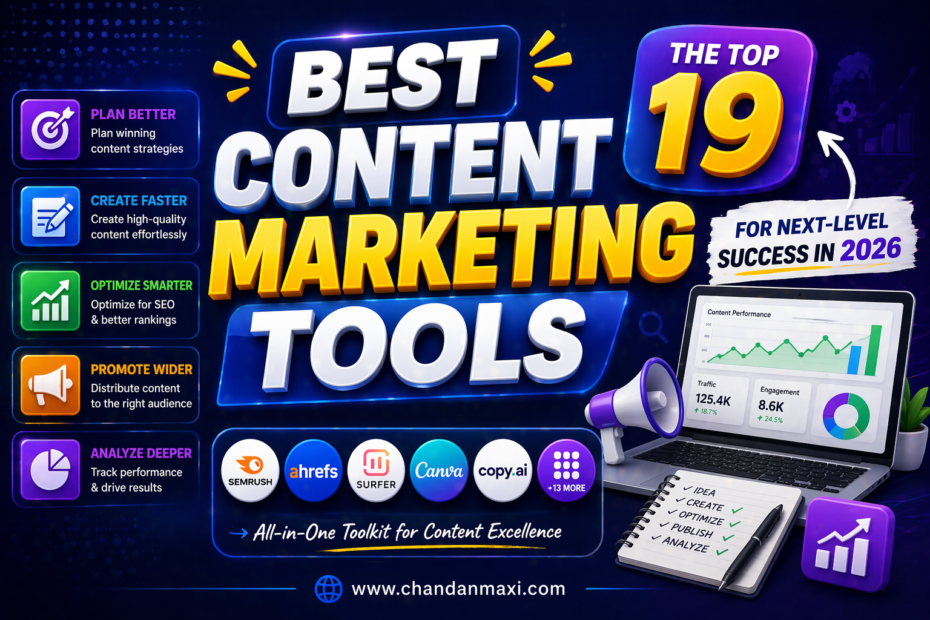
Quick Summary — what you’ll gain:
– 19 proven content marketing tools for 2026, across planning, creation, distribution, and analytics
– A step-by-step framework to evaluate and implement tools that fit your goals
– Real-world examples and practical tips to boost quality, speed, and ROI
– Common mistakes to avoid and pro tips to maximize impact
– Actionable FAQs to boost search visibility and reader confidence
Launching a fearless content marketing strategy in 2026 isn’t about chasing every shiny tool. It’s about choosing the right ones, integrating them smoothly into your workflow, and using data to keep improving. This guide breaks down the top 19 tools you’ll actually use, plus a practical path to implement them without overwhelming your team. Think of it as a blueprint you can customize for your brand, whether you’re a solo creator or a growing team.
Why these 19 tools stand out for content marketing in 2026
Content marketing evolves fast. Platforms update, new formats emerge, and consumer expectations shift toward more authentic, helpful, and searchable content. The tools below were chosen because they cover core stages of content marketing — from ideation and SEO research to production, distribution, and measurement — while offering ease of use, strong integrations, and measurable value. You don’t need every feature; you need the right features for your goals.
1) Semrush — #1 for SEO-driven content strategy
Semrush continues to be a workhorse for keyword research, competitive analysis, and content planning. Use its Topic Research and SEO Content Template to align content with search intent, and pair it with its Backlink Analytics to understand what it takes to outrank competitors. Real-world tip: start with a core keyword, map related questions, and craft a content cluster that positions you as the go-to resource.
2) Ahrefs — the deep-dive backlink and content explorer
Ahrefs shines in backlink intelligence and content gaps. The Site Explorer helps you see what’s driving traffic to competitors, and the Content Gap tool reveals opportunities your audience actually wants. Pro move: run a content audit to identify pages that can be improved and repurposed into multiple formats (a pillar page plus supporting clusters).
3) Clearscope — razor-sharp content optimization
Clear, human-friendly optimization is where Clearscope earns its keep. It gives you semantic keywords, readability cues, and a scoring system that’s easy to act on. Real-world use: draft your post, run Clearscope, then refine with the recommended terms in natural language so you don’t get keyword-stuffed.
4) Surfer SEO — on-page optimization at scale
Surfer helps you tailor your on-page elements to rank for your target terms. It pairs well with your CMS, offering guidelines on headings, word count, and structure that align with top-ranking pages. Quick tip: grab the page blueprint and adjust from there rather than chasing a perfect score.
5) BuzzSumo — content discovery and trend tracking
Need ideas that resonate? BuzzSumo shows you what’s performing in your niche, plus influencer signals and questions people ask. Use it for topic ideation, headline testing, and finding angles that genuinely resonate with your audience. A practical approach: search for your core topic, identify top-performing formats, and model your approach after successful examples—while adding your unique twist.
6) MarketMuse — content strategy and optimization
MarketMuse helps with content briefs, topic modeling, and clustering at scale. It’s particularly powerful for organizations building large content ecosystems. Use it to plan a content calendar that covers user intent from awareness to decision, ensuring your pages link to a coherent set of topics.
7) Copy.ai / Jasper AI — smarter content generation and ideation
AI writing tools are great helpers for drafts, outlines, or overcoming writer’s block. Use them to draft intro paragraphs, generate meta descriptions, or brainstorm angles. Always edit to fit your brand voice and accuracy—AI should empower your creativity, not replace it.
8) Grammarly / Hemingway — clarity and readability
Good writing persuades. Grammarly catches grammar and tone issues; Hemingway highlights readability problems. Combine both to ensure your content is clear, concise, and accessible to a broad audience. A quick practice: aim for 7–9 on the Flesch-Kincaid readability scale for most business content.
9) Canva Pro / InVideo — visual content made simple
Strong visuals boost engagement. Canva Pro covers social graphics, infographics, and short-form visuals; InVideo helps with video storytelling for blog intros, explainers, and social clips. Real-world tip: create a reusable visual kit (colors, fonts, and layouts) to maintain brand consistency across formats.
10) Visme — data storytelling and interactive visuals
If your marketing leans on data, Visme helps you turn numbers into compelling charts, dashboards, and interactive visuals. Use it to craft case studies, quarterly reports, and content that invites shares and saves.
11) Trello / Notion — workflow and content calendars
Team alignment matters. Trello’s boards and Notion’s pages make it easy to track ideas, briefs, drafts, and publication dates. Pick one and set up a simple workflow: Ideas → Brief → Draft → Review → Publish. The key is a visible, frictionless process that everyone understands.
12) Airtable — content database and automation hub
Airtable blends spreadsheet familiarity with database power. It’s fantastic for managing content calendars, asset inventories, and cross-team collaboration. Use it to tag assets, assign owners, and automate reminders for upcoming deadlines.
13) Sprout Social / Buffer — social publishing and listening
Social remains a crucial distribution channel. Sprout Social and Buffer help you schedule, monitor engagement, and analyze performance across platforms. Pro tip: create sets of evergreen posts that you can recycle with fresh hooks to maximize reach without burning out your team.
14) CoSchedule — all-in-one marketing calendar
CoSchedule brings content, social, and email into one calendar with project management features. It’s especially helpful for teams juggling multiple channels and campaigns. Use it to visualize workflows and ensure your content aligns with product launches or seasonal themes.
15) Google Analytics 4 / GA4 Explorations — measurement and insights
Data-driven decisions start with solid measurement. GA4 offers event-based analytics, audience segmentation, and Explore reports that reveal how content influences conversions. A simple habit: set up goals, track content-specific events (page views, scrolls, video plays), and review monthly trend dashboards.
16) Sistrix / SERPWatcher — search visibility and rank tracking
Keeping tabs on your rankings is essential. Tools like Sistrix and SERPWatcher monitor keyword positions, SERP features, and visibility trends. Use them to validate whether content updates drive better rankings or if you need to adjust your strategy.
17) Hotjar / Smartlook — user behavior insights
User behavior matters more than you might think. Heatmaps, session recordings, and surveys from Hotjar or Smartlook help you understand where readers drop off, what questions linger, and how users navigate your pages. Use findings to improve UX and content flow.
18) ClickFunnels / ConvertKit — conversion-focused funnels and email automation
Turn readers into subscribers and customers with funnel-building tools. ConvertKit is fantastic for email automation and list growth; ClickFunnels excels at landing pages and sales funnels. The aim is to convert content readers into meaningful actions without heavy friction.
19) Lately AI — social media content repurposing and scheduling
Lately AI shines in turning long-form content into social posts, blogs into micro-content, and videos into snippets. It helps you maximize reach with less manual rewriting. A practical use: input a webinar transcript and get dozens of social-ready clips and captions.
Step-by-step Guide to using these tools effectively
- Define clear goals: traffic, leads, or brand authority. Align tool choices to those outcomes.
- Map your content funnel: topic ideation, creation, optimization, distribution, and measurement.
- Choose a core set of tools for each stage. Avoid tool fatigue by limiting to 4–6 essential platforms first.
- Build a content brief standard: use MarketMuse or Semrush templates to ensure every piece targets intent and conversion paths.
- Develop a consistent workflow: briefs go to writers, then editors, then designers; automation nudges keep deadlines on track.
- Integrate with your CMS and analytics: ensure data flows into GA4, your CRM, and email platforms for closed-loop reporting.
- Test and iterate: run quarterly audits to remove low-performing assets and amplify high-impact content clusters.
Pro Tips to maximize tool ROI
- Start with a 30-day trial for big-ticket tools and compare against a baseline content plan.
- Use data-driven briefs: require specific keywords, target personas, and measurable outcomes in every brief.
- Automate routine tasks where it makes sense—posting schedules, KPI dashboards, and repetitive edits.
- Keep your brand voice consistent across formats; use a tone guide that tools can reference during drafting.
- Prioritize content repurposing: turn webinars into blog posts, infographics, and short-form videos to stretch value.
Common Mistakes (and how to avoid them)
- Overloading with tools: pick a core set that covers planning, execution, and analytics; add others only when you truly need a gap filled.
- Ignoring user intent: every post should address a specific audience question or problem, not just a keyword.
- Neglecting data hygiene: inconsistent tagging, missing meta data, and unmanaged assets kill ROI.
- Skipping audits: regular content audits reveal what’s working, what isn’t, and where to invest next.
- Forgetting mobile experience: ensure your visuals and text render well on small screens and load quickly.
Best Tools (the core toolkit you’ll likely rely on)
Below is a curated selection of tools that tend to deliver the most value across typical content marketing workflows. They’re listed not just for features, but for how they fit into a realistic, scalable process.
SEO and content planning
Semrush, Ahrefs, Clearscope, Surfer SEO, MarketMuse
Content creation and editing
Copy.ai / Jasper AI, Grammarly, Hemingway, Canva Pro
Visuals and storytelling
Visme, InVideo, Canva Pro, BuzzSumo
Workflow and collaboration
Trello, Notion, Airtable, CoSchedule
Measurement and optimization
Google Analytics 4, GA4 Explorations, Sprout Social, Buffer, SERP tracking tools
Automation and distribution
Lately AI, ConvertKit, ClickFunnels
Feature Snippet: Quick answer for readers who want a fast takeaway
To boost your content marketing in 2026, focus on a tight set of integrated tools that cover planning, optimization, distribution, and measurement. Start with Semrush or Ahrefs for SEO, Grammarly for clarity, Canva for visuals, and GA4 for analytics; add automation and repurposing tools as you scale, and keep your content aligned with clear audience intents.
Question-driven insights: Frequently asked questions
FAQ
What are the must-have content marketing tools for 2026?
The must-haves typically include SEO research tools (Semrush or Ahrefs), on-page optimization ( Clearscope or Surfer SEO), writing and editing (Grammarly, Hemingway, or AI assistants), visuals (Canva Pro, Visme), workflow (Trello, Notion, Airtable), and analytics (Google Analytics 4). Depending on your niche, you might add social scheduling (Buffer, Sprout Social) and automation (ConvertKit, Lately AI).
How do I choose the right tools for my team?
Start by mapping your content process from idea to publish, then identify where gaps exist. Choose one tool per gap that integrates well with your existing stack. Run short trial periods and involve the team in testing to ensure adoption and ease of use.
Can AI writing tools replace human editors?
They’re great assistants, not complete replacements. AI speeds up drafting, ideation, and repetitive tasks, but human editors ensure brand voice, factual accuracy, and nuanced storytelling. Use AI to offload repetitive work and keep human review as a core bottleneck for quality.
What metrics should I track with these tools?
Key metrics include organic traffic, keyword rankings, content engagement (time on page, scroll depth), conversion rate, and content ROI. Set up dashboards in GA4 and your chosen analytics tools to monitor these over time.
How can I implement a content marketing toolstack quickly?
Start with a 90-day plan: define goals, pick 4–6 core tools, configure automations, build a content calendar, and run a pilot project with a single topic cluster. Iterate monthly, phasing in additional tools as you gain comfort and see impact.
Internal links for deeper reads
Readers who want to deepen their SEO foundations can explore the essential SEO practices for a content-driven site and how to build a powerful blog content strategy to complement this toolkit.
How to implement this toolkit in your workflow: a practical path
Step 1: Audit your current content and performance. Identify which topics drive traffic, engagement, and conversions. Step 2: Choose a core 4–6-tool stack focused on SEO, content creation, visuals, and analytics. Step 3: Create a standard content brief using a template from MarketMuse or Semrush and attach it to every piece of content. Step 4: Build a simple content calendar in Notion or Trello, linking every piece to a pillar page and corresponding cluster. Step 5: Launch a pilot with a single topic cluster for 8–12 weeks. Step 6: Measure, adjust, and scale. Step 7: Expand with repurposing and automation as you gain confidence and bandwidth.
Final quick wins to boost your blog’s visibility
- Publish consistently with a predictable cadence that your audience expects.
- Use topic clusters to improve site architecture and topical authority.
- Optimize every post for search intent and readability, not just keywords.
- Repurpose top-performing content into at least three formats (blog, video, social snippets).
Backlink and content auditing cadence
Review your top 20 pages quarterly to refresh facts, update internal links, and upgrade media. Track improvements in rankings, traffic, and conversions after updates. A proactive audit keeps your content evergreen and competitive in 2026.
Final notes on your 2026 content strategy
The tools above aren’t magic wands. They’re accelerators. The real win comes from combining strategic intent, disciplined execution, and continuous learning. Start small, measure, and grow. Your audience will notice the difference when your content is easier to find, easier to read, and consistently valuable.
Our Social Presence:
Website- https://chandanmaxi.com/
Website – https://www.bedforsell.com/
Facebook link – https://www.facebook.com/Chandanmaxi/
Instagram link – https://www.instagram.com/chandanmaxig/
Youtube link – https://www.youtube.com/@chandanmaxig
Linkedin- https://www.linkedin.com/in/chandanmaxi/
Quora – https://chandanmaxi.quora.com/
WhatsApp Channel- https://whatsapp.com/channel/0029Va5oE4l2ER6fAHBu692X