
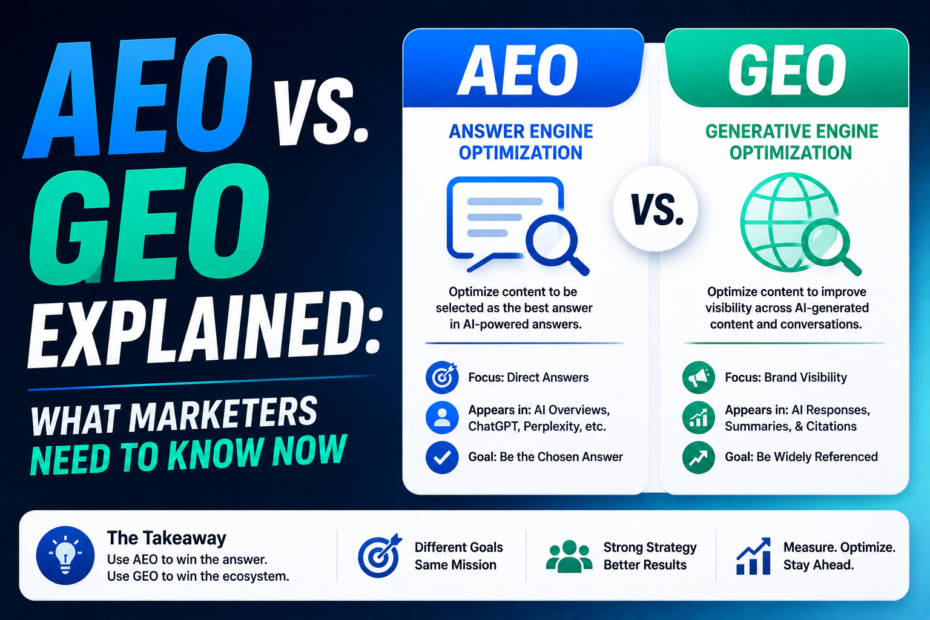
AEO and GEO aren’t rivals at all — they’re two powerful lenses you can use to turbocharge your marketing. If you’ve been treating SEO as one monolith, you’re about to discover how optimizing for Answer Engines (AEO) and Geographic Search (GEO) can work together to capture different parts of your audience. Let’s cut through the buzz and show you practical, implementable methods that actually move rankings, clicks, and conversions.
What is AEO and what is GEO? A practical guide for marketers
Think of AEO as the art of answering questions that people ask into search or voice devices. It’s about tuning content so it’s more likely to appear as a direct answer, a knowledge panel, or in a quick response. GEO, on the other hand, is all about location. It’s the craft of making your business visible when people search about products, services, or experiences near them. Both matter, and they play nicely together when you structure content with intent and location in mind.
Why marketers should care right now
Two big shifts are shaping the game. First, search habits are getting more conversational. People ask long questions, use voice assistants, and expect fast, precise answers. Second, local intent is exploding in consumer behavior. People want nearby options, real-time availability, and accurate business data. AEO helps you win the “answer” or “assistant” moments, GEO helps you win the “near me” moments. Get both aligned, and you create a robust funnel from awareness to action.
Featured snippet: quick take on AEO vs. GEO
Answer Engine Optimization (AEO) focuses on crafting content that directly answers questions and is discoverable by AI assistants and search features. Geographic SEO (GEO) centers on optimizing for local intent, location signals, and business data to appear in local packs and near-me searches. When combined, you cover both conversational queries and local shopping needs, boosting visibility across voice, web, and maps.
How AEO works in practice
Let’s break down the core ideas you can implement this week. AEO isn’t about tricking an algorithm; it’s about delivering high-quality, structured information people actually want in a way search engines and assistants can understand.
1) Map questions to answers
Audit your content for common questions your audience asks. Create concise, direct answers that can be pulled into snippets. Use a Q&A format on relevant pages, then expand with details in the surrounding copy.
2) Optimize for intent, not just keywords
When someone asks, “What is X and why does it matter for my team?”, the intent is to learn. Build content that immediately addresses the “why” and then offers practical steps, not just definitions. Use structured data where it makes sense to help engines understand the relationship between concepts.
3) Use structured data to signal relevance
Schema.org markup for FAQ, HowTo, and Organization can help you land featured snippets and rich results. Don’t overdo it, but do implement where it fits naturally into the content.
4) Optimize for voice search with natural language
Voice queries are often longer and more conversational. Create content that reads like a natural reply to a user asking a question aloud. Include short, punchy sentences and direct answers upfront.
5) Leverage content clusters for authority
Group related questions into pillar pages with tight internal linking. Each cluster becomes a reliable source for users, and search engines see you as an authority on that topic.
What GEO means for local visibility
Local intent isn’t just a nice-to-have — it can be a major revenue driver. GEO is about making sure people near you can find you, trust your business, and choose you over the competition. Here are practical steps to harness GEO power.
1) Claim and optimize your Google Business Profile
Consistency is key. Ensure your business name, address, phone number (NAP), hours, and services are accurate across all platforms. Add fresh photos, respond to reviews, and post updates frequently.
2) NAP consistency across directories
Inaccurate listings kill local rankings. Use a reliable citation management strategy to keep your NAP uniform across critical directories like Yelp, Apple Maps, Bing Places, and industry-specific directories.
3) Local content that resonates
Publish case studies, testimonials, or blog posts that highlight local customers, landmarks, or community events. Local relevance signals trust and boosts visibility in local results.
4) Local schema and event data
Use LocalBusiness schema to mark up essential details and Event markup for happenings near you. This helps search engines connect your business with local intent and events in your area.
5) Reviews and social proof
Reviews matter. Encourage satisfied customers to share their experiences, and respond professionally to feedback. Rich review data can improve click-through rates and trust signals in local results.
Step-by-step Guide: implementing AEO and GEO together
- Audit your current content for questions and local intent. List top 20 questions your audience asks and map to existing or new pages.
- Create AEO-focused pages with direct answers at the top, followed by practical steps, examples, and downloadable resources.
- Define your local targets. List your core locations, service areas, and nearby landmarks to weave into content naturally.
- Set up structured data for FAQs, HowTo, and LocalBusiness. Validate with tools like Google’s Rich Results Test.
- Optimize your Google Business Profile and ensure NAP consistency across key directories.
- Build content clusters that blend AEO and GEO signals. A cluster might include a pillar page on “Local SEO for Small Businesses” with related Q&As and location-specific pages.
- Improve on-page elements with clear intent signals: meta titles that promise quick answers, meta descriptions that set expectations, and header hierarchy that mirrors user questions.
- Launch a local landing page strategy. Create 1-2 pages per location with unique value propositions and local social proofs.
- Monitor performance weekly.Track impressions, click-through-rate, and local pack visibility. Adjust based on what’s performing.
- Iterate. Add new questions as they emerge, refine the answers, and refresh local data to stay current.
Pro Tips
- Use concise, answer-first paragraphs in the first 2–4 sentences of each answer page.
- Incorporate a “What people ask next” section to guide further exploration and internal linking.
- Keep local pages visually distinct by using location-specific imagery and testimonials.
- Match your content to the purchase journey. AEO for awareness and education; GEO for conversion near the point of decision.
- Test voice snippets by reading content aloud and ensuring natural cadence and clarity.
Common Mistakes
- Over-stuffing with keywords or awkwardly forcing structured data where it doesn’t fit.
- Ignoring local data quality; inconsistent NAP or outdated hours can hurt rankings.
- Fragmented content strategy — not linking AEO-focused pages with local pages to create a unified funnel.
- Neglecting user-reported questions. If you aren’t addressing the questions people actually ask, you’re leaving clicks on the table.
- Timing gaps in local updates. Markets change; your local pages need fresh information on promotions, events, and inventory.
Best Tools to Boost AEO and GEO
- Answer the Public or Soovle for uncovering common questions to guide AEO content.
- Schema.org and Google’s Rich Results Test for validating structured data.
- Google Business Profile (GBP) for local presence, reviews, and posts.
- BrightLocal or Whitespark for local citations and NAP consistency.
- SEMrush, Ahrefs, or Sistrix for keyword intent analysis and competitive benchmarking across AEO and GEO signals.
- Google Analytics and Google Search Console for performance signals and technical health checks.
FAQ: AEO vs. GEO
Is AEO only about featured snippets?
Not at all. AEO is about answering user questions clearly and accurately across search, voice, and AI experiences. Featured snippets are a possible outcome, but the core aim is to fulfill intent with trustworthy, structured content.
Can GEO improve overall site authority?
Absolutely. Local optimization often reveals strong signals about relevance and trust, which can lift broader rankings when your local expertise is perceived as high quality by search engines.
How do I measure AEO success?
Track answer-driven metrics: proper snippet capture, position for question-based queries, click-through rate on FAQ/HowTo pages, and engagement metrics like time on page and scroll depth for answer content.
What is the best order to implement AEO and GEO?
Start with a foundation: audit questions and local data, implement structured data for both, claim GBP, and build clusters that tie AEO pages to local landing pages. Then iterate based on performance data.
Do I need new content to do AEO and GEO?
Often yes. You may repurpose existing FAQs and service pages into more direct answer formats, add local landing pages, and create new content that directly addresses common questions with location-specific context.
Internal links
To deepen your learning and connect to related topics, check these guides:
Advanced local link-building strategies for small businesses
How to craft content clusters for SEO in 2024
Voice search optimization: 10 actionable steps
Conclusion: syncing AEO and GEO for a stronger marketing funnel
When you align AEO and GEO, you’re not just chasing rankings. You’re building a smarter, more responsive site that answers real questions and helps nearby customers find you. It’s not about choosing one path; it’s about weaving both paths into a seamless experience that guides users from curiosity to conversion. Start by listening to what your audience asks, map those questions to solid, locally anchored pages, and keep refining based on data. The result is clear: more visibility, more trust, and more conversions from both voice-enabled and local search moments.
Quick Summary
- AEO = Answer Engine Optimization — focus on direct answers, structured data, and voice/search-friendly content.
- GEO = Geographic SEO — optimize for local intent, GBP, local citations, and location-specific pages.
- Use content clusters to pair AEO and GEO signals for better authority and local presence.
- Structured data and local data consistency are your best friends for featured snippets and local packs.
- Measure success with snippets capture, local pack visibility, CTR, and engaged-on-page metrics.
Our Social Presence:
Website- https://chandanmaxi.com/
Website – https://www.bedforsell.com/
Facebook link – https://www.facebook.com/Chandanmaxi/
Instagram link – https://www.instagram.com/chandanmaxig/
Youtube link – https://www.youtube.com/@chandanmaxig
Linkedin- https://www.linkedin.com/in/chandanmaxi/
Quora – https://chandanmaxi.quora.com/
WhatsApp Channel- https://whatsapp.com/channel/0029Va5oE4l2ER6fAHBu692X