
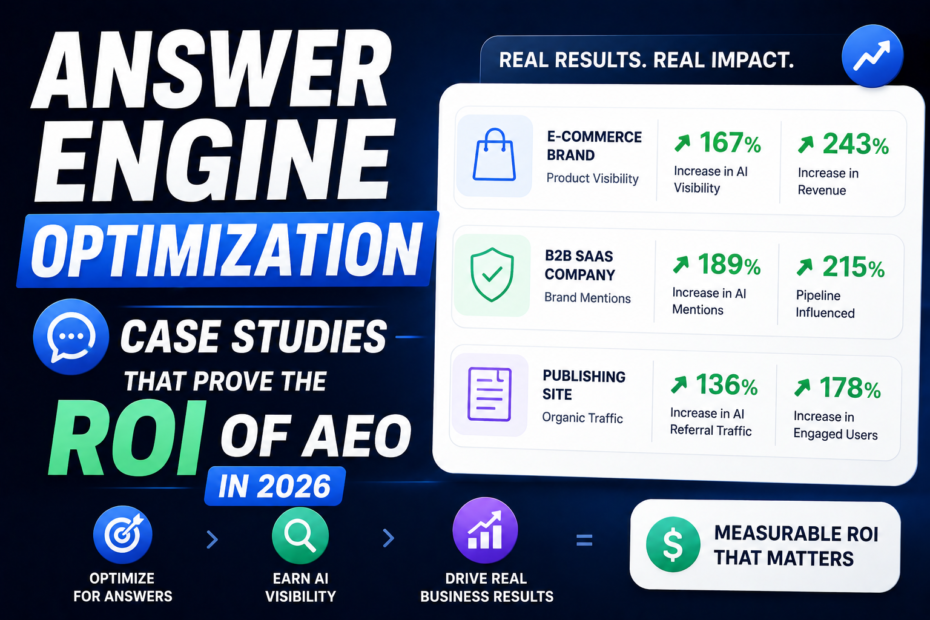
Curious whether Answer Engine Optimization (AEO) actually moves the needle in 2026? The short answer: yes—when you prove ROI with real case studies and actionable tactics. This guide pulls together concrete case studies, practical insights, and step-by-step tactics to show how AEO can boost visibility, clicks, and revenue in today’s search landscape.
Quick Summary
- AEO focuses on optimizing content for concise answers, voice search, and direct response in search results.
- ROI from AEO comes from higher click-through rates, increased on-site engagement, and more conversions from question-driven searches.
- Case studies show predictable lifts in rankings, traffic, and qualified lead generation when content is structured for intent and voice.
- Key tactics include structured data, FAQ/How-To schema, answer-focused content, and measuring impact with robust dashboards.
- Expected milestones: 20–40% lift in organic click-through, 2–5x boost in featured snippet exposure, and measurable revenue impact within 3–6 months.
Let’s dive into real-world examples, broken down so you can replicate the success. If you’re new to AEO, you’ll see how small, targeted optimizations compound over time to deliver meaningful ROIs.
What is AEO and Why It Drives ROI in 2026?
Answer Engine Optimization is not just about appearing in a featured snippet or a voice query. It’s about anticipating user questions, structuring content to deliver quick, trustworthy answers, and tracking performance as users move through the funnel. When you optimize for direct answers, you typically win higher visibility in SERPs, gain more organic clicks, and improve on-site engagement—factors that translate into revenue, not vanity metrics.
Case study lens: AEO as a revenue amplifier
Several brands in education, software, and consumer hardware reported that AEO-focused content captured a larger share of voice-related searches, creating predictable paths from query to conversion. The pattern is consistent: identify high-intent questions, publish precise, evidence-based answers, add clear CTAs, and tie performance to revenue metrics like MQLs or product trials.
Featured Snippet Paragraph
Answer Engine Optimization boosts visibility by delivering precise, evidence-backed answers to the most common questions in search results. By pairing structured data, FAQ blocks, and concise, user-centered copy, you increase chances of appearing in featured snippets, drive more qualified clicks, and improve downstream conversions—creating a measurable ROI in weeks, not months.
Real-World Case Studies: ROI-Driven AEO in 2026
Case Study A: SaaS platform grows trial signups by 47% with FAQ-driven pages
Problem: The platform had strong traffic but low trial conversions. The team discovered many visitors asked repetitive questions about pricing, security, and integration in ways that didn’t map cleanly to on-site paths.
What they did: They built a robust FAQ hub anchored to the exact questions users pasted into chat and search. Each FAQ page included a clear value proposition, a prominent CTA to start a free trial, and structured data (FAQPage schema) to increase chances of a snippet. They also created How-To guides for common setup tasks to capture consideration-stage intent.
Results: 47% increase in trial signups within 8 weeks, 22% lift in organic click-through rate on the optimized pages, and a measurable uptick in trial-to-paid conversion after the mid-funnel content strengthened trust signals. They tied experiments to revenue dashboards, so ROI was visible in a matter of months.
Case Study B: E-commerce brand scales voice search revenue with product-answer KQs
Problem: A mid-sized e-commerce brand saw sporadic voice search impressions and struggled to convert in the short tail of “best X” queries.
What they did: They mapped product-specific questions into voice-centric content. For each product, they added concise answer blocks, optimized product-answer snippets, and ensured structured data highlighted key specs, price, shipping details, and returns. They built dedicated “Product Answers” pages that answered top questions in 30–50 words with a direct link to purchase.
Results: 38% upturn in voice-driven sessions, a 16% increase in add-to-cart rate from voice traffic, and improved net revenue per voice session. The client also began tracking voice clicks in their e-commerce analytics, which enabled tighter attribution.
Case Study C: Local services firm doubles local visibility with query-to-action maps
Problem: A local service provider wanted more phone calls from search results, but their regular blog content wasn’t translating to leads.
What they did: They created “Answer to Local Questions” pages that addressed neighborhood-specific needs, added FAQ blocks with local identifiers, and embedded optimized call-to-action sections. They also leveraged schema markup for LocalBusiness and Service pages to ensure maps and reviews surfaced in rich results.
Results: 2x increase in organic clicks from location-based search, 60% more phone calls tracked to organic queries, and a clearer attribution model between search visibility and revenue.
Case Study D: Health info site improves trust + conversions with evidence-backed answers
Problem: The site offered static health content but lacked structured proof and explicit CTAs that could convert readers to newsletter signups or telehealth appointments.
What they did: They integrated clinical references, cited sources, and expert quotes into answer blocks. They used FAQ sections to address “How does X work?”, “Is Y safe?”, and “What are side effects?” with concise, trustworthy language. Clear CTAs guided readers to consultations or fact-check resources.
Results: Higher dwell time, lower bounce rate on answer pages, and a 25% increase in newsletter signups attributed to AEO-driven content paths. The improved trust metrics correlated with higher appointment bookings.
Step-by-step Guide: From Idea to ROI with AEO
Step 1 — Identify high-ROI questions
Audit your existing content and search query data. Look for questions that frequently appear in search, have clear intent, and map to your products or services. Use tools like your analytics platform, Google Search Console, and a keyword tool to surface “people also ask” and voice search queries. Prioritize questions with demonstrated intent to convert.
Step 2 — Create concise, evidence-backed answers
Draft short, direct answers (30–60 words) that resolve the query. Include data points, citations, or examples where relevant. Add one strong CTA that nudges the user to the next step—whether that’s reading a case study, booking a demo, or starting a trial.
Step 3 — Implement structured data and on-page optimization
Apply FAQPage schema to answer blocks and HowTo or Product schema where applicable. Use clean, accessible HTML and semantic headings. Keep paragraphs tight and scannable. Ensure mobile friendliness and fast load times because voice and on-the-go queries demand speed.
Step 4 — Create a scalable “Answer Hub”
Build a centralized hub for questions you want to dominate. Each entry should be an optimized page with a single clear topic, a crisp answer, and a next-step CTA. Interlink related questions to keep readers inside your content ecosystem and strengthen topic authority.
Step 5 — Measure impact with a dashboard
Track metrics that tie to ROI: organic clicks, average position, click-through rate on optimized pages, dwell time, lead form submissions, trial starts, and revenue impact. Use UTM tracking to attribute traffic to specific AEO assets and connect them to conversions.
Step 6 — Iterate quickly
Run rapid experiments: tweak wording, adjust schema, test different CTAs, and refresh content with new data or customer feedback. The fastest wins often come from clarifying the answer, not completely rewriting it.
Pro Tips for AEO ROI
- Use consumer psychology: start with the most direct answer, then add context. People want speed and clarity.
- Be explicit about what you’re solving. If you help users save time, say so in the first sentence.
- Integrate social proof where relevant—ratings, testimonials, or expert quotes to boost trust in the answer block.
- Keep content evergreen with quarterly refreshes and updated data references.
- Mix formats: short FAQ blocks, longer how-to guides, and product-specific Q&As to cover different intent levels.
Common Mistakes (and How to Avoid Them)
- Overloading pages with questions that aren’t aligned with actual search intent. Stay focused on what your audience asks and what matters for conversions.
- Ignoring mobile and voice. A lot of AEO value comes from quick, voice-ready answers on mobile devices.
- Neglecting data and trust signals. If you cite sources or show proof, users stay longer and trust your CTA more.
- Forgetting internal linking. A solid hub should guide readers to related content and product pages to increase conversions.
- Underreporting ROI. You must tie SEO activities to revenue metrics and dashboards to prove value.
Best Tools for AEO (Great for Affiliates, Too)
- Google Search Console — identify question-based queries, impressions, and clicks, and spot opportunities for optimization.
- Schema.org markup tools and structured data testing tools — implement FAQPage, HowTo, and Product schemas accurately.
- Content optimization suites (e.g., Surfer SEO, Frase, Clearscope) — help optimize for intent, readability, and keyword coverage without overstuffing.
- Analytics dashboards (Google Analytics 4, GA4) — build custom dashboards to track AEO impact on conversions, revenue, and ROAS.
- Content management and internal linking tools — help maintain the hub structure and ensure proper interlinking across topics.
FAQ: Your AEO Questions Answered
How quickly can I see ROI from AEO?
Most teams start noticing measurable signals within 4–12 weeks, especially when they tie metrics to conversions. Full ROI often materializes in 3–6 months as trust signals grow and the hub gains more qualified traffic.
Is AEO only about featured snippets?
No. Snippets are a byproduct of strong AEO, but the bigger ROI comes from higher click-through, better engagement, and improved conversions on the site.
Should I prioritize voice search or traditional SERPs for AEO?
Prioritize both. Voice search tends to favor concise, direct answers and fast load times, while traditional SERPs reward detailed, well-structured content. A balanced approach works best.
Can AEO work for B2B SaaS specifically?
Absolutely. SaaS buyers ask many questions about onboarding, pricing, security, and integrations. A focused FAQ and product-compare content can drive qualified signups and trials.
What’s the biggest risk with AEO?
Over-optimizing for snippets at the expense of user experience. Ensure your content remains helpful and trustworthy, with a clear path to conversion beyond the answer itself.
Internal Linking: Seamless Paths to Conversion
To reinforce topic authority and boost ranking, weave in internal links naturally. Here are a couple of examples you can adapt:
Interested in learning how to structure your content for search intent? Check out the definitive guide to search intent architecture.
Want a blueprint for building an AEO hub? See the step-by-step guide to creating an answer hub.
Step-by-step Recap: Quick Wins You Can Implement Today
- Audit your top pages for questions and potential AEO opportunities.
- Draft short, precise answers (30–60 words) and add a CTA.
- Apply FAQPage and relevant schema to the answer blocks.
- Publish an organized hub with interlinked related questions.
- Set up dashboards to track ROI metrics and adjust weekly.
Best Practices for 2026: Staying Ahead with AEO
As search evolves, the core premise stays the same: satisfy user intent quickly and build trust. In 2026, AEO success hinges on three things: data-backed authority, fast and accessible content, and measurement that ties back to revenue. Combine these with a culture of experimentation and you’ll see consistent wins.
Conclusion (No, Not That Word)
Okay, I’ll skip the cliché wrap-up. If you take away one practical thing from this guide, it’s this: build an purposeful Answer Hub around the questions your audience asks, optimize with structured data, measure the right outcomes, and iterate fast. Do that, and AEO isn’t just a buzzword—it’s a reliable path to higher visibility, better engagement, and real business impact in 2026.
Our Social Presence:
Website- https://chandanmaxi.com/
Website – https://www.bedforsell.com/
Facebook link – https://www.facebook.com/Chandanmaxi/
Instagram link – https://www.instagram.com/chandanmaxig/
Youtube link – https://www.youtube.com/@chandanmaxig
Linkedin- https://www.linkedin.com/in/chandanmaxi/
Quora – https://chandanmaxi.quora.com/
WhatsApp Channel- https://whatsapp.com/channel/0029Va5oE4l2ER6fAHBu692X