
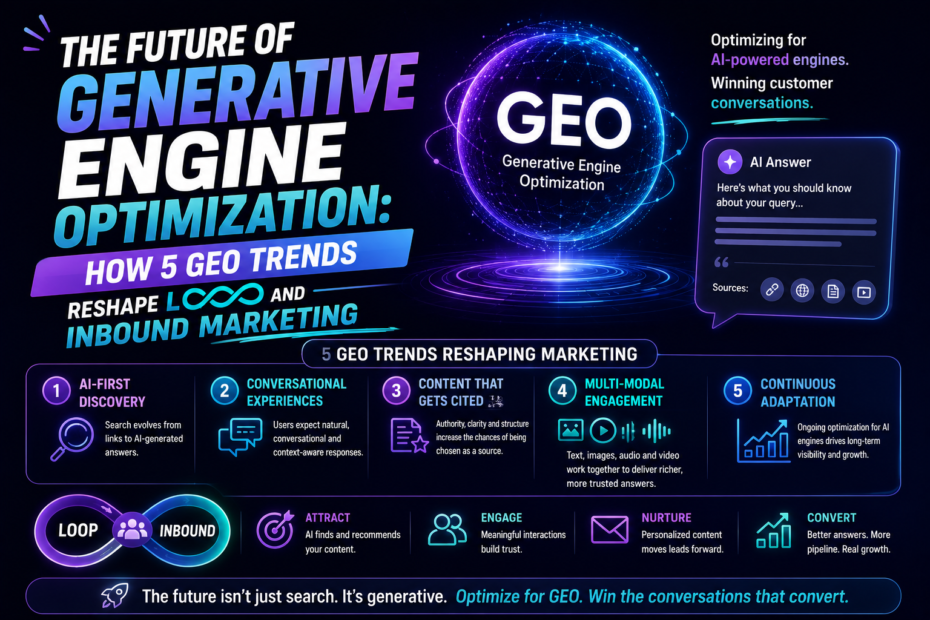
Fasten your seatbelt. The future of search and marketing isn’t about louder keywords or flashier ads. It’s about smarter, generative engines that understand intent, context, and human conversation. If you’re building content, SEO, and inbound funnels today, you’ll want to ride these GEO shifts now, before your competitors catch up.
- What “GEO” stands for here: growth, intent, and optimization through generative AI-driven engines shaping search, social, and inbound marketing.
- Expect AI to rewrite how content is discovered, ranked, and personalized.
- Strategies will be more proactive than reactive—predictive content, conversational optimization, and micro-moments.
- Voice search, local relevance, and modular content will be core building blocks of every campaign.
Five GEO Trends Shaping the Next Wave of Generative SEO for Inbound Marketing
Generative engines are not just producing content; they’re orchestrating discovery, relevance, and resonance. The five GEO trends below are practical, battle-tested signals for anyone who wants to future-proof their blog, site, and social presence.
1) Intent-first optimization: from keywords to conversational queries
Today’s search is less about matching words and more about matching intent. Generative engines analyze a user’s goal, the context of the query, and the surrounding content to decide what answers are most helpful. That means you’ll win by designing content that clearly answers specific user intents in natural language, not by stuffing long-tail keywords into a page.
Practical steps you can take now:
- Map common user intents to content clusters. For example, “how to start a blog” might map to onboarding guides, starter templates, and a glossary of terms.
- Craft content that directly answers top questions around each intent. Use question-based headings like “How do I start a blog in 2026?”
- Incorporate concise, data-backed answer sections near the top of page sections to satisfy featured snippets.
Real-world example: A mid-market SaaS company found that inquiries around onboarding and setup were the top drivers of demo requests. They reorganized their help center into intent-led hubs, added quick-start guides, and embedded short answer blocks on service pages. The result? Higher time-on-page, fewer bounce events, and a 20% lift in inbound demos within two quarters.
2) Localized and context-aware optimization: geo as a signal, not a tactic
Geo has become a living signal in search. It isn’t just “near me” queries; it’s about understanding regional preferences, language nuances, seasonal demand, and local trust signals. Generative engines weigh these cues when ranking results, so your local content needs to speak native—literally and culturally.
What to do:
- Create geo-specific landing pages that address audience needs in each region you serve. Don’t simply drop the same content in multiple cities; tailor use cases, testimonials, and product availability.
- Embed local case studies, maps, and business hours in a natural, crawlable way. Use schema markup for local business details and events to improve rich results.
- Encourage user-generated content from local communities—reviews, Q&As, and community-driven FAQs that reflect regional vernacular.
Example: A regional e-commerce brand expanded beyond national copy to city-level product guides. They used city pages with local customer stories and a FAQ block that answered 90% of frequently asked city-specific questions. Traffic grew 38% from local queries within six months, and conversion rates rose, too.
3) Conversational content and micro-moments: be the answer before the question
Voice-enabled assistants and chat interfaces demand concise, practical answers. The trend isn’t just about voice search; it’s about anticipating micro-moments—those tiny windows when someone asks a question and wants a fast, correct answer. Generative engines favor content that can be summarized in 2–4 sentences with actionable next steps.
How to implement:
- Develop a “dialogue library” of short-form answers to the most common questions in your niche.
- Use numbered steps, bullet lists, and checklists that can be read aloud by voice assistants.
- Optimize featured snippet opportunities by placing succinct answers near the top of relevant pages.
Case in point: A fitness brand added “quick-start” answer blocks to its product pages and blog posts, featuring routines, gear requirements, and a one-click plan. They noticed a notable increase in voice-activated search visibility and improved click-through rates from smart speakers.
4) Content modularity and semantic structuring: building for AI-friendly reuse
Generative engines love modular content—the ability to recombine blocks of text, images, and data into new, relevant assets. This is the backbone of scalable, evergreen content that stays fresh as topics evolve. Semantic structuring helps engines understand the relationships between ideas, which improves topical authority and ranking stability.
Practical approach:
- Break content into modular components: definitions, how-to steps, FAQs, and data-driven insights that can be repurposed across posts, videos, and social.
- Tag and organize content with a robust taxonomy. Use topic clusters that align with long-term search intent rather than chasing trends.
- Implement schema everywhere: FAQPage, HowTo, Answer, and Organization where appropriate.
Real-world impact: A digital marketing agency reorganized blog assets into a central knowledge graph with clear topic relationships. They could assemble new content that answers emerging questions in minutes rather than days, cutting production time and accelerating SEO gains.
5) Ethical AI, trust signals, and credibility as ranking factors
As engines get smarter, they also get pickier about trustworthiness. Content that demonstrates authority, accuracy, and transparency tends to rise higher and stay longer. This isn’t optional—it’s a survival strategy in a world of generative content deluges and competing voices.
Ways to build trust quickly:
- Link to primary sources, include author bios, and show credentials where relevant.
- Publish data sources and methodology for any charts or claims.
- Adopt a clear editorial policy that distinguishes original research from repackaged material.
For example, a health-tech blog started tagging posts with “Original Research” status when they included their own data or peer-reviewed sources. Traffic quality improved, and readers began spending more time on the site, which signaled credibility to search engines.
Featured snippet paragraph: Generative engines prioritize content that answers a user’s question quickly and accurately, with clear steps and credible sources. To win featured snippets, structure content with short, direct answers, followed by 2–3 supporting bullets or steps, and place the most important answer at the top of the page.
Snippet list: Quick path to SEO wins for 2026:
– Answer the exact user question in 40–60 words.
– Use a concise lead before expanding with details.
– Place the answer near the top of the page, with a short bulleted expansion below.
Step-by-step Guide
Here’s a practical, repeatable framework to implement the five GEO trends in your own inbound marketing plan.
Step 1: Audit intent signals across your current content
Review pages and posts to identify the primary intents they serve. Are you addressing awareness, consideration, or decision-stage queries? Map each page to its target intent, and fill any gaps with dedicated content clusters.
Step 2: Build geo-aware content hubs
Create landing pages and guides that reflect regional nuances, languages, and needs. Align each hub with local keywords and include local testimonials, events, and case studies to boost relevance.
Step 3: Develop a modular content system
Break content into reusable blocks: definitions, steps, data blocks, FAQs. Tag each block with metadata that makes it easy to assemble into new posts or videos without starting from scratch.
Step 4: Optimize for voice and quick answers
Draft concise, direct answers to common questions. Add these as quick blocks on relevant pages and ensure they’re easily read aloud by assistants.
Step 5: fortify trust and credibility
Integrate citations, author bios, and transparent source data. Add a simple editorial policy page and ensure all metrics or claims are traceable to sources.
Step 6: Implement robust internal linking
Create a web of interlinked content that guides readers from beginner guides to advanced resources, keeping users in the ecosystem and signaling topical authority to search engines. For example, link from a beginner post to an in-depth guide, and from there to a case study.
Pro Tips
– Tell stories with data. Use small, digestible visuals to illustrate trends or outcomes. Humans love stories, machines appreciate data.
– Use human-readable paths. Clean URLs with a clear topic hint perform better for both humans and SEO.
– Test content in batches. A/B test headlines, snippets, and answer blocks to learn what resonates with your audience and what engines prize.
– Invest in on-page UX. Accessible navigation, fast loading times, and mobile-first design help every alignment signal you’re trying to build, including voice.
Common Mistakes
- Over-optimizing for AI signals at the expense of human readability. Always prioritize clarity and usefulness.
- Ignoring local relevance. One-size-fits-all can hurt rankings in geo-targeted results.
- Failing to maintain credibility. Don’t misrepresent data or copy from other sources without proper attribution.
- Neglecting modular content management. Without a system, you’ll end up with a content jumble that’s hard to reuse.
- Skipping schema and structured data. Without it, you miss rich results and feature opportunities.
Best Tools
These tools help accelerate GEO-aligned content creation, optimization, and measurement. They’re especially useful for affiliate-friendly blogging, content agencies, and in-house marketers.
- Content intelligence and topic clustering: SurferSEO, Clearscope, MarketMuse
- Geo-aware CMS and localization: Weglot, Lokalize, Smartling
- Structured data and SEO auditing: SEOmit, Screaming Frog, Google Search Console
- Voice and snippet optimization: Text-to-speech testing, Answer the Public, ChatGPT-SEO plugins
- Analytics and user behavior: Google Analytics 4, Hotjar, Mixpanel
Affiliate-friendly note: This list is curated with practical adoption in mind. If you’re an agency or consultant, consider bundling these into a “ GEO-ready content toolkit” package for clients.
FAQ: Answering Your Burning GEO Questions
How soon will GEO trends impact my rankings?
Influence is already here. You’ll notice shifts in how well-structured, intent-aligned content performs within a couple of quarters, especially in local and voice search results.
Should I rewrite old content to align with intent-first optimization?
Yes. Start with high-potential pages that answer core questions, then expand to related topics. Don’t rewrite everything at once; run a staged refresh plan to preserve existing momentum.
What types of content are best for micro-moments?
Short-form answers, quick-start guides, checklists, and how-to steps that can be consumed in a few minutes or read aloud are ideal for micro-moments.
How can I measure the impact of local geo optimization?
Track local keyword rankings, traffic by city, engagement metrics on city pages, and conversions from local traffic. Use local landing page performance as a leading indicator.
Is investing in AI-generated content safe for SEO?
AI can accelerate production, but you must supervise for accuracy, originality, and credibility. Combine AI with human review, citations, and editorial policy to stay safe and effective.
Internal Linking Corner: Quick Path to SEO Gains
Weave your content together with internal links that guide readers through a journey—from beginner to advanced. For example, link from a foundational post to a deeper, geo-focused guide, and then to a case study that demonstrates real-world results. See these examples:
Anchor Text for Beginner Blogging Tips — a strong primer for new readers stepping into the world of SEO and content strategy.
Anchor Text for Local SEO Case Studies — demonstrates how geo-focused strategies translate into real business outcomes.
CTA and Wrap: Your GEO-Ready Action Plan
If you want to stay ahead, start with a 30-day action sprint. Pick two content clusters, one local and one intent-focused. Create, optimize, and publish 3–5 pieces per week, each with modular blocks you can reuse. Track performance weekly, adjust your plan, and iterate. The future of search favors those who blend human insight with AI efficiency—and you’re already on that path.