
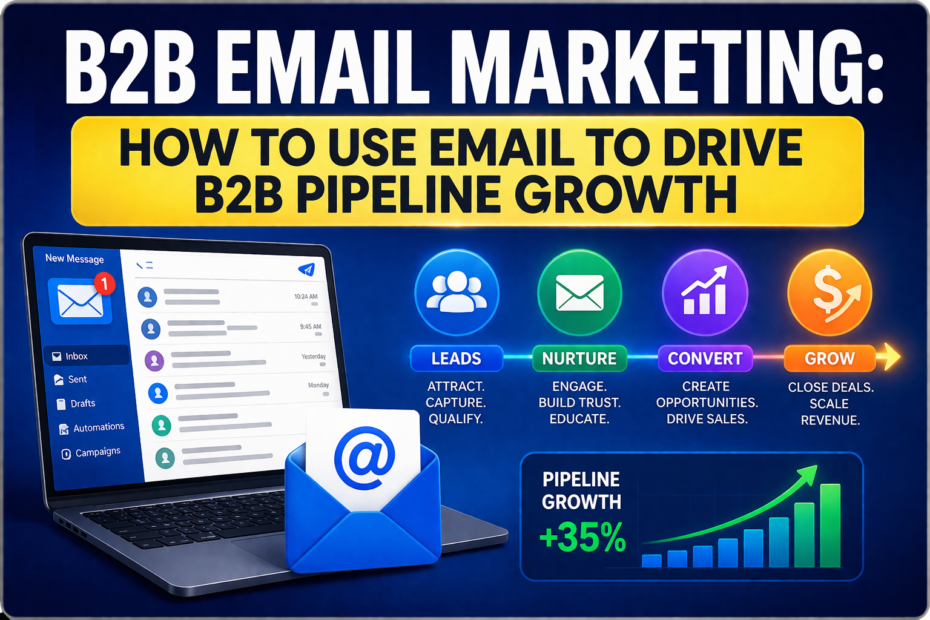
Unlock the power of email to grow your B2B pipeline. This guide–written in plain language with practical steps–shows you how to craft emails that build relationships, drive conversations, and convert prospects into loyal customers. If you’re tired of spammy outreach and vague metrics, you’re in the right place.
- Quick, practical playbooks to boost response and pipeline
- Concrete steps you can implement this week
- Real-world examples and templates you can reuse
- Tools and tactics tailored for B2B buyers
- Pro tips to avoid common pitfalls and skepticism
What makes B2B email marketing different—and why it works
B2B buyers move slower, collect more stakeholders, and demand clear ROI. Your emails should be helpful first, persuasive second, and always relevant. Rather than blasting everyone, you’ll nurture a precise audience, map their journey, and deliver precise value at each stage. When done well, email becomes the steady drumbeat that builds awareness, trust, and demand for your solutions.
Featured Snippet: A clear, concise answer for quick readers
In B2B email marketing, the fastest path to a bigger pipeline is to map buyer journeys, personalize around roles, and send timely, value-forward messages that address a real business problem—then invite a low-friction next step, like a brief call or a tailored demo.
Step-by-step Guide to B2B email pipeline growth
1) Define your ideal customer profile and buying personas
Start by documenting who you sell to. Create 2–4 buyer personas: title, company size, typical challenges, decision-making style, and the metrics they care about. In B2B, you’ll often have multiple stakeholders—CEO, CFO, IT lead, procurement. Know what keeps each person up at night and tailor messages accordingly. This isn’t “one email fits all”; it’s a conversation engineered for decisions.
2) Build a permission-based, clean subscriber list
Quality beats quantity here. Use opt-in forms on your site, gated assets, and event sign-ups to grow a list of engaged professionals. Maintain hygiene: remove hard bounces, suppress unengaged contacts every 90 days, and keep data up to date. You’ll save money on sends and improve deliverability.
3) Craft a compelling value proposition for email
Your subject line gets them to open; the body gets them to act. Lead with outcomes, not features. Show how you save time, reduce cost, or unlock revenue. Use concrete numbers, case study snippets, and social proof. In B2B, a compelling case or ROI quote often matters more than tech specs.
4) Design a multi-step nurture sequence
Map a 6–12 week journey from awareness to decision. Start with a welcome email that confirms the problem and promises value. Then follow with educational content, micro-case studies, and then a tailored offer. Use a cadence that respects their calendar—weekly might be too frequent for some buyers, monthly for others.
5) Personalize with role-based relevance
Personalization isn’t just inserting a first name. Reference the executive’s role, relevant metrics, and the buyer’s industry. Use dynamic content blocks so the same email can feel personally crafted for different recipients. A 15-second data check—job title, company size, industry—can unlock big gains.
6) Use a strong, clear CTA with a frictionless next step
Each email should invite a specific action: book a 15-minute discovery call, download a tailored ROI calculator, or view a short product demo. Keep the required effort minimal. A calendar link or a short form works best. Don’t demand a long commitment in the first touch.
7) Optimize deliverability and sender reputation
Authenticate your domain (SPF, DKIM), segment by engagement, and monitor sender score. Avoid spammy language and too many capitalized phrases. A clean, consistent sending pattern helps ISPs trust you, which improves inbox placement—crucial for B2B where response rates can be low.
8) Measure what matters—and act on it
Track opens, clicks, replies, conversions, and pipeline velocity. Don’t chase vanity metrics like total opens if they don’t predict pipeline. Use the data to refine subject lines, messaging, and timing. A quick feedback loop with your sales team is priceless.
9) Align sales and marketing on the handoff
Define what constitutes a qualified lead for sales. Create a shared service-level agreement (SLA) with criteria like engagement score, company size, and fit. When the handoff is smooth, reps respond faster and win rates climb.
10) Test, learn, and iterate
A/B test subject lines, preheaders, body copy, CTAs, and send times. Small wins compound into big results over months. Treat email like a living program—not a one-off campaign.
Pro Tips to sharpen your B2B email outcomes
Make each email a value-first conversation
Lead with outcomes and business impact. Avoid product-centric chatter in the first touch. If you can show how you reduce a cost, shorten a process, or improve reliability, you win attention.
Use micro-case studies and social proof thoughtfully
One-pagers or 2–3 sentence ROI quotes from a peer company can convert better than long descriptions. Include a logo and a punchy stat if possible. Relevance beats volume here.
Lean into timing that respects buyer cycles
Manufacturing cycles run on quarters, software procurement can require multiple approvals, and professional services may need a pilot phase. Schedule your sequences to align with these rhythms and avoid cluttering calendars with too many touchpoints too quickly.
Make replies easy and safe
Invite questions and ensure your replies are prompt. A quick, friendly reply from a human inbox beats a bot-generated response every time. If possible, promise a 24-hour turnaround and actually hit that window.
Offer a no-pressure next step
Give prospects an option that doesn’t require a big commitment: a short discovery call, a tailored ROI worksheet, or access to a product tour. Lowering friction increases reply rates and builds momentum.
Common Mistakes (and how to avoid them)
1) Sending to cold lists without consent
Always prefer opt-ins and relevant segmentation. Cold emails may work sporadically, but they tank deliverability and trust fast.
2) Overloading with features
B2B buyers care about outcomes. Lead with impact, not specs, and only bring the details after you’ve earned interest.
3) Ignoring the sales handoff
Marketing should pave the way, but sales must own the next steps. A crisp SLA prevents misalignment and keeps momentum going.
4) Poor follow-up cadence
Too little follow-up kills opportunities; too much feels spammy. Find a respectful cadence based on signals like opens, replies, and engagement scores.
5) Weak subject lines
A dull subject line is the fastest path to the trash. Test multiple angles—curiosity, ROI, risk reduction—and choose clear, concise language.
Best Tools to power B2B email marketing
Choosing the right stack matters as much as the messaging. Here are core categories and examples to consider, with a focus on flexibility for B2B pipelines.
- CRM with marketing automation: HubSpot, Salesforce Pardot, or ActiveCampaign
- Email deliverability and testing: Mailgun, SendGrid, or Litmus
- Lead scoring and personalization: Terminus, 6sense, or Bombora
- Sales enablement and sequencing: Outreach, Salesloft, or Apollo
- Analytics and attribution: Google Analytics, HubSpotReports, or Funnel.io
For affiliate-friendly readers, these tools often offer affiliate programs or partner discounts. If you’re exploring affiliate partnerships, look for programs that support co-branded landing pages and trackable email templates. Internal note: link to relevant posts such as How to choose the right marketing automation platform and Measuring email ROI in B2B campaigns for deeper reader value.
Step-by-step templates you can reuse today
Welcome email template
Subject: Welcome — here to help your team move faster
Hi [First Name],
Thanks for connecting. I help [role/industry] teams streamline [pain point], delivering [quantifiable outcome]. In the next few days, I’ll share a short guide on [relevant topic]. If you’d like, we can set aside 15 minutes to understand your current process and see if there’s a fit.
Best,
Value-first nurture email
Subject: Quick win idea for [company/industry]
Hi [First Name],
I pulled a quick example of how [peer company] cut [cost/time] by [X%] using a simple approach to [solution]. If you’re open, I can tailor a similar outline for your team and share a one-page ROI model.
Would you be up for a 15-minute chat this week?
ROI-focused outreach
Subject: ROI calculator for [their role/industry]
Hi [First Name],
Would a 10-minute walkthrough of a practical ROI model help your team decide whether to explore [your solution]? I’ve attached a one-page worksheet you can customize. If it resonates, we can dive deeper with a live demo.
Common internal process tips for better results
– Align marketing with sales from day one. A short, practical SLA makes life easier for both teams.
– Create clean, buyer-centric content assets that your team can drop into emails.
– Maintain a centralized content library so reps don’t reinvent the wheel every time.
FAQ
Q1: How often should I send B2B emails without becoming spammy?
A practical cadence is essential. Start with a thoughtful welcome sequence, then a monthly or bi-monthly touchpoint that adds new value. Monitor engagement and adjust. If open and click rates fall, slow down and refresh your content.
Q2: What metrics really matter for B2B email pipeline growth?
Engagement rate (opens and clicks), reply rate, qualified lead rate, time-to-first-touch, and pipeline velocity. Don’t chase vanity metrics; chase signals that predict revenue.
Q3: How do I personalize at scale?
Use dynamic content blocks, account-level data, and role-based messaging. Start with a few segments (by industry, company size, role) and gradually expand as your data quality improves.
Q4: How can I improve email deliverability?
Authenticate your emails, keep a clean list, segment by engagement, and avoid spammy language. Consistency and relevance beat aggressive spam tactics every time.
Q5: Should I automate all my emails?
Automation is powerful, but not everything should be automated. Reserve high-signal interactions for automation and keep some personalized, human-led follow-ups for best results.
Internal linking and additional reading
To deepen your understanding, check these related posts:
A practical framework for email sequence design to guide your nurture stages and handoffs.
How to measure email ROI in B2B campaigns for concrete attribution models and dashboards.
Key takeaways that drive real results
In B2B email marketing, you win by delivering value, aligning with sales, and treating each touch as a step in a longer journey. Personalize with intention, nurture with care, and optimize with data. The pipeline follows when you treat every message as a real business conversation, not a sales pitch.
Best Practices in summary
- Map buyer journeys and tailor messages to roles
- Clean, permission-based lists with regular hygiene
- 6–12 week nurture programs with clear next steps
- Strong, testable subject lines and progressive personalization
- Sales and marketing alignment with a clear SLA
Final Thoughts for a thriving B2B email program
Start today with a clear hypothesis: “If we send X value-led emails to Y audience, we’ll move Z prospects toward a demo.” Then execute, measure, and refine. Your best emails will feel human, be genuinely useful, and speak directly to the business impact your prospects care about. The results will follow for those who stay consistent and stay curious.
Our Social Presence:
Website- https://chandanmaxi.com/
Website – https://www.bedforsell.com/
Facebook link – https://www.facebook.com/Chandanmaxi/
Instagram link – https://www.instagram.com/chandanmaxig/
Youtube link – https://www.youtube.com/@chandanmaxig
Linkedin- https://www.linkedin.com/in/chandanmaxi/
Quora – https://chandanmaxi.quora.com/
WhatsApp Channel- https://whatsapp.com/channel/0029Va5oE4l2ER6fAHBu692X