
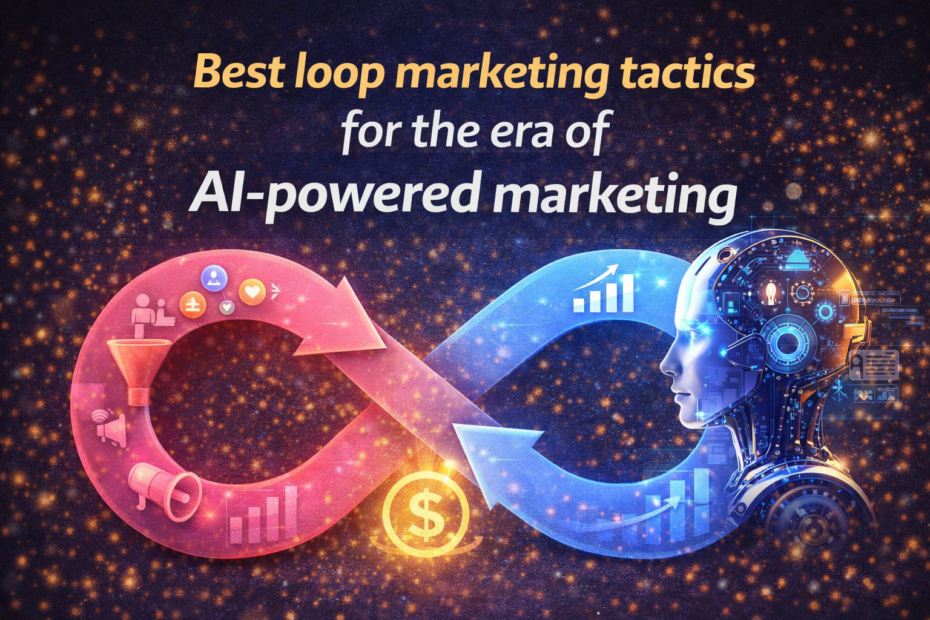
In the AI era, loop marketing isn’t a buzzword. It’s a practical playbook that keeps customers engaged, grows lifetime value, and compounds results over time. The core idea: design campaigns that continuously feed data, learn from it, and automatically adjust the next action. When you lean into feedback loops—between content, product, and person—you turn one-time interactions into ongoing relationships. If you’re tired of one-off launches that fizzle, this guide breaks down the best loop marketing tactics you can start using today.
What are the best loop marketing tactics for an era powered by AI?
Loop marketing in 2024 and beyond is less about a single channel and more about how you connect signals across your funnel. You’ll combine data-driven content, personalized journeys, automated experimentation, and social proof into a self-optimizing system. The result? Messages that feel timely, offers that match intent, and a customer experience that gets smarter every week.
Why loop marketing works in AI-powered environments
Artificial intelligence excels at spotting patterns, predicting behavior, and handling repetitive optimization at scale. When you structure your marketing around loops—observe, hypothesize, test, act, learn—you unlock faster, more reliable growth. AI handles the heavy lifting: segmentation at depth, creative optimization, real-time bidding adjustments, and content personalization. Humans handle strategy, empathy, and big-picture decisions. The collaboration is powerful because it combines human intuition with machine precision.
Key components of a strong loop marketing system
Think of four pillars that hold everything up:
- Data backbone: clean signals from user actions, content consumption, purchase behavior, and product usage.
- Audience engines: dynamic segments that update as behavior changes.
- Content and offer engines: automated personalization, adaptive landing pages, and adaptive emails/CAMPAIGNS.
- Measurement and learning: rapid experimentation, quantifiable hypotheses, and clear feedback loops.
When these parts work in harmony, your marketing feels alive—like a living system that responds to user needs before they voice them.
Step-by-step Guide: Building a self-optimizing loop marketing machine
Follow these steps to set up a practical, AI-friendly loop marketing system. I’ve included concrete actions, examples, and quick checks so you can implement them this week.
Step 1 — Map your customer journey and define the loop
Do a quick map of the typical customer journey from awareness to advocacy. Identify the key touchpoints where you can observe behavior and influence decisions. At each stage, define a simple loop you can automate:
- Observe: What user action triggers data collection? (e.g., email click, demo request, article read time)
- Hypothesize: What might be driving that action? (e.g., email subject lines with personalization perform better)
- Act: What is the smallest tactical change you can implement? (e.g., A/B test subject lines or on-page copy)
- Learn: How will you measure impact? (e.g., conversion rate lift, time on page, NPS)
Step 2 — Build a data-informed content engine
Content should adapt to intent signals. Create a content matrix that pairs intent clusters with content formats. For example:
- Research intents get educational guides and case studies.
- Product intent gets feature-focused pages and ROI calculators.
- Retention signals get how-to videos and refresh emails.
Set up dynamic content blocks on pages and in emails. If a visitor has downloaded a blueprint, show a Related Assets panel. If they’ve viewed a pricing page, display a calculator-friendly offer.
Step 3 — Create personalized journeys powered by AI
Personalization is no longer optional. You want journeys that adapt in real time. Start with a 3-branch model:
- New visitor: greet with lightweight value and quick onboarding steps.
- Returning lead: surface tailored content based on prior actions and time in funnel.
- Trial or paid user: push advanced tips, exclusive resources, and renewal-ready messaging.
Use AI to predict the next best action (NPA) and route users accordingly. Don’t overdo it—keep the experience human-friendly and opt-out easy.
Step 4 — Automate experimentation and optimization
Run ongoing experiments with a clear hypothesis and small, rapid iterations. Typical experiments include:
- Subject line variants and send times for email campaigns
- Landing page layouts and value propositions
- In-app prompts and onboarding nudges
Adopt a lightweight test framework: weekly cycles, 20–30% sample sizes for early signals, and a 2-week decision window. Let AI handle multivariate tests when possible to untangle interaction effects faster.
Step 5 — Implement social proof and advocacy loops
AI amplifies the power of social proof by targeting segments most likely to convert with testimonials that match their context. Create loops for advocacy:
- Ask for reviews after successful outcomes and auto-share them on relevant pages.
- Trigger referral nudges when a customer hits a milestone.
- Feature customer stories in dynamic newsletters based on industry and use case.
Step 6 — Measure with clarity and act with speed
Define 2–3 North Star metrics per loop (e.g., conversion rate, time-to-value, retention rate, LTV). Use dashboards to surface anomalies and opportunities in real time. Make sure you can answer quickly: what changed, who was affected, and what’s next?
Step 7 — Scale responsibly
As the loop accelerates, guardrails matter. Maintain data quality, privacy, and consent. Build modular components so you can swap in new AI models or data sources without overhauling the system. Document decisions so new teammates can jump in without retracing every step.
How to implement a few high-impact loop tactics right away
If you’re short on time, start with these tactics that deliver fast, repeatable wins and scale later:
1) Dynamic email journeys powered by user signals
Map key signals to emails. For example, if a user reads a pricing article but doesn’t sign up, trigger a test drive invitation with a ROI calculator. Use AI to pick the best subject line, send time, and content blocks for each segment. Real-world example: a SaaS company reduced trial drop-offs by 18% by tailoring onboarding emails based on feature interests shown in the trial.
2) On-site personalization that respects privacy
Show content blocks based on recent activity and inferred intent. If a visitor has browsed multiple pricing plans, display a chat prompt offering a quick ROI snapshot. If they’ve read case studies, show customer logos and downloadable ROI documents. The goal is relevance without feeling invasive.
3) AI-assisted content optimization for evergreen value
Publish cornerstone guides and optimize them with AI-driven updates as search trends evolve. Build a content loop where analytics inform new sections, update old ones, and surface related internal links to boost SEO signals. A useful approach is to routinely re-seed old posts with new, data-backed insights to maintain freshness.
4) Social loop amplification with earned media signals
Monitor social conversations for questions your audience asks. Create quick response content plans—short videos, micro-posts, or carousel explainers—that address the top questions. Every positive mention can trigger a follow-up testimonial or case study push, creating a virtuous loop between social proof and conversion.
Pro Tips for mastering AI-powered loop marketing
- Start with one loop you can own end-to-end, then layer in more loops as you gain confidence.
- Keep data clean and privacy-first. If you don’t trust the data, you won’t trust the loop.
- Make your experiments blame-free and learning-forward. Celebrate small wins and document what didn’t work.
- Use natural language generation to draft content variations, but always human-edit the final copy to preserve brand voice.
- Prioritize customer-centric metrics. LTV, retention, and time-to-value beat vanity metrics every time.
- Design for voice search with concise, question-based answers and clear sections.
- Stay human. AI should augment, not replace, your brand voice and empathy.
Common Mistakes to Avoid in AI-driven Loop Marketing
- Over-automating without guardrails, causing inconsistent customer experiences.
- Imbalanced data privacy and aggressive personalization that feels creepy.
- Underestimating the importance of clean data and proper attribution.
- Trying to run too many loops at once, leading to diluted impact.
- Ignoring the customer feedback loop—if customers give feedback, you should act on it.
Best Tools to Power Your Loop Marketing (Affiliate-friendly)
Choosing the right stack makes or breaks a loop strategy. Below are categories and examples that fit a modern marketing machine. If you’re promoting tools, you’ll appreciate how these choices enable affiliate-style recommendations without compromising quality.
Data and intelligence
Customer data platforms (CDPs) and analytics platforms with AI capabilities help you unify data, segment deeply, and predict next actions. Examples include tools that support API integrations with your CRM, email, and site analytics. Look for features like cross-channel attribution, cohort analysis, and real-time scoring.
Content and personalization engines
Platforms that automate content personalization, dynamic landing pages, and adaptive experiences are essential. They should support simple drag-and-drop content creation with AI-assisted recommendations and performance-driven variants for A/B tests.
Marketing automation and experimentation
Automation platforms that can trigger multi-channel journeys based on signals, plus built-in experimentation and AI-assisted optimization, save time and boost learning velocity.
Social proof and advocacy
Tools that collect reviews, display case studies, and automate referral prompts help close loops with real-world validation. Look for options to surface proofs relevant to each audience segment and to automate share-as-you-win moments.
Communication channels
Ensure your stack covers email, on-site messaging, SMS, and chat, with integration into AI-driven decisioning for the best channel at the right moment.
Frequently Asked Questions
Q1: How do I measure the impact of loop marketing on ROI?
Track a small set of North Star metrics for each loop—like conversion rate, time-to-value, and repeat purchase rate. Use attribution modeling to see how loops influence revenue over time. Regularly compare cohort performance to identify which loops scale best.
Q2: Can AI really personalize at scale without feeling invasive?
Yes, but you should always start with opt-in, transparent personalization. Use permissioned data and provide clear value with each interaction. Keep the balance between relevance and privacy, and let users adjust their preferences easily.
Q3: How often should I update my loop hypotheses?
Revisit hypotheses on a monthly cadence, or faster if you’re running high-velocity experiments. If a loop shows stable performance for several cycles, you can scale it; if not, retire it and replace with a new one.
Q4: What’s the role of human creativity in AI-driven loops?
Humans craft the strategy, emotional appeal, and brand voice. AI handles data-driven decisions, optimization, and rapid testing. The strongest loops emerge when humans set guardrails, write compelling narratives, and interpret insights with context.
Q5: How can I ensure my content stays fresh in a looping system?
Use a content-refresh cadence: periodically re-skim analytics, add new data points, refresh visuals, and incorporate fresh customer stories. Build an evergreen core with a quarterly refresh plan to keep it relevant for search and users alike.
Internal Linking: Related topics you may enjoy
As you tighten your loop marketing system, consider these deeper reads that pair well with the ideas above:
- How to Build a Content Calendar for Evergreen SEO
- Personalization that Converts: From Data to Delight
- AI-Powered Analytics for Small Teams: A Practical Guide
Quick Summary
- Loop marketing turns data into sustained customer engagement through observe-hypothesize-test-act-learn cycles.
- Start with one high-impact loop and scale once you’ve validated the approach.
- AI accelerates personalization, experimentation, and content optimization while humans provide strategy and empathy.
- Prioritize data quality, privacy, and a clear measurement framework to avoid common pitfalls.
- Use the best tools to power data, content, automation, and social proof; integrate them thoughtfully for seamless loops.
Notable Snippet: Quick Featured Answer
What makes loop marketing effective in an AI-powered world? It creates a self-improving system that observes user actions, tests hypotheses, and quickly adapts messages, content, and experiences across channels. The loop accelerates learning, boosts relevance, and compounds impact over time through continuous optimization.
List Snippet: 6 Quick Steps to Launch Your First Loop
- Identify one high-value loop with clear signals and a measurable outcome.
- Define the observe-hypothesize-test-act-learn process for that loop.
- Build dynamic content blocks and personalized journeys around observed signals.
- Automate experiments with rapid cycles and simple hypotheses.
- Incorporate social proof and advocacy to feed the loop with validation.
- Measure, learn, and scale the loop while maintaining privacy and customer trust.
Voice search-friendly Q&A: Simple answers that work well for VEO/AEO
How can I start loop marketing today? Start with one measurable loop, set up clear signals, automate a small test, and iterate weekly based on data.
What makes a loop marketing system sustainable? Clean data, human oversight, transparent personalization, and a culture of testing and learning.
Which channels are best for loop marketing in 2026? Email, on-site experiences, and AI-driven content are core; add chat and social as amplifiers based on your audience.
How do I balance AI automation with brand voice? Establish guardrails for tone, review every automated core message, and maintain a human-in-the-loop for creative elements.
What’s a quick win for improving SEO with loop marketing? Refresh cornerstone articles with updated data and internal linking, then surface related, high-intent content to boost rankings and dwell time.
Best Practices: Maintaining a healthy loop machine
- Always begin with consent and privacy-first design; transparency builds trust and long-term engagement.
- Keep experiments small and interpretable; you should be able to explain why a change worked or didn’t.
- Ensure your loops don’t create a bad user experience by over-targeting or over-emailing.
- Document hypotheses, outcomes, and decisions to enable scalable growth across teams.
- Continuously test new data signals—behavior, intent, and value signals evolve as markets shift.
Wrap-up: Your AI-powered loop marketing blueprint
Loop marketing is less about gimmicks and more about disciplined systems that learn from users. AI helps you scale the right actions, but the real magic happens when you couple machine precision with human storytelling. Start small, stay customer-first, and build a learning loop that compounds value over time. If you’re aiming to rank higher, convert more visitors, and create a marketing machine that feels alive, this approach gives you a practical, repeatable path to take.
Our Social Presence:
Website- https://chandanmaxi.com/
Website – https://www.bedforsell.com/
Facebook link – https://www.facebook.com/Chandanmaxi/
Instagram link – https://www.instagram.com/chandanmaxig/
Youtube link – https://www.youtube.com/@chandanmaxig
Linkedin- https://www.linkedin.com/in/chandanmaxi/
Quora – https://chandanmaxi.quora.com/
WhatsApp Channel- https://whatsapp.com/channel/0029Va5oE4l2ER6fAHBu692X