
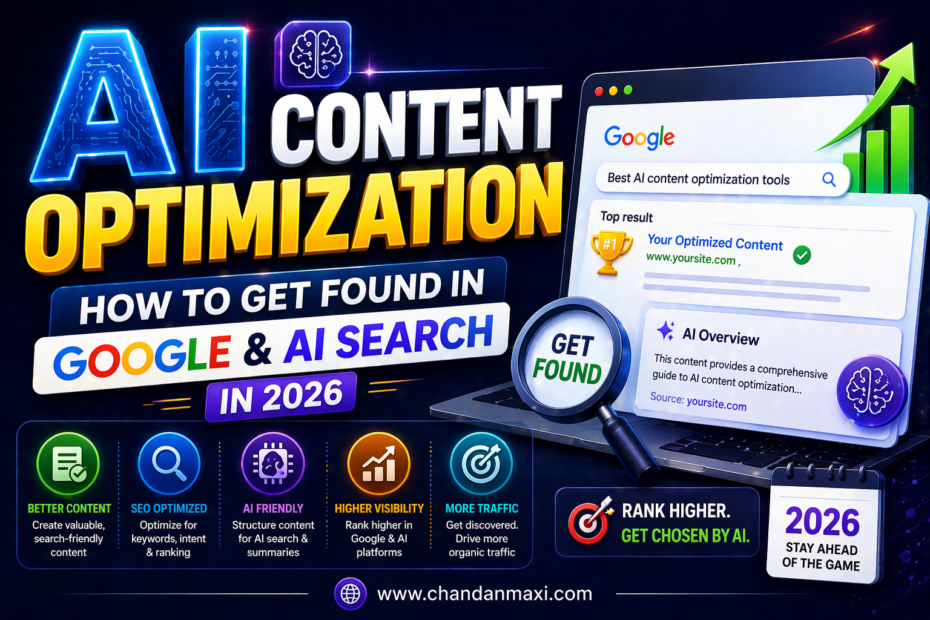
AI content optimization in 2026 isn’t a mystery trick. It’s about making content that both humans and machines love—so Google finds it, understands it, and serves it to the right people. If you want to show up in Google search and in AI-powered search results, you need a practical, human-friendly approach that blends technical best practices with real-world storytelling. This guide walks you through the exact steps, tools, and mindset you need to win in AI-driven search without turning your content into a keyword-stuffing robot.
- Clarify intent: match reader questions with strategic content goals.
- Structure for comprehension: use headers, concise paragraphs, and skimmable blocks.
- Align with on-page signals: E-E-A-T, topic authority, and contextual relevance.
- Optimize for voice and AI: plain language, natural phrasing, and clear answers.
- Measure and iterate: track rankings, user signals, and content performance.
Featured snippet answer: AI content optimization in 2026 means creating content that directly answers user questions with clear, structured information while signaling topical authority. It blends human readability with machine-interpretability, so Google’s AI understands intent, ranks higher, and users find fast, trustworthy answers.
Why AI search and Google ranking are merging in 2026
The big shift isn’t about chasing a single algorithm update. It’s about making content that speaks in plain language, demonstrates authority, and preserves a natural reading experience. Google and AI searchers want the same thing: fast, accurate, useful information. When your content telegraphs intent, provides concrete value, and is easy to navigate, you win across traditional SERPs and AI-generated results.
Key building blocks for AI-optimized content
Think about three pillars: intent, structure, and signals. Intent means knowing what your reader wants at each moment. Structure is how you present that information so both humans and machines can parse it quickly. Signals are the trust cues—citations, authoritativeness, freshness, and relevance—that tell Google you’re a reliable source.
Step-by-step Guide
- Define the user intent for each topic. Start with core questions your audience asks. For example, if you’re writing about AI content optimization, you might segment into: planning, execution, measurement, and troubleshooting.
- Map content to search intent signals. Create content that answers questions in the order a reader would ask them. Use direct answers up front, then expand with context, examples, and sources.
- Craft a skimmable content structure. Use a clear hierarchy with short paragraphs, bullet lists, and descriptive subheadings. Each section should satisfy a concrete user goal.
- Use natural language and voice. Write as if you’re explaining to a colleague. Avoid stuffing keywords; focus on readability and accuracy.
- Incorporate schema and structured data where appropriate. Article schema, FAQ schema, and how-to markup help AI understand content and improve eligibility for featured snippets.
- Anchor content to real-world use cases. Include examples, templates, and checklists that users can actually apply.
- Optimize internal links for topical authority. Link to related posts that deepen the topic and strengthen your site’s topic cluster.
- Monitor performance with a dual lens. Track traditional metrics (sessions, CTR, dwell time) and AI-relevant signals (semantic coverage, question-level intent, and snippet eligibility).
- Iterate quickly. Update content to reflect new insights, tools, and evolving user needs. Freshness matters, but relevance matters more.
- Balance speed and depth. Deliver fast, concise answers for voice and AI readers, then provide deeper dive sections for in-depth engagement.
How this approach plays out in real life
Imagine you run a small marketing blog. You publish a post titled AI content optimization for 2026. To optimize for AI search, you don’t just use keywords like “AI content optimization.” You structure a practical guide: what readers want to know first (the quick win), then how to implement, then how to measure impact, supported by examples and templates. You include an FAQ that answers common questions in a question-and-answer format, which helps with voice search and featured snippets.
Feature snippet: quick, practical answer that earns rich results
AI content optimization in 2026 means designing content that answers user questions succinctly, uses clear headings, and demonstrates topical authority with practical examples, sources, and templates, so Google’s AI and traditional AI readers can understand and rank it higher.
Content architecture that appeals to AI and humans
Structure is your best friend here. The more your content is organized into clear sections with descriptive headings, the easier it is for AI to parse. Use activity-based headings (What, How, Why, When) and keep sentences digestible. A well-ordered article reads like a helpful guide, not a dense textbook.
Headings that help SEO and AI surface results
Question-based headings align with Google SGE and AI expectations. Instead of a generic “On AI content optimization,” use headings like “What is AI content optimization in 2026?” or “How to implement AI content optimization for faster ranking.” This approach feeds both knowledge panels and conversational AI.
Keyword strategy that respects intent
Keywords aren’t dead, they’re just evolving. Instead of chasing broad terms, build topic clusters around intent signals. For AI content optimization, cluster around: planning for AI-ready content, structuring for reader and machine comprehension, measuring success with AI-aware metrics, and scaling with templates and workflows.
How to create a topic cluster that wins
- Core pillar: AI content optimization in 2026 — the hub piece that covers the high-level framework.
- Supporting posts: content planning for AI, structuring content for AI readability, measuring impact, case studies, templates.
- Internal linking strategy: link from pillar to supporting posts and back, reinforcing topical authority.
Real-world examples and practical insights
Let’s ground this in practical steps you can take today.
Example 1: Quick-win content refresh
Take a post about “AI content optimization basics.” Update it with a clear answer at the top, a concise hero section that lists 5 practical steps, and an FAQ section with 5 questions. Add a template that readers can download to apply the steps in their own projects. This format provides immediate value and increases the chance of being featured in snippets.
Example 2: Building a content workflow for teams
Create a reusable workflow: research, outline, draft, optimize with AI-friendly signals, review, publish, and measure. Each step includes checklists, templates, and example snippets. This not only improves consistency but also helps search engines understand you’re delivering a repeatable system, not a one-off post.
Step-by-step Guide for content optimization in 2026
- Audit existing content for intent alignment. Are you answering the most common questions people ask? If not, identify gaps and plan updates.
- Develop a content brief that emphasizes user intent and AI-friendly structure. Include target questions, sections, examples, and sources.
- Write with clarity first, optimization second. Let readability and usefulness guide the draft; then tune for semantic signals and schema where it’s sensible.
- Implement schema markup where it adds value. Article schema, FAQPage, HowTo, and QAPage formats help with rich results and AI understanding.
- Enhance content with practical assets. Templates, checklists, calculators, and case studies increase engagement and shareability.
- Optimize for voice search with concise, direct answers. Voice queries tend to be questions; ensure your content can answer them in a sentence or two.
- Set up a measurement frame. Track rankings, click-through rate, dwell time, scroll depth, and snippet performance. Use this data to iterate quickly.
- Experiment with different content formats. Short-form explainers, long-form guides, and interactive elements all feed AI search signals differently.
- Cross-link to related content to build topical authority. This helps both readers and AI understand the broader expertise you offer.
- Continue refining. The AI search landscape shifts with updates in models and user behavior. Regular updates keep you relevant.
Pro Tips to speed up results
- Write for the first two lines of your paragraph as a direct answer to the question or intent.
- Use plain language and concrete examples; AI readers value clarity over cleverness.
- Insert one or two skimmable checklists per article to boost engagement and snippet potential.
- Apply FAQ schema to common questions; this often unlocks featured snippets and voice answers.
- Track sentiment and user intent signals in analytics; adjust content to reduce bounce and improve completion.
Common Mistakes that sabotage AI-friendly content
- Over-optimizing for keywords at the expense of readability.
- Forgetting to answer the top questions up front in each section.
- Lacking clear authorship signals or credible sources for claims.
- Neglecting structured data where it would add value.
- Relying on a single format; failing to offer multiple formats (text, templates, visuals).
Best Tools to speed up AI-aware SEO and content creation
- Keywords and intent mapping: Semrush, Ahrefs, or Moz for topic clustering and competitor insight.
- Content optimization: Surfer SEO, Clearscope, or MarketMuse for semantic guidance without sacrificing readability.
- Schema and structured data: Schema.org quick references and Google’s Rich Results Test to validate markup.
- Analytics and testing: Google Analytics 4, Search Console, and Heatmaps (Hotjar or Crazy Egg) to understand user behavior.
- Content templates and processes: Notion or Airtable for living content briefs and checklists you can reuse.
How to measure success in AI and Google ranking terms
Measure both visibility and quality signals. Visibility means rankings, impressions, and click-through rate. Quality signals include time on page, scroll depth, return visits, and the frequency with which readers engage with follow-up content. For AI-specific signals, watch semantic coverage, question-level intent fulfillment, and your snippet eligibility rate. A well-performing piece often improves across multiple dimensions, not just one metric.
5-Step quick-start plan you can implement this week
- Choose a topic with clear, common questions that your audience asks.
- Draft a concise answer up front (no fluff). Then add 3–5 supportive paragraphs with concrete examples.
- Add a FAQ section with 4–6 questions and short, precise answers.
- Include a practical template or checklist readers can download or copy.
- Publish with schema and a focused internal linking plan to related posts.
FAQ
What exactly is AI content optimization in 2026?
It’s the practice of crafting content that answers user questions clearly and quickly while signaling topic authority to AI systems and traditional search engines. It combines readable writing with structured data, measurable outcomes, and ongoing optimization.
How do I structure content for AI search and human readers?
Lead with a direct answer, then provide context, examples, and steps. Use descriptive headings, short paragraphs, and bullet lists. Add FAQ sections for common questions and use schema where sensible to help AI understand intent and content relationships.
Can I use templates to scale AI-friendly content?
Yes. Templates reduce friction and ensure consistency. Use a repeatable outline for similar topics, including an intro with the key question answered, a step-by-step guide, a practical template or checklist, an FAQ, and a resources section with credible sources.
What tools help with AI-focused optimization?
Tools for topic clustering, semantic guidance, and structured data are invaluable. Consider Semrush, Clearscope, or MarketMuse for content alignment; Schema markup tools for structured data; and Google Search Console for performance signals.
How do I know if my content is performing well with AI search?
Look for higher snippet eligibility, more questions resolved in featured results, improved semantic coverage, longer dwell times, and better engagement on related content. Also monitor whether voice searches return your page as a direct answer.
Internal links
To deepen your SEO topic clusters, check out these related posts:
For a practical workflow and templates: How to Build a Content Creation Workflow for SEO
On mastering long-form content that ranks: Long-Form Content that Ranks in 2026: A Practical Guide
And for understanding user intent and topic authority: How to Map Intent to SEO Wins
Common sense CTR and engagement boosters
Snappy, curiosity-driven subheadings work. Include numbers where possible and give readers a clear next step or takeaway. For example, a subheading like “5 practical templates you can steal today” tends to perform well in scrollable feeds and featured snippet experiments.
Best practices recap for 2026
- Answer the core question up front in every section.
- Structure content for quick comprehension by humans and AI.
- Leverage schema and structured data without overdoing it.
- Provide assets readers can use immediately (templates, checklists, calculators).
- Monitor both traditional SEO metrics and AI-specific signals.
Take action: a quick-start checklist
- Identify top questions your audience asks about AI content optimization.
- Write a concise, direct answer and a 2–4 paragraph expansion for context.
- Create an FAQ section with 4–6 questions and short answers.
- Apply schema to the article and FAQs.
- Publish with internal links to related content and a downloadable template.