
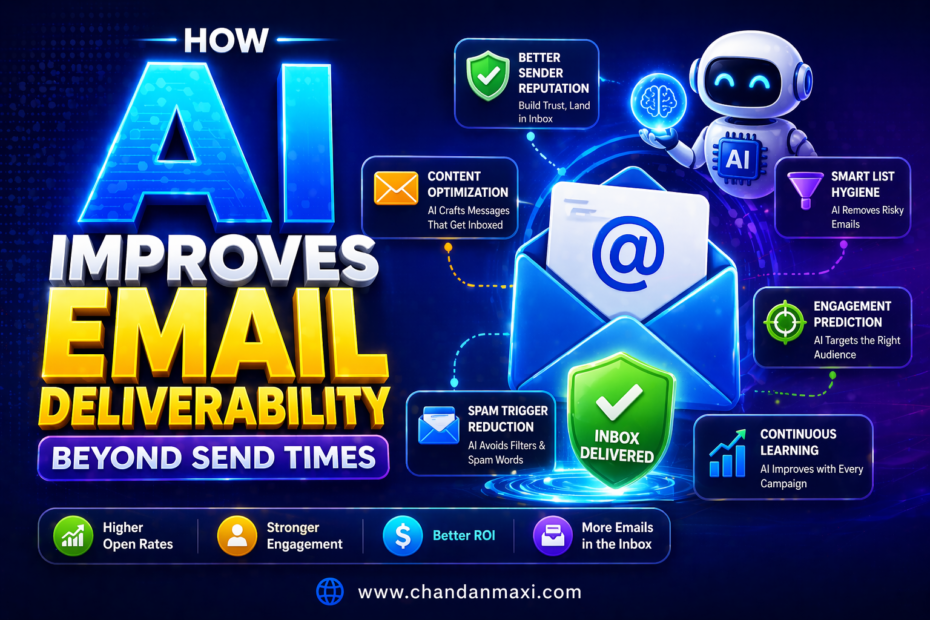
Email deliverability isn’t just about when you press send. It’s about understanding reputation, content quality, list hygiene, authentication, and engagement signals—and AI is quietly rewriting how all of that works. If you’ve struggled with emails landing in promotions or spam folders, you’re not alone. AI helps optimize factors you can control, often more effectively than simply changing send times.
- Understand AI-driven deliverability signals beyond send times
- How AI flags and fixes sender reputation issues
- Practical steps to implement AI in your sending and content workflow
- Real-world examples and mistakes to avoid
- Tools and resources to boost deliverability now
Featured snippet: AI improves email deliverability not by magic timing alone, but by continuously optimizing sender reputation, inbox placement signals, content quality, and engagement metrics. It analyzes micro-behaviors—like reader interactions, complaint patterns, and SPF/DKIM alignment—then automatically adapts campaigns to maximize inbox placement over time.
Why AI matters for inbox placement beyond when you press send
Email algorithms look at more than a clock. Major providers constantly evaluate how recipients interact with messages, whether the content matches expectations, and whether the sender behaves consistently. AI shines here by turning messy, noisy data into precise, actionable adjustments. It’s like having a quiet, tireless assistant that tests tiny changes, learns what works, and then scales those wins without you manually babysitting every campaign.
Think of it as three layers working together:
- Sender reputation layer: AI monitors engagement, spam complaints, bounce rates, and list hygiene to keep your domain and IPs trusted.
- Content relevance layer: It analyzes subject lines, preview text, and body copy against audience signals to improve engagement while avoiding triggers that push messages to spam.
- Delivery routing layer: It adjusts sending rates, pacing, and segmentation to align with ISP expectations and recipient behaviors in real time.
How AI builds a stronger sender reputation
Reputation isn’t fixed. It fluctuates with behavior. AI helps in three concrete ways:
1) Real-time monitoring of engagement signals
AI tracks opens, clicks, time spent reading, and conversions at micro-segments. If a segment shows fatigue, AI can throttle or pause sends to that group and re-route to more engaged audiences. This keeps complaint rates low and recipients happy.
2) Automated list hygiene and warm-up routines
New contacts are risky. AI can stagger warm-up sends, verify engagement patterns, and prune stale or dormant addresses with minimal learning cost. The result is fewer bounces and a more healthy sender footprint over time.
3) Consistent authentication and domain protection
AI isn’t a security feature, but it nudges you toward best practices—like consistent DKIM signing, SPF alignment, and DMARC reporting. It flags misconfigurations quickly and suggests fixes before ISPs penalize you.
Content optimization: AI as your copy editor and signal analyzer
Content quality drives engagement, and engagement drives deliverability. AI helps you write more effective emails and deliver the right signals to inbox providers.
Subject lines that pass the sniff test
AI tests thousands of variants, measuring which ones yield higher open rates across segments while staying compliant with brand voice and email policies. It also checks for spammy triggers and culls them without sacrificing creativity.
Preview text that aligns with reader intent
Preview text is a magnet. AI helps craft snippets that accurately reflect the email body, reducing confusion and improving curiosity without being misleading.
Body copy that respects attention spans
Short paragraphs, scannable bullets, and clear CTAs perform better. AI can restructure any draft to improve readability, personalize tone, and maintain brand consistency across campaigns.
Real-world examples: what AI changes look like in practice
Example A: An e-commerce brand used AI-driven segmentation to identify a high-engagement subset that preferred morning emails. After shifting to a morning send window for that segment and personalizing offers, open rates rose by 18% and unsubscribe rates dropped by 9%. The overall deliverability improved as ISP feedback loops showed better engagement signals.
Example B: A B2B software company battled spam complaints during a big product launch. AI detected that certain subject lines triggered false positives in spam filters. By replacing risky wording and coordinating the launch with a phased email cadence, complaints halved and inbox placement improved across major providers.
Example C: A nonprofit used AI to enforce better consent and preference management. It sent targeted re-permission campaigns to dormant segments while keeping content relevant. Deliverability stayed stable even as email volume surged during year-end campaigns.
Step-by-step Guide: implement AI to boost deliverability
- Audit your current sender reputation: Gather data on bounce rates, complaint rates, unsubscribe trends, and historical deliverability. Identify the top offenders and fix technical issues first.
- Set up robust authentication: Ensure DKIM, SPF, and DMARC are correctly configured. If you’re unsure, partner with your ESP or a deliverability consultant to validate settings.
- Implement AI-driven list hygiene: Use AI to identify and prune stale addresses, detect suspicious signups, and automate re-permission workflows for inactive subscribers.
- Enable engagement-based routing: Create audience segments that reflect true engagement levels. Let AI pace sends to avoid ISP throttling and to maximize inbox placement.
- Test subject lines and preview text at scale: Run A/B tests with AI-assisted hypothesis generation to discover winning combinations without risking brand integrity.
- Personalize at scale: Use AI to tailor messages based on behavior, preferences, and lifecycle stage while keeping the core message aligned with your brand voice.
- Monitor outcomes continuously: Watch open rates, click-throughs, conversions, bounces, and complaints. Let AI alert you to anomalies and propose fixes.
- Iterate and optimize: Treat deliverability as an ongoing experiment. AI helps you test new strategies without slow manual processes.
Pro Tips: fast wins you can apply today
- Keep a clean list hygiene routine—remove inactive subscribers quarterly, not annually.
- Layer personalization on top of solid segmentation to boost relevance without overcomplicating templates.
- Use a predictable sending pattern. If you pause a campaign, communicate it to your audience to avoid confusing recipients.
- Prefer plain-text versions for high-priority messages to improve deliverability when syntax or HTML issues arise.
- Regularly review DMARC reports and align with your AI educator to catch misconfigurations early.
Common Mistakes that hurt deliverability—and how AI helps
- Overwhelming inboxes with too much volume too quickly: AI can pace sends to protect reputation.
- Ignoring engagement data: AI uses engagement signals to guide who sees what and when.
- Poor list hygiene: AI automates pruning and re-permission, reducing risk from stale addresses.
- Inconsistent branding across devices: AI keeps tone and content aligned with brand across channels.
- Neglecting authentication: AI flags misconfigurations and nudges toward best practices.
Best Tools for AI-powered deliverability (and why they matter)
Choosing the right tools is half the battle. Look for these capabilities in your stack, especially if you’re planning affiliate-friendly content and reviews.
AI-driven ESPs and deliverability platforms
These platforms integrate real-time engagement analytics, automated list hygiene, and send-time optimization powered by machine learning. They help you maintain a clean reputation while scaling volume.
AI copy and subject line tools
Tools that test variants, detect spammy patterns, and suggest better phrasing help you stay compliant and improve engagement without sacrificing your voice.
DMARC, DKIM, SPF monitoring with AI alerts
Automation that spots misalignments and makes real-time recommendations reduces risk and helps maintain inbox healthy signals.
Internal tools for data hygiene and orchestration
When your data is messy, AI shines by cleaning it up, deduplicating profiles, and personalizing safely at scale.
Some trusted names that frequently appear in deliverability conversations include providers with deep AI integrations and robust reporting. If you’re evaluating options, start with trials focusing on AI-assisted segmentation, subject line optimization, and engagement-driven sending rules.
FAQ: quick answers to common questions
How does AI help avoid being marked as spam?
AI analyzes content, engagement, and historical sending patterns to spot red flags. It then adjusts subject lines, copy, and send timings to minimize spam triggers and align with recipient expectations.
Can AI replace a dedicated deliverability expert?
Not entirely. AI handles data-driven, repetitive decisions at scale, but human oversight remains crucial for strategy, brand voice, and complex ISP quirks.
Will AI increase open rates automatically?
It can, by optimizing subject lines, previews, and timing based on datasets. The biggest wins come from a combination of AI-driven content relevance and smart pacing.
Is AI suitable for small lists?
Yes. Small lists can benefit from precise, automated hygiene and personalized messaging. AI helps you maintain a strong sender reputation even with lower volumes.
What should I measure to know if AI is working?
Key metrics include deliverability rate (inbox vs. spam), bounce rate, hard vs. soft bounces, complaint rate, open rate, click-through rate, and unsubscribe rate. Look for trends over time rather than single-campaign spikes.
Voice search optimization: how to phrase questions and answers
People often ask, “How can AI improve email inbox placement?” Answer: By optimizing sender reputation, content relevance, and delivery routing through automation and adaptive learning. For quick voice queries, keep responses concise and actionable.
Internal links for deeper learning
Want to dive deeper into writing for SEO and newsletters? Check these related posts:
The Ultimate Guide to Email List Hygiene for Marketers
How to Write Newsletters That Get Noticed by Readers and Search Engines
Step-by-step Summary: how to implement AI for deliverability, in short
- Audit, fix authentication, and define clean data rules
- Adopt AI-driven segmentation and engagement-based sending
- Test, learn, and iterate on subject lines and previews
- Monitor DMARC reports and maintain consistent brand voice
- Scale with automated list hygiene and re-permission workflows
Best practices: a quick checklist you can copy
- Keep garden-variety triggers out of subject lines
- Match message content to user intent and prior behavior
- Limit daily sending to avoid ISP throttling during growth spurts
- Maintain a consistent sending cadence and inform subscribers about changes
- Use AI to validate and optimize before sending to a wide audience
Conclusion without saying the word “conclusion”: what to take away
AI isn’t a magic button that instantly lands every email in the inbox. It’s a practical, continually learning system that helps you protect your reputation, deliver relevant content, and pace sends in harmony with how ISPs and readers behave. When you combine AI with solid authentication, clean data, and thoughtful creative, you’ll see deliverability improve in measurable ways—and you’ll do it without burning out your team.
Our Social Presence:
Website- https://chandanmaxi.com/
Website – https://www.bedforsell.com/
Facebook link – https://www.facebook.com/Chandanmaxi/
Instagram link – https://www.instagram.com/chandanmaxig/
Youtube link – https://www.youtube.com/@chandanmaxig
Linkedin- https://www.linkedin.com/in/chandanmaxi/
Quora – https://chandanmaxi.quora.com/
WhatsApp Channel- https://whatsapp.com/channel/0029Va5oE4l2ER6fAHBu692X