
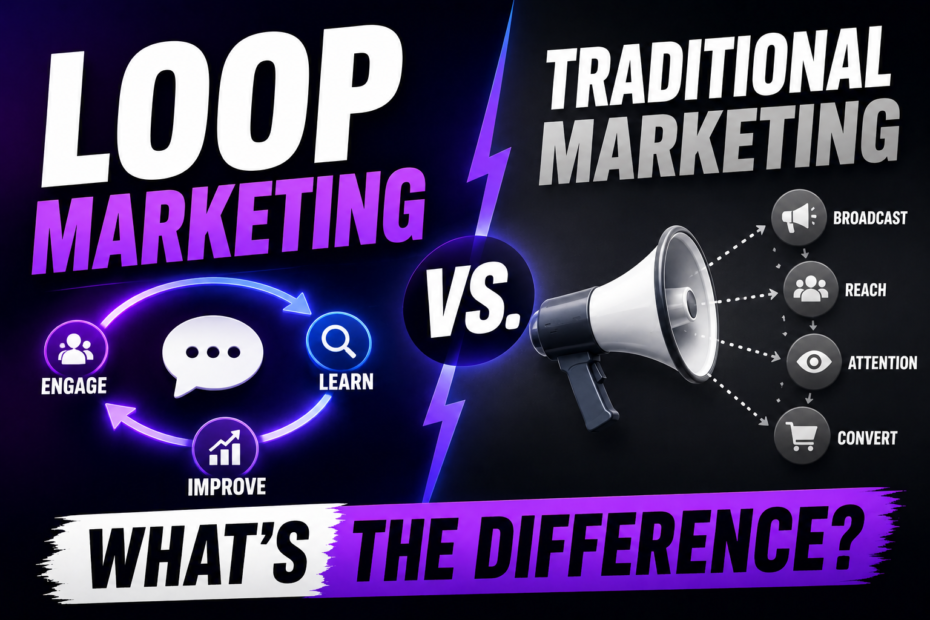
Loop marketing is not just a buzzword blasting through marketing conferences. It’s a practical framework that uses feedback loops to continuously optimize for growth. If you’ve been doing traditional marketing for a while and feel like you’re shouting into a void, loop marketing could be the missing link. In short: loop marketing is about building cycles of constant learning, testing, and improvement, rather than one-off campaigns that soak in a single burst of attention.
- Understand customer feedback loops to improve campaigns
- Prioritize continuous optimization over one-and-done tactics
- Align content, ads, and product signals for steady growth
Loop Marketing vs. Traditional Marketing: What’s the Difference?
Let’s cut to the chase. Traditional marketing often relies on large, upfront campaigns, broad messaging, and a “set it and forget it” mindset. Loop marketing flips that script. It builds a system where data, insights, and customer responses continuously feed back into strategy, creative, and product development. The result? Faster learning, higher ROI, and messaging that actually resonates over time rather than just during the flight of a single ad push.
Think of traditional marketing as planting a big harvest every season. Loop marketing is more like farming with a smart orchard: you plant, observe, prune, and reap in smaller, iterative cycles. You never stop watching the trees for signs of drought, pests, or nutrient needs. And you tweak your approach accordingly.
Key Concepts: The Core of Loop Marketing
To understand how this works in practice, you need to know the core ideas behind loop marketing. Here are the actionable pieces you’ll use every day.
Customer feedback loops drive decisions
Loop marketing treats customer signals—what people say, do, and buy—as the engine. Reviews, comments, onboarding data, support tickets, and product usage stats all become input. You analyze that input, adjust messaging or features, and measure the effect. Then you loop back for another round. It’s not fancy. It’s disciplined, repeatable optimization.
Data-informed iterations over big, one-off bets
Instead of throwing money at a big launch and hoping for the best, you test small, cheap variations. A/B tests, micro-budget pilots, and rapid experiments are the currency. Each test should answer a specific question, like “Does this headline reduce bounce rate on the landing page?” or “Will this video format increase share rate on social?” The goal is to learn fast and scale what works.
Integrated marketing, product, and customer service signals
Loop marketing isn’t siloed. Your ads, content, product onboarding, and support teams share dashboards and goals. When a user experiences a friction point in onboarding, you fix it in the product and reflect that improvement in your messaging. This creates a virtuous circle where every department amplifies the others.
Systematic measurement and skimmable dashboards
Loop marketers rely on small, consistent metrics. Think micro-conversions, phase-specific KPIs, and leading indicators. Weekly dashboards beat quarterly reports because they reveal trends early. You want to know what’s moving the needle before big decisions come up.
Real-World Examples: How It Plays Out
Let’s look at a few scenarios where loop marketing shows its value in the wild.
Example 1: SaaS onboarding tweaks
A SaaS company notices onboarding drop-offs after the first 10 minutes. They launch a small, customer-driven test: a revised onboarding checklist and shorter video tips. They measure completion rate, time-to-value, and trial-to-paid conversion. Weeks later, they see a clear uplift in activation and signups. The loop continues: collect feedback, refine the flow, test again.
Example 2: Content strategy informed by user questions
A content team tracks the exact questions users ask in support chats. They convert the top 5 questions into short blog posts and evergreen videos. Each new piece is promoted in parallel with a micro-survey asking readers, “Did this answer your question?” The feedback shapes future topics, internal links, and FAQ pages.
Example 3: Social ads that evolve with audience sentiment
A retailer runs a set of Facebook ads. When comments reveal confusion about a promo code, they pause the generic ad. They replace it with a clearer variation and add a quick explainer video. Engagement improves, negative sentiment decreases, and ROI climbs. The loop: monitor sentiment, test clarity, repeat with new creatives.
Step-by-step Guide: Build Your Loop Marketing System
Step 1: Map your loop architecture
Draw a simple diagram: Customer signals feed into insights, which drive experiments, which generate results, which inform the next set of actions. Identify your data sources (analytics, CRM, support tickets, social listening) and assign owners for each loop. Keep it simple at first; complexity comes later.
Step 2: Pick 3–5 high-leverage loops to start
Choose areas with clear impact and measurable signals. Examples: onboarding optimization, landing page messaging, retargeting creative, email nurture flows, and product feature announcements. Don’t try to fix everything at once. Start with the loops most likely to move metrics fast.
Step 3: Establish rapid feedback cycles
Set a cadence—weekly or bi-weekly—for collecting data, reviewing insights, and testing changes. Use lightweight experiments with predefined success criteria. If a test doesn’t meet criteria, learn from it and move on quickly.
Step 4: Create cross-functional dashboards
Bring marketing, product, and customer success onto shared dashboards. Align goals so everyone can see how improvements in onboarding impact activation, or how content quality affects paid acquisition efficiency. Transparency accelerates learning.
Step 5: Iterate, scale, and retire what doesn’t work
When a tactic proves successful, codify it into a repeatable playbook. If something underperforms after a few cycles, retire it and reallocate resources. The goal is a living system that continuously improves, not a permanent campaign shelf.
Pro Tips: Make Loop Marketing Work for You
- Start with quick wins. Small tests with obvious metrics win early confidence.
- Use simple, consistent naming conventions for experiments so you can track what’s working across teams.
- Automate where possible. Basic automation for data collection and reporting keeps you in the loop faster.
- Document learnings in a central playbook. It becomes your repeatable advantage.
- Balance speed with quality. Fast tests are great, but relevance to customer needs matters more.
Common Mistakes to Avoid
- Treating loops as one-off experiments rather than a system-wide approach
- Overloading teams with too many loops at once
- Poor data quality or inconsistent measurement
- Ignoring qualitative insights from customer conversations
- Failing to close the loop—no follow-through on learnings
Best Tools (Great for Affiliate-Friendly Marketing)
These tools help you implement loop marketing without breaking the bank. They’re also friendly for affiliate promotions because they’re widely adopted and have clear integration paths.
- Analytics and experimentation: Google Analytics 4, Mixpanel, Amplitude
- Heatmaps and user behavior: Hotjar, Crazy Egg
- Customer feedback: Qualtrics, Typeform, Delighted
- CRM and automation: HubSpot, ActiveCampaign, Salesforce
- Content and SEO optimization: Clearscope, Surfer SEO, Ahrefs
If you’re looking for affiliate-friendly tools, many of these offer affiliate programs or partner integrations. For example, you can promote analytics or SEO tools with case studies showing how loop marketing improved CAC and LTV, and earn commissions when your readers adopt the tools.
FAQ: Quick Answers to Common Questions
What exactly is loop marketing in plain terms?
Loop marketing is a continuous learning system where customer data and feedback drive ongoing experiments, which then refine messaging, product features, and campaigns in small, repeatable cycles.
How is loop marketing different from growth hacking?
Growth hacking focuses on rapid growth through clever tactics, often short-lived. Loop marketing emphasizes disciplined, repeatable cycles of learning and optimization across the whole funnel and product.
Can loop marketing work for small teams?
Yes. Start with one or two loops and a simple dashboard. Small wins compound quickly when you learn what matters most to your customers and streamline the feedback process.
What metrics matter most in loop marketing?
Leading indicators like engagement rate, activation rate, and time-to-value, plus micro-conversions in onboarding, signups, and email responses. Use a mix of quantitative data and qualitative feedback for a full view.
How often should I run experiments?
Weekly or bi-weekly cycles work well for most teams. The key is consistency and clear decision criteria so you know when to scale or stop a test.
Featured Snippet: Quick, Clear Answer
Loop marketing is a continuous, data-informed system that uses customer feedback to drive small, rapid experiments. These experiments yield learnings that refine messaging, product, and campaigns in an ongoing cycle, creating steady, compounding growth instead of one-off campaigns.
List Snippet: 5 Steps to Start Loop Marketing Today
- Map your loops: identify where feedback, experiments, and results connect
- Choose 3 focus areas with clear metrics
- Set a weekly review cadence and lightweight tests
- Build shared dashboards across marketing, product, and support
- Document results and codify successful plays into templates
Internal Resources
If you’re planning to deepen your SEO and blogging game alongside loop marketing, check these posts for practical guidance:
Mastering on-page SEO basics and
Boost your blog engagement with smarter content.
Step-by-step Guide Recap
- Define the loop architecture and choose starting loops
- Implement rapid, inexpensive experiments with clear metrics
- Share findings in cross-functional dashboards
- Scale proven plays and retire underperformers
Bottom Line: Why Loop Marketing Pays Off
Because it treats marketing as a living system rather than a one-off set of campaigns. You stop guessing and start learning, fast. The feedback you collect from real users becomes your most valuable asset, shaping both your messaging and your product. And that alignment? It’s what makes audiences feel understood, not marketed to.
Our Social Presence:
Website- https://chandanmaxi.com/
Website – https://www.bedforsell.com/
Facebook link – https://www.facebook.com/Chandanmaxi/
Instagram link – https://www.instagram.com/chandanmaxig/
Youtube link – https://www.youtube.com/@chandanmaxig
Linkedin- https://www.linkedin.com/in/chandanmaxi/
Quora – https://chandanmaxi.quora.com/
WhatsApp Channel- https://whatsapp.com/channel/0029Va5oE4l2ER6fAHBu692X