
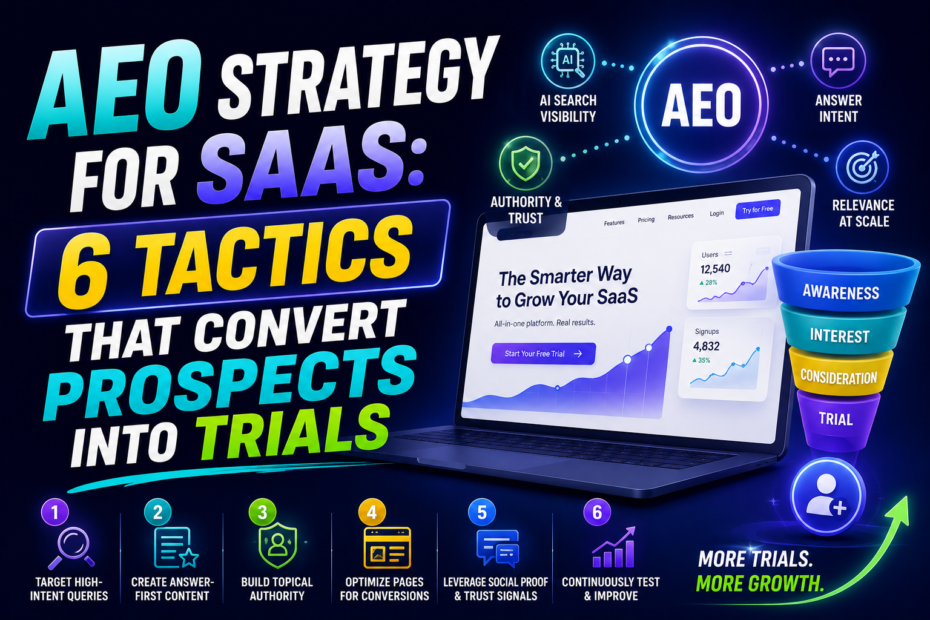
Quick Summary
- What AEO is and why it matters for SaaS: Aligning user intent with search visibility to turn trials into conversions.
- 6 battle-tested tactics that convert prospects into trials, with practical steps and real-world examples.
- Step-by-step guide to implement, measure, and optimize AEO in SaaS marketing.
- Pro tips, common mistakes to avoid, and the best tools to accelerate results.
If you’re selling software as a service, you know the funnel isn’t just about getting traffic. It’s about getting the right traffic—prospects who are primed to try your product. AEO, or Authorized Economic Optimization (in our world more practically: Authoritative, Experience-driven Optimization), is a framework that blends audience intent, on-site experience, and credibility signals to push visitors from curiosity to trial signup. This guide breaks down six concrete tactics you can deploy today to boost trials and shorten time-to-value for your SaaS product.
What is AEO for SaaS and why should you care?
AEO for SaaS is about shaping your online presence so when a potential customer searches for a problem your product solves, your pages answer with clarity, confidence, and compelling proof. It’s not just SEO in the traditional sense. It’s SEO, content, UX, pricing clarity, and social proof all working in harmony to nudge visitors toward starting a free trial or booking a demo. When done well, AEO turns ambiguous visits into qualified trials and lowers the friction of activation.
6 tactics that convert prospects into trials
Tactic 1: Craft intent-aligned onboarding content that educates before it sells
People don’t sign up for software because they’ve heard a great feature list. They sign up because they feel understood—because they’ve found answers to their specific questions. Start with content that mirrors the buyer’s journey: awareness, consideration, decision. Create high-value resources that address real pains and show how your product solves them. This isn’t about hard selling; it’s about solving a problem and earning trust.
Real-world example: A project-management SaaS built a “Getting Started with [Product]” onboarding hub; it includes a 10-minute setup guide, a 15-minute workflow template, and a case study showing a similar team saving 20 hours per week. The page ranks well for long-tail questions like “how to automate task assignment in [Product]” and converts visitors into trials at a higher rate than generic feature pages.
Practical steps:
- Map top customer intents to content assets: problem-aware, solution-aware, product-aware.
- Produce one cornerstone piece per intent with a practical action plan and visuals.
- Embed a frictionless trial flow link and a short checklist that customers can use within the article.
Internal link example: Learn more about practical content strategies in our guide to content marketing for SaaS.
Tactic 2: Optimize product-landing experiences for trial initiation
Your landing pages should answer two questions in 5 seconds: “What is this product?” and “Why should I try it now?” That means concise value statements, scannable bullets, clear CTAs, and proof that a trial is low-risk and high-value. Use a strong hero value proposition, a visible trial CTA above the fold, and a secondary CTA for a guided tour or pricing Q&A.
Real-world example: A CRM SaaS split its pricing page into three sections: “Why this CRM works for teams like yours,” “What’s included in a 14-day trial,” and “What people say.” The result was a 23% bump in trial starts and more qualified signups from visitors who could instantly picture themselves using the product.
Practical steps:
- Run a/b tests on hero statements and CTA copy (Try Free vs Start Free Trial vs See Demo).
- Show a lightweight, no-credit-card-required trial option to reduce friction.
- Highlight clear next steps after signup (guided setup, sample data, first 24-hour plan).
Tactic 3: Build social proof and credibility signals that influence decision-makers
For SaaS buyers, trust signals matter. Testimonials from recognizable brands, case studies with quantified outcomes, and product logos increase perceived value and reduce risk. Don’t just collect social proof—position it where the decision-maker searches and reads. Use varied formats: short quote cards, long-form case studies, video testimonials, and customer logos on pricing pages.
Real-world example: A security software company embedded “customer impact” sections on trial signup pages, featuring a 60-second video case study and a one-paragraph win summary with measurable outcomes. The combination produced a noticeable lift in trial starts among mid-market prospects.
Practical steps:
- Develop 3–5 customer stories across industries you serve.
- Place logos and quotes near CTAs on product pages and pricing pages.
- Create a press and awards section to lend third-party validation.
Tactic 4: Implement a data-informed pricing and packaging strategy to reduce friction
Pricing is often the gatekeeper. If your pricing confuses or intimidates, people abandon the trial before they begin. AEO-friendly pricing presents clear tiers, explicit value at each tier, and a frictionless upgrade path. Consider a “free trial” that doesn’t require a credit card and a visible “Compare plans” tool that makes cost-to-value obvious.
Real-world example: A marketing automation SaaS introduced a single-page pricing comparison with a 14-day trial, then added a “What you’ll achieve in 14 days” outcomes list. Trials increased for the mid-tier because users could quickly map benefits to outcomes in their own context.
Practical steps:
- Audit pricing copy for clarity and value language; remove jargon.
- Offer an option to start a trial without a credit card.
- Provide a dynamic ROI calculator or outcome expectations tailored to common roles (e.g., marketer, sales rep, ops).
Tactic 5: Accelerate activation with in-product onboarding experiences tied to marketing touchpoints
Activation isn’t a one-click moment—it’s a coordinated journey. Use marketing automation to trigger onboarding steps, guided product tours, and contextual help when a trial user first lands. The goal is to reduce the time to first meaningful action and demonstrate value quickly.
Real-world example: A collaboration tool connected a welcome email to an in-app walkthrough highlighting the first project setup. The user saw a quick win within 10 minutes, which boosted the likelihood of continuing the trial and upgrading later.
Practical steps:
- Define critical activation events (first project, first integration, first report).
- Track onboarding funnel metrics and intervene with targeted guidance for users who stall.
- Use in-app messaging to guide trial users toward a use case relevant to their role.
Tactic 6: Optimize for voice search and answer-focused content to capture intent-driven visibility
Voice search is on the rise, and many buyers ask concise, question-based queries. Optimize content to answer specific questions in a natural, digestible way. This improves not just SEO rankings but also the likelihood that a top result becomes a quick-trial catalyst when users hear the answer aloud.
Real-world example: A helpdesk SaaS created a “FAQ by role” content hub answering common questions in short, direct paragraphs. The pages ranked for voice queries and earned several featured positions in snippet results, driving more trial signups from voice-enabled devices.
Step-by-step Guide
- Audit your current AEO signals: content, pages, pricing, trust elements, and onboarding flow. Identify gaps where visitors slip away before starting a trial.
- Define intents and map them to assets: awareness (problem-centric blog posts), consideration (comparisons and ROI content), decision (trial-focused pages, pricing clarity, and sign-up CTAs).
- Revamp product pages with a single, crisp value prop, visible trial CTA, and proof points near the fold. Ensure trial initiation is frictionless (no unnecessary forms, quick signup).
- Publish intent-aligned content hubs: one hub per major problem your product solves. Each hub contains a cornerstone guide, supporting posts, a case study, and a trial CTA.
- Boost social proof: embed customer logos, testimonials, and short case highlights on pricing and product pages.
- Improve in-product onboarding and automation: trigger guided tours or checklists after signup; personalize tours based on role or industry.
- Optimize for voice search and featured snippets: answer common questions clearly in short paragraphs and use bullet lists for steps or outcomes.
- Test and iterate: run frequent A/B tests on headlines, CTAs, and onboarding messages. Measure trial-start rate, activation rate, and time-to-value.
Pro Tips
- Use micro-moments: tiny signals like “how to reset a password” can be a doorway to a trial if you tie it to a helpful guide and trial CTA.
- Keep forms short: ask only essential information in trial sign-ups; offer progressive profiling later.
- Prioritize mobile optimization: many trial signups happen on mobile; ensure fast load times and tappable CTAs.
- Leverage retargeting with value-driven messages: remind visitors of outcomes they can achieve with a trial, not just product features.
- Measure quality of trial users: track not only signups but time-to-first-value, feature adoption, and likelihood to upgrade.
Common Mistakes
- Overloading pages with features but under-delivering on outcomes.
- Failing to align content with stages of the buyer journey.
- Asking for too much information during signup, causing friction.
- Ignoring post-signup activation signals and onboarding bottlenecks.
- Neglecting voice search optimization and snippet-ready content.
Best Tools
Choosing the right tools speeds up everything from content optimization to onboarding automation. Here are some categories and examples to consider.
- SEO & content optimization: Surfer SEO, Clearscope, MarketMuse
- User onboarding & product analytics: Mixpanel, Pendo, Appcues
- Pricing & conversions: Crisp pricing experiments tools, Optimizely for A/B testing
- Content management & internal linking: WordPress with SEO plugins, Drupal with structured data
- CRM & marketing automation: HubSpot, Marketo, ActiveCampaign
Note: Select tools that integrate well with your stack and give you actionable signals for trial optimization. If you’re building an affiliate-friendly approach, these tools also help create reliable, scalable content that affiliates can promote with confidence.
FAQ
How do I measure AEO success for SaaS?
Track trial starts, activation rate (first meaningful action), time-to-value, and conversion rate from trial to paid. Also monitor organic search rankings for intent-based keywords and the share of voice on high-intent pages.
What are the best questions to answer for trial-focused content?
Questions like “How long does it take to set up [Product]?” “Can I see ROI with [Product] in 30 days?” and “What does the onboarding look like?” tend to perform well. Answer them with concise, practical steps and include a clear path to starting a trial.
Should I require a credit card for trial signups?
Consider offering a no-credit-card free trial to reduce friction, then require a card when upgrading. If you must collect card details, provide reassurance and a clear opt-out path.
How important are case studies in AEO for SaaS?
Very important. They demonstrate real-world results and reduce perceived risk. Include a mix of short quotes and long-form stories that show measurable outcomes.
How do I optimize pricing for trials?
Offer transparent value-to-cost messaging, a clear comparison of plans, and easy upgrade paths. Test free trial variants (no card vs. card on signup) and tier boundaries to see what resonates with your audience.
Featured Snippet Paragraph
To turn SaaS visitors into trials, align your content and UX with buyer intent, showcase credible proof, and streamline activation. Clear value propositions, frictionless signup, and fast paths to first value reduce risk and boost trial starts and conversions.
List Snippet
- Match content to buyer intent
- Show clear trial value upfront
- Provide social proof near CTAs
- Offer frictionless signup (no credit card or quick card-on-signup)
- Guide onboarding with in-product tours
Internal Linking
Within this guide you’ll find practical strategies that pair well with deeper dives. For broader content on building a solid content foundation, check out the ultimate guide to content marketing for SaaS. If you want to align product-led growth with your SEO plan, see product-led growth and SEO: a practical framework.
Voice Search Optimization: Simple Answers that Travel
People often speak in direct questions. Structure content to answer those questions in clean, short sentences. Use question-based headings to make it easier for Google SGE and AEO to pull your content as a featured answer. For example, “How can I start a free trial for [Product]?” and “What is the onboarding time for [Product]?” are good candidates. Keep paragraphs under 60 words where possible and use numbered lists for steps.
Outcome-focused, Experience-driven Approach
The heart of AEO for SaaS is delivering outcomes that feel tangible. When a prospect reads a blog post, watches a short case study, and immediately sees how your trial can unlock their goals, they’re more likely to sign up. Tie every piece of content to a concrete action: start a trial, book a demo, or view a quick onboarding walkthrough. Your pages should whisper: this is the path you take to achieve X result.
Common Questions About AEO for SaaS
What does “authentic authority” mean in SaaS content?
It means content built from real customer outcomes, credible data, transparent pricing, and clear proof of impact. It’s not a buzzword—it’s about showing you understand the buyer’s problem and can deliver a reliable solution.
Can AEO work for startups with limited brand recognition?
Absolutely. Start with problem-focused content, leverage case studies from early customers, and use trial-first CTAs. As you gather data and success stories, your authority grows organically.
How long does it take to see results from AEO changes?
Some wins appear in weeks (on-page optimization and onboarding improvements), but durable effects on trials and paid conversions usually unfold over a few months as content accumulates, rankings improve, and the onboarding experience matures.
Should I customize content by industry or role?
Yes. Industry- and role-specific content helps you speak the language of the buyer. Use tailored ROI calculations, use cases, and onboarding flows to increase relevance and trial likelihood.
What are quick wins I can implement this month?
Run a trial-focused content sprint: rewrite a pricing page for clarity, publish 2–3 outcome-focused case studies, add a no-credential-required trial option, and optimize a high-intent landing page for a top problem you solve.
Step-by-step Quick Checklist
- Identify top high-intent keywords and questions your buyers ask.
- Publish 3 core intent-based hubs (awareness, consideration, decision) with trial CTAs.
- Revamp product pages to emphasize value, speed to first win, and no-friction signup.
- Incorporate social proof and credible case studies near critical CTAs.
- Implement guided onboarding that activates key features quickly.
- Test pricing clarity and trial entry options (no card, quick signup).
- Optimize for voice search with concise, question-based content.
- Monitor metrics and iterate weekly based on data.
Final Thoughts
AEO isn’t a single tactic; it’s a mindset. It’s about creating a seamless experience where a visitor’s intent meets your product’s promise, supported by credible proof and a frictionless path to trial. Start with intent-driven content and onboarding, layer in social proof and clear pricing, then optimize for search and voice. When all the pieces align, you’ll see more qualified trials, faster activation, and stronger growth for your SaaS business.