
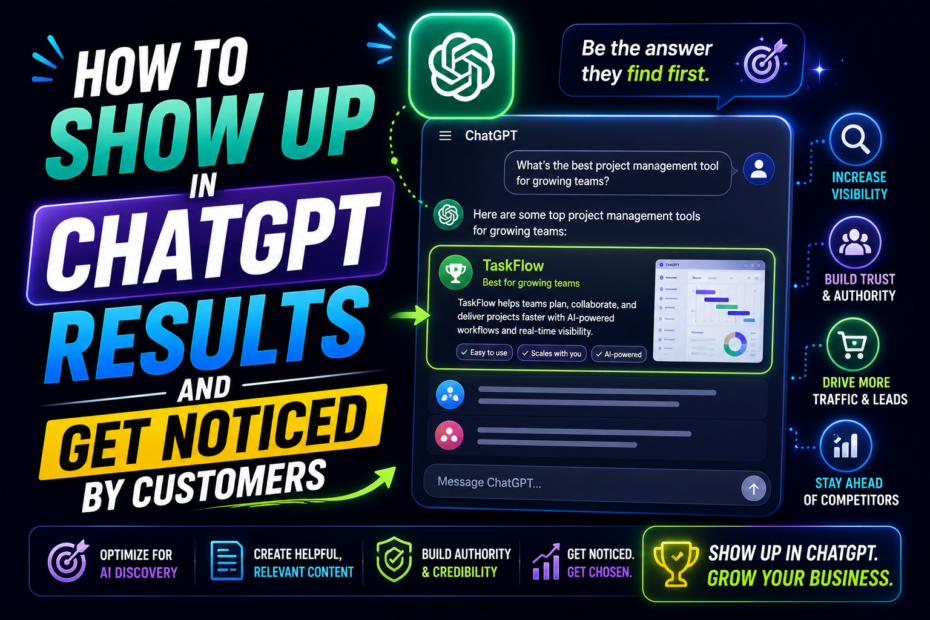
Looking to show up in ChatGPT results and actually catch customers’ eyes? You’re not alone. Businesses across niches want to be the go-to answer when people ask questions related to their field. The good news: with the right approach, you can optimize your content so ChatGPT recognizes it as a trustworthy, helpful source. This guide walks you through practical, battle-tested steps to appear in ChatGPT results, boost your visibility, and drive real conversations with potential customers.
Quick Summary
- Understand how ChatGPT surfaces content and what it trusts (quality signals, E-E-A-T, structured data).
- Create helpful, answer-focused content that directly answers common questions in your niche.
- Structure content for ChatGPT’s preferences: clear definitions, step-by-step guides, and practical examples.
- Leverage on-page optimization, FAQs, and internal linking to boost discoverability.
- Use tools and processes to maintain freshness, accuracy, and consistency across channels.
What it means to show up in ChatGPT results
ChatGPT doesn’t pull from a single source; it synthesizes information from a wide array of web pages, documents, and structured data. The key is to become a reliably high-quality source that the model finds clear, accurate, and useful for answering user questions. Think of it as becoming a trusted neighbor who always has the right answer, not just a loud aggregator.
Why this is different from traditional SEO
Traditional SEO is mostly about ranking on search engines like Google for keyword phrases. When it comes to ChatGPT, you’re competing for inclusion in a language model’s training data and its live retrieval prompts. That means quality signals, but also how you present information, how you structure answers, and how you demonstrate usefulness across related questions. You’ll want to align with both search engine best practices and conversational clarity for AI models.
Who should care
Small business owners, consultants, freelancers, and marketing teams who want to be seen as trusted authorities in their niche. If your target customers ask questions that your business can answer—whether it’s how to choose a product, how to implement a service, or what the best practices are—then this guide is for you.
Step-by-step Guide
Follow these steps to increase your chances of appearing in ChatGPT results and getting clicks from customers who land on your pages.
1) Map the questions your audience asks
Create a questions-first content map. Start with customer intents: what problems do they have, what decisions are they making, and what outcomes do they seek? Then turn each question into a well-researched, clearly answered article or page.
2) Craft clarity-first answers
When you answer, aim for clarity over cleverness. Lead with the answer, then provide context, steps, and examples. Use plain language and avoid jargon unless you define it. Short, direct sentences help AI models parse the content quickly and accurately.
3) Structure content for AI-friendly consumption
Use a clean hierarchy: short introductory paragraph, followed by numbered steps or bullet lists, then deeper dives. Break long sections with subheadings that contain keywords and questions your audience might ask. Include bolded definitions for key terms (without overdoing it). AI models like structured content with predictable patterns.
4) Build trust signals into every page
ChatGPT tends to favor sources that demonstrate expertise, authority, and trustworthiness. Include author bios with credentials, cite reputable sources, and show updates for accuracy. Use structured data where relevant—FAQPage, HowTo, and Organization schemas can help search engines and AI understand your content better.
5) Create high-value, evergreen content plus timely updates
Evergreen guides (e.g., “How to choose X” or “10 best practices for Y”) stay useful. Pair them with timely updates (e.g., “New trends in 2026 for Z”) to keep your content fresh. AI models appreciate content that remains relevant and accurate over time.
6) Optimize on-page elements with clear intent signals
Title tags, headings, meta descriptions, and slug structure should reflect intent and include natural variations of questions your audience asks. Keep titles conversational and include a user-facing benefit. For example, “How to pick the right CRM in 2026: a practical guide” feels actionable and clear.
7) Target voice-search friendly formats
Voice search favors concise, direct answers. Create short paragraphs that answer a question in 20-40 words, followed by optional steps. Include “answer first” snippets that are easy to verbalize.
8) Leverage FAQs and structured data
FAQ pages are gold for AI. They’re designed to answer common questions succinctly and can be picked up by chat assistants. Use question-based headings and answer them succinctly. Include schema markup where appropriate to help search engines and AI understand intent.
9) Build internal and external signals
Internal links help AI models see how pages relate. External links to authoritative sources reinforce trust signals. Use anchor text that describes the linked resource rather than generic phrases.
10) Measure, test, and iterate
Track metrics like time on page, bounce rate, click-through rate from search results, and retrieval quality signals (do users discuss your content in comments or reviews, or cite your guidance in other articles?). Iterate based on what works best for your audience and search landscape.
Best practices for content design that helps you show up in ChatGPT results
Assuming you want practical, repeatable patterns, here are the best practices to implement now.
Quality and clarity first
AI models like content that’s accurate, well-structured, and easy to parse. Avoid fluff. If you can’t explain something in one paragraph, break it into steps with examples. Clarity helps both humans and AI developers who tune these models.
Specificity over buzzwords
Use precise language. Instead of “best practices” too often, name concrete actions: “use customer testimonials in your case studies,” “include a 60-second elevator pitch in your About page.” Specific steps are easier for AI to reference and for users to follow.
Authoritative sourcing
When you cite statistics or research, link to the original source. Inclusion of credible sources boosts perceived authority and helps AI trust your content as a reliable reference point.
Concrete formats that AI loves
How-to guides, checklists, step-by-step instructions, and clear definitions. Use numbered lists for sequences, bullet points for quick tips, and callouts for key takeaways. This makes it easier for AI to extract actionable content.
Consistency across channels
Publish consistently across your website, blog, and resource pages. Consistency builds a recognizable footprint that AI can connect to your brand, making it likelier to surface your content as a trusted answer across contexts.
Real-world examples and practical insights
Here are a few hypothetical scenarios and how you’d structure content to appear in ChatGPT results.
Example 1: A small marketing agency answering “How do I choose a marketing technology stack?”
Publish a detailed guide with sections like: define goals, map your required capabilities, compare tools by feature sets, run a 30-day trial plan, calculate TCO, and include a decision checklist. Add a quick FAQ with questions like “What are essential tools for B2B marketing?” and “How often should you reassess your stack?”
Example 2: A boutique fitness studio answering “What’s the best way to start at-home workouts?”
Publish a beginner-friendly program with daily routines, equipment lists, safety tips, and progression milestones. Include a printable week-by-week plan and a short video snippet. Add FAQ about equipment alternatives and common injuries.
Example 3: An e-commerce store answering “How to choose the right ergonomic chair for remote work?”
Create a comparison guide with product criteria, safety considerations, test routines, and maintenance tips. Provide a decision matrix and a sub-article on “common desk setup mistakes” to link back.
Step-by-step Guide (detailed)
Below is a practical workflow you can execute in a week, or adapt to your team’s cadence.
Step 1: Research user questions that matter
Use keyword tools to surface questions people ask about your niche. Look at “People also ask” boxes, forums, and social conversations. Tag questions by intent: informational, navigational, transactional. Build a content plan around high-potential questions with clear, actionable answers.
Step 2: Create an “Answer-first” content template
Template outline:
- Question (headline)
- Direct Answer (1-2 sentences)
- Why this matters (context)
- Step-by-step instructions (bulleted)
- Examples or case study
- Common pitfalls and how to avoid them
- FAQ (related questions)
Stick to the template for consistency, which helps AI parse your content quickly.
Step 3: Build a robust FAQ section
Create 8–14 FAQs that address common questions in your niche. Use natural, conversational questions in the headings and provide concise, factual answers. Use structured data to help search engines recognize the FAQ content.
Step 4: Optimize page structure for AI and humans
Use clear H2s with question-based headings, H3s for sub-questions, and short paragraphs. Include internal links to related guides and product pages. Ensure page speed is fast, images have alt text, and the mobile experience is solid.
Step 5: Build trust with author info and sources
Include author bios with relevant credentials, publish author pages, and link to credible sources within the content when you cite data. This signals expertise and trust, which helps AI consider your content a reliable reference.
Step 6: Create an internal linking map
Link related articles to form a logical content web. Use anchor text that describes the page you’re linking to. This helps AI understand relationships and discoverability across your site.
Step 7: Publish and promote with a multi-channel approach
Publish the content and share it through newsletters, social media, and partner networks. Encourage user-generated questions and comments to keep content fresh and demonstrate engagement signals.
Step 8: Monitor and update regularly
Track performance and refresh older articles with updated data, examples, and fresh insights. Regular updates signal that your content remains accurate and valuable, a factor AI models appreciate.
Pro Tips
- Write in a natural, human voice. A few imperfect, genuine touches beat robotic precision every time.
- Use micro-long-tail questions in headings to capture a broader set of queries.
- Repurpose core guides into multiple formats: short FAQs, checklists, video scripts, and slides.
- Leverage user testimonials and case studies to illustrate real-world results.
- Audit your competitors to identify gaps and opportunities AI might leverage in your space.
Common Mistakes
- Overloading pages with SEO jargon and keyword stuffing; aim for clarity first.
- Neglecting updates; stale data harms trust signals for AI and users alike.
- Ignoring FAQ optimization; many AI-driven answers originate from well-crafted FAQs.
- Forgetting mobile and accessibility considerations; poor UX reduces engagement and signals.
- Focusing only on rankings; priority should be usefulness and accuracy.
Best Tools
These tools help you research, create, and optimize content with AI-friendly signals in mind. They’re also useful for affiliate marketing and long-term SEO growth.
- Keyword and topic research: Semrush, Ahrefs, Answer the Public
- Content structure and readability: Surfer SEO, Clearscope
- Schema markup and structured data: Google’s Structured Data Testing Tool, Schema.org
- Content quality and originality: Grammarly, Hemingway Editor
- CMS and automation: WordPress with SEO plugins, HubSpot CMS
- Internal linking and site architecture: Screaming Frog, Sitebulb
FAQ
How can I ensure my content is designed for ChatGPT’s preferences?
Focus on clarity, structure, and usefulness. Answer questions directly, use numbered steps, and provide real-world examples. Include FAQs and keep information up to date with credible sources.
What types of content are most likely to surface in ChatGPT results?
How-to guides, step-by-step instructions, checklists, clearly defined terms, and concise answers to common questions. Content with structured data and well-defined intent signals tends to perform better.
How often should I update evergreen content?
Review quarterly or semi-annually. If you operate in a fast-changing field, update more frequently. Fresh data, examples, and updated best practices keep content credible for AI and readers.
Can internal linking really impact ChatGPT visibility?
Yes. A logical internal linking strategy helps AI understand relationships among pages, which can improve discoverability and the likelihood of your content appearing as a relevant answer.
Is voice search optimization essential for ChatGPT results?
Yes. Voice search favors concise, direct answers. Structuring content with question-based headers and clear, short responses helps both users and AI when spoken queries happen.
Internal Linking
Boost the authority and discoverability of your content with natural internal links. Here are a couple of examples you can adapt in your posts:
- For a guide on “How to choose a CRM,” link to related articles such as CRM selection criteria for small teams.
- From an article about “content marketing for SaaS,” reference a deeper piece on “SEO basics for SaaS vendors” with anchor text SEO basics for SaaS vendors.
Featured Snippet Paragraph
To appear in a featured snippet, answer the user’s question directly in the first paragraph and then expand with steps. Example: “The simplest way to show up in ChatGPT results is to publish clear, structured how-to content with a direct answer at the top, followed by a numbered list of steps, real-world examples, and a robust FAQ. Regular updates and credible sourcing reinforce trust signals, making your content a reliable reference point.”
List Snippet (Steps or Tips)
- Identify the exact questions your audience asks about your field.
- Write direct, answer-first content with clear steps.
- Structure pages with question-based headings and FAQs.
- Use internal links to connect related guides and resources.
- Keep content accurate and update it regularly.
Voice Search Optimization (Simple Answers)
Yes, this matters. People ask things the way they speak. Provide short, clear answers and then elaborate if needed. Include direct responses like, “Yes, you should start with a 30-day plan,” and follow with steps. This approach helps ChatGPT and voice assistants deliver precise, actionable results.
Conclusion (friendly wrap-up)
Becoming a trusted source for ChatGPT results isn’t magic. It’s a mix of clear answers, thoughtful structure, credible signals, and ongoing maintenance. Start by mapping questions, answering with authority, and building a network of interlinked resources. Over time, your content quality and visibility will grow, increasing the chances that ChatGPT cites you when customers seek help in your niche.