
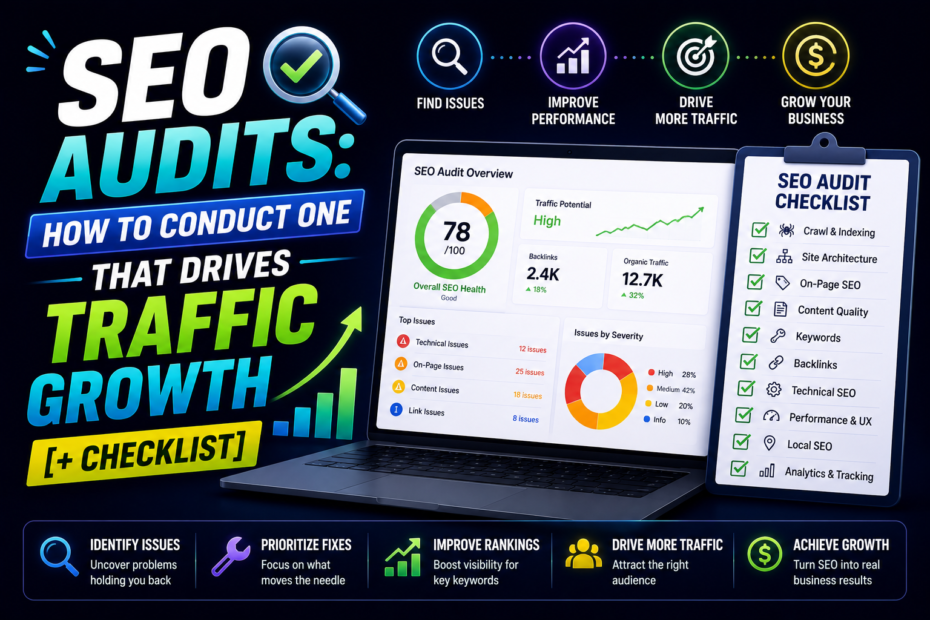
Wanna grow organic traffic fast? A sharp SEO audit is the secret weapon. It uncovers what’s holding your site back and shows you exactly what to fix to climb search rankings, attract more visitors, and convert better. Let’s walk through a practical, beginner-friendly approach you can implement this week.
Quick Summary
- What an SEO audit is and why it matters for traffic growth
- A step-by-step, actionable checklist you can use right away
- Common mistakes to avoid and quick wins that move the needle
- Best tools to speed up your audit and why you should stack them
- How to turn audit findings into a repeatable optimization process
Featured snippet: An SEO audit is a structured evaluation of your website’s on-page, technical, and off-page factors to identify issues that block search engines from crawling, indexing, and ranking your pages. By fixing these issues and prioritizing high-impact actions, you can boost visibility, traffic, and conversions over time.
What is an SEO audit and why it matters for traffic growth
An SEO audit is not a one-off task. It’s a disciplined, data-driven health check of your entire site. You’ll review technical health (like crawlability and site speed), on-page optimization (titles, meta descriptions, headers), content quality, internal linking, user experience signals, and external factors such as backlinks and brand presence. The goal is simple: identify every friction point that stops search engines from delivering your content to the right people at the right moment.
Think of it like a physical checkup for a car. You don’t want to discover problems after you’ve driven into a busy intersection. A solid audit finds issues before they become traffic-killing problems, helping you prioritize fixes that yield the biggest traffic and ranking gains. And the best part: you don’t have to overhaul your entire site at once. You can tackle high-impact fixes first, then iterate monthly or quarterly to keep momentum.
Step-by-step Guide: conduct an SEO audit that actually moves the needle
Step 1: Define your goals and KPI targets
Before you touch a line of code, ask: what does a successful audit look like for us? Is it more organic sessions, lower bounce rate, more revenue from organic traffic, or better ranking for a handful of core keywords? Set specific targets—e.g., +25% organic sessions in 90 days, or top-5 rankings for 3 core terms. Tie these to business outcomes so the team stays focused.
Step 2: Crawl your site and map URL health
Run a full site crawl to capture all URLs, status codes, canonical tags, and internal links. Tools like Screaming Frog or Ahrefs Site Audit give you a crawl map you can filter by errors such as 404s, 301s loops, or orphaned pages. Export the data and categorize issues by impact and ease of fix. If you’re new, start with 100–200 top pages and scale up.
Step 3: Prioritize technical health issues
Technical problems often produce the biggest, fastest wins. Prioritize:
- Indexability: ensure you’re not unintentionally blocking pages with robots.txt or meta robots noindex.
- Crawlability: fix broken internal links, ensure proper sitemap submission, and remove redirect chains longer than two hops.
- Site speed: optimize LCP (largest contentful paint) and TBT (total blocking time). Even small speed gains can lift rankings.
- Mobile usability: confirm responsive design, tap targets, and readability on mobile devices.
Pro tip: fix 80/20 issues first—those that block search engines from discovering your best content or slow user experience for a large share of users.
Step 4: Audit on-page optimization and content depth
Review title tags, meta descriptions, headers, and image alt text. Check that each page has a clear, user-first purpose and a single primary keyword target. Look for keyword cannibalization—multiple pages competing for the same term—and consolidate or re-optimize where necessary. Make sure content depth matches user intent for each target query.
Step 5: Assess content quality and relevance
Google rewards content that thoroughly answers user questions. For each page, assess:
- Depth: does it cover the topic beyond surface-level details?
- Value: are examples, data, case studies, or visuals included?
- Freshness: does the page stay up to date with current trends or stats?
- User signals: is it easy to read, skimmable, and engaging?
If a page scores low on any, set a revision plan and a clear timeline. Don’t forget to audit underperforming pages that rank for long-tail terms—they’re often low-hanging fruit with high conversion potential.
Step 6: Review internal linking and site architecture
Internal links help pass authority and guide users. Check for:
- Logical hierarchy: clear parent-child relationships in categories and subcategories
- Contextual linking: use relevant anchor text that aligns with the target page’s intent
- Orphan pages: fix or redirect pages that receive no internal links
Tip: create a simple internal-link map for your top 20 posts and ensure each has at least 2–3 quality internal links pointing to it from different sections of the site.
Step 7: Evaluate external signals and backlink profile
Backlinks aren’t everything, but they matter. Review the quality and relevance of your inbound links. Look for toxic links that could harm rankings and mark them for disavow if needed. Identify high-potential content campaigns to attract natural, high-quality links—think data studies, original research, and useful tools.
Step 8: Analyze user experience and conversion signals
SEO is not just about search engines. It’s about users. Check bounce rate, average time on page, and conversions from organic traffic. If users arrive but don’t convert, you’re missing a UX or value-lead optimization opportunity. Run A/B tests for headlines, CTAs, and page layout on top-performing pages to improve engagement and conversions.
Step 9: Create a prioritized action plan and owner assignments
Turn your audit findings into a backlog. Rank tasks by impact and effort, assign owners, and set deadlines. A simple format works well: high-impact quick wins (low effort), then medium-impact improvements, then long-term optimizations. Build in a cadence for re-audit every 4–8 weeks to track progress and adjust.
Step 10: Measure, report, and iterate
Set up dashboards that track critical metrics: organic traffic, rankings for target keywords, click-through rate from SERPs, and conversion rate from organic traffic. Report to stakeholders with clear visuals and a narrative that ties actions to outcomes. Use these insights to fuel the next audit cycle.
7 quick, high-impact audit fixes you can implement this week
Curiosity-driven quick wins
These fixes don’t require a complete site rebuild but often deliver noticeable improvements in a short time.
- Fix 404s and broken internal links on top pages that drive most traffic
- Improve page titles and meta descriptions with clear value propositions and keywords
- Compress images and enable lazy loading to boost Core Web Vitals
- Consolidate duplicate content into one authoritative page
- Audit header structure to ensure a clean H1/H2/H3 hierarchy
- Optimize for featured snippets with concise, direct answers to common questions
- Improve internal links to pass authority to cornerstone content
Pro tips for sustained results
- Build a quarterly SEO maintenance ritual: crawl, fix, optimize, report
- Document changes with rationale and expected impact to maintain organizational clarity
- Use data to guide content updates—prioritize pages with high traffic but low conversions
- Combine technical fixes with content improvements for compounding effects
- Keep a watchful eye on core metrics and adapt to algorithm shifts
Common Mistakes to Avoid
- Treating audits as a one-time event rather than a process
- Over-optimizing for search engines instead of user intent
- Ignoring mobile performance and accessibility
- Forgetting to monitor a backlink profile and toxic links
- Underestimating the importance of internal linking and site structure
Best Tools for an Effective SEO Audit (and why they matter for affiliates)
Choosing the right toolbox accelerates your audit and boosts accuracy. Here are some favorites, along with why they matter:
- Screaming Frog SEO Spider — comprehensive crawl data, easy export, ideal for large sites
- Ahrefs Site Audit — great for comprehensive technical checks and backlink insights
- Google Search Console — essential for real-world indexing, performance, and mobile usability signals
- PageSpeed Insights and Lighthouse — actionable speed and performance metrics
- Google Analytics 4 — user behavior, goal tracking, and conversion data
- SQL/Spreadsheet tools (Excel/Sheets) — for organizing data and creating a centralized audit story
For affiliate marketers, a well-chosen toolkit isn’t optional—it’s a revenue multiplier. Use your favorite tools, but don’t chase every shiny feature. Prioritize data you can act on and that aligns with your audience’s needs.
Step-by-step checklist you can copy-paste into your workflow
- Define goals and success metrics
- Run a full site crawl and export the report
- Fix critical 404s, redirects, and crawl errors
- Audit key on-page elements (title, meta, headers, alt text)
- Assess content depth and alignment with user intent
- Review internal linking and site structure
- Evaluate page speed and mobile usability
- Examine backlink quality and disavow toxic links if needed
- Prioritize fixes by impact and effort; assign owners
- Publish a documented action plan and schedule the next audit
FAQ: quick answers to common SEO audit questions
How long should an SEO audit take?
It depends on site size and resources. A thorough audit of a small site can take 1–2 weeks with a focused team; larger sites may require 4–6 weeks with ongoing monitoring. You don’t need perfect results at first; you need a reliable roadmap.
What are the most important audit signals to fix first?
First, fix crawlability and indexability issues, then tackle core page speed and mobile usability. Next, address duplicate content and thin content problems, followed by internal linking and canonicalization issues.
How often should I run an SEO audit?
Aim for a formal audit quarterly, with monthly mini-checks for critical pages and major campaigns. Use continuous monitoring to catch issues early and keep momentum between full audits.
Can an audit help with voice search optimization?
Yes. Structure content around clear, question-based formats and short, direct answers. This helps voice assistants pick up concise responses and improves overall relevance for user queries.
How do I measure the impact of audit changes?
Track changes in organic traffic, rankings for targeted keywords, click-through rate from search results, and conversion rate from organic visitors. Compare pre- and post-audit data over a consistent window to gauge impact.
Internal linking spotlight: quick examples
Better internal linking helps search engines discover more pages and distributes authority. For instance, you could link from this beginner’s guide to keyword research to a pillar post about content strategy, and from the pillar to related case studies like our real-world content audit workflow.
Step-by-step Guide (condensed in case you skim)
Here’s a tight recap you can print or save as a quick-start plan:
- Define goals and KPI targets
- Crawl site and map health
- Prioritize technical fixes
- Audit on-page elements
- Assess content depth and alignment
- Review internal linking and architecture
- Evaluate external signals and backlinks
- Analyze UX and conversions
- Create an actionable backlog
- Measure, report, and iterate
Best Practices for SEO Audits in 2026
- Keep user intent at the center of every fix
- Automate data collection but humanize the interpretation
- Document changes and maintain an audit log
- Prioritize high-traffic, high-conversion pages
- Balance technical fixes with content improvements
Pro Tips for Affiliate-Driven SEO Audits
- Audit pages that rank for high-value affiliate keywords first
- Explore content gaps where your competitors outperform you
- Leverage internal links to push product reviews and buyer guides
- Use data-driven updates to improve product-focused content
Common Mistakes (and how to fix them fast)
- Over-optimizing metadata without improving content value — fix by enriching content first
- Ignoring accessibility and usability signals — fix by testing with real users
- Relying on a single tool for all insights — fix by triangulating data from multiple sources
Best Tools (affiliate-friendly showcase)
- Screaming Frog SEO Spider
- Ahrefs Site Audit
- Google Search Console
- Lighthouse/PageSpeed Insights
- Google Analytics 4
Pro moving tip: use a combination of tools to validate findings, but document actions in a single shared sheet or project board so your team stays aligned across sprints.
Additional Resources and Internal Connections
Want to dive deeper? Check out related discussions on SEO content optimization strategies and technical SEO checklist for 2026 to complement your audit workflow.
Final take: turning audit into ongoing traffic growth
Audits are not a one-and-done sprint; they’re the backbone of a repeatable optimization loop. By starting with a clear goal, tackling high-impact issues, and turning findings into an action-ready backlog, you’ll create a scalable process that consistently lifts traffic and harvests better engagement from organic search. Ready to start? Pick your top 5 pages, run the crawl, and begin fixing with the mindset of delivering real value to your audience.