
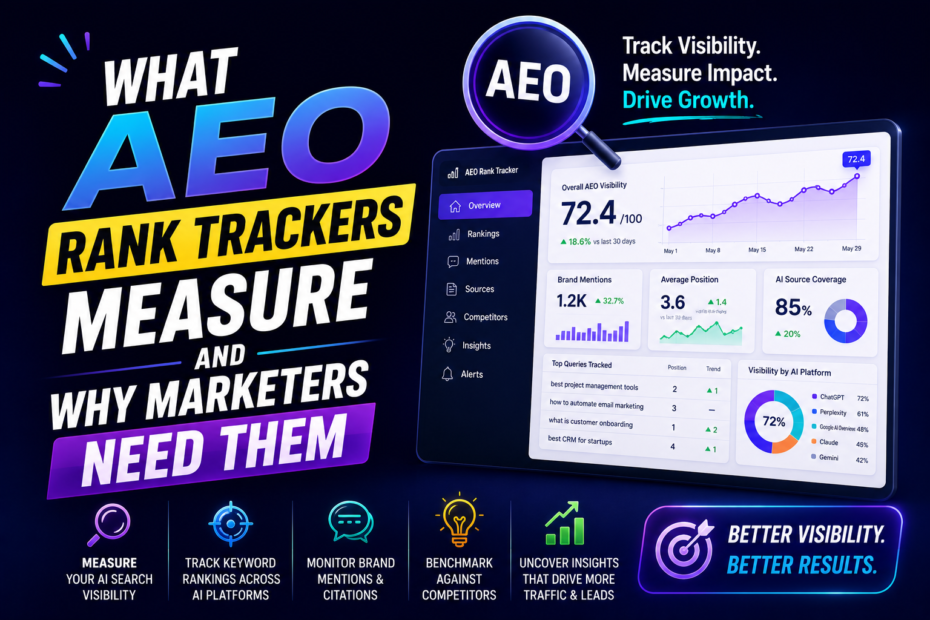
If you’re working with paid or organic search, you’ve likely run into AEO rank trackers—tools that help you see where your ads and pages stand in a crowded digital landscape. These trackers aren’t just about numbers; they’re about understanding how your content performs across search engines and marketplaces and translating that into actionable tweaks. In this guide, you’ll learn what AEO rank trackers measure, why marketers need them, and how to use the data to drive real results.
What AEO rank trackers measure and why marketers need them
AEO rank trackers measure where your content appears in search results, how visible it is, and how effectively it competes for clicks. They don’t just tell you if you rank on the first page; they reveal the quality of your ranking, the density of your presence across queries, and how changes to your pages, ads, or strategy shift positions over time. If you’re investing in content, SEO, or paid campaigns, these trackers are your early-warning system and performance dashboard in one.
Think of an AEO rank tracker as a smart observer. It watches the SERP (search engine results page) for your keywords, your competitors’ keywords, and related search terms. It logs positions, featured snippets, knowledge panels, local packs, image results, video results, and other rich results. It also records metrics like search impression share, click-through rate (CTR), and estimated traffic from each ranking position. The real power shows up when you combine that data with intent signals and conversion data—from someone who found you via a keyword to a paying customer.
Featured snippet: An AEO rank tracker tells you where your pages deserve to appear in featured snippets, monitors when you win or lose them, and guides you through the quick wins that push your content into prime real estate on the SERP.
Key metrics you’ll typically see
Here are the metrics that matter most for marketers using AEO rank trackers:
- Average position across target keywords
- Impression share and visibility index
- Click-through rate by position and by keyword
- Rank volatility (how often positions change)
- SERP features presence (featured snippets, people also ask, image/video blocks)
- Competitor rank movements and gap analysis
- Estimated organic traffic from rank positions
- Click-through value per query (economic impact of ranking)
- Indexability and crawlability signals (technical health indicators)
- Voice search readiness (simple answers, natural language queries)
Why marketers can’t ignore AEO rank tracking
If you care about ROI from content and ads, you need visibility into how your content performs in the wild. AEO rank trackers help you:
- Connect ranking data to business outcomes: understand which rankings drive sales or leads.
- Spot content gaps before your competitors steal the spotlight.
- Identify which SERP features you should chase (featured snippets, FAQ blocks, etc.).
- Measure the impact of on-page optimizations and technical fixes over time.
- Benchmark against top competitors and set realistic targets.
Real-world example: a mid-size e-commerce site
Imagine an e-commerce site selling hiking gear. They track 200 keywords, including product names, buying-intent phrases, and category terms. Over three months, they notice that product pages frequently appear in the “People also ask” box but rarely convert from those impressions. With an AEO tracker, they create FAQ-rich content and schema markup to push those impressions into click-worthy results. Within six weeks, not only do they rank higher for the primary product terms, but traffic from the FAQs converts more often, lifting overall revenue from organic search.
Step-by-step Guide to using AEO rank trackers effectively
Here’s a practical, repeatable process to turn tracker data into action. You can run this monthly or quarterly to keep your strategy fresh.
Step 1: Define your target keywords and pages
Start with your core products or services, plus a long-tail mix that captures buying intent and informational search queries. Map each keyword to a specific page or content asset. This mapping helps you see where gaps exist and where you already perform well.
Step 2: Set up benchmarks and targets
Record your baseline positions, impression shares, and CTRs. Set SMART targets (Specific, Measurable, Achievable, Relevant, Time-bound) for the next sprint—say, a 10% improvement in average position and a 5% lift in CTR.
Step 3: Track SERP features and intent shifts
Monitor which SERP features appear for your keywords and how that distribution changes over time. If featured snippets or knowledge panels start appearing for your competitors, you’ll want to adapt by creating concise, authoritative content that answers questions directly.
Step 4: Analyze competitor movements
Look at who’s moving up or down for the same terms. Are they using different pages, fresh FAQs, better internal linking, or updated schema? Use these signals to adjust your own content plan.
Step 5: Optimize based on data, not guesswork
Turn insights into action. If a page ranks well but has a low CTR, rewrite meta titles and meta descriptions with stronger calls-to-action and benefit statements. If a page ranks well but converts poorly, review on-page content, trust signals, and internal linking.
Step 6: Test, learn, iterate
Run A/B tests or controlled experiments on page elements, structured data, and internal linking changes. Track how rankings respond and tie them back to conversions.
Step 7: Report with a storytelling angle
When you report to stakeholders, translate the numbers into business impact. Show how improvements in ranking translated into traffic, engagement, and revenue, not just a list of positions.
Pro Tips for maximum impact
- Focus on intent-aligned content: align your pages with the user’s goal behind the query.
- Prioritize quick wins: optimize for pages ranking in the top 10 but with mediocre CTR.
- Leverage schema markup and structured data to support SERP features you want to win.
- Coordinate with paid search: when you own an ad slot on a SERP, ensure landing pages mirror ad promises for a coherent experience.
- Use voice-search friendly phrasing: short, direct answers that can fit into featured snippets or quick replies.
- Maintain a healthy crawl budget with clean site structure and robust internal linking.
- Track user engagement signals alongside rankings to gauge quality of traffic.
Common mistakes to avoid with AEO rank trackers
- Relying on a single metric (e.g., position) without considering CTR or intent.
- Ignoring mobile SERP differences and fast-loading experiences, which affect rankings and user behavior.
- Chasing rankings for vanity keywords that don’t convert or align with your business goals.
- Not segmenting data by device, region, or intent, which hides meaningful patterns.
- Failing to close the loop with content updates and on-page optimization after discovering gaps.
Best Tools for AEO rank tracking and why they matter
Choosing the right tool depends on your needs, budget, and how deeply you intend to integrate insights into your workflow. Here’s a quick roundup of popular options and what they’re best at:
- Tool A: Great for comprehensive keyword tracking, solid SERP features coverage, and regular updates. Ideal for mid-sized teams that want robust data without fiddly setup.
- Tool B: Excellent for competitive analysis and gap identification. If you want to see what your top rivals are ranking for and how to beat them, this is a strong pick.
- Tool C: Lightweight, affordable, and super easy to use. Perfect for beginners or small teams who want quick wins and straightforward reporting.
- Tool D: Advanced in technical SEO signals, schema support, and voice-search readiness. Best for sites with complex structures or that rely on rich results.
Whichever tool you pick, aim for a setup that lets you automate data collection, customize dashboards for stakeholders, and export findings into your content calendar. This makes it much easier to turn insights into actions without getting overwhelmed.
Best practices to tie AEO data to content strategy
Data without a plan is just noise. Here are practical ways to weave AEO insights into your content roadmap:
- Content refresh cadence: schedule updates for pages that rank in top 20 but have stagnant CTR.
- FAQ-rich updates: for queries showing as “People also ask,” add concise, authoritative answers on your pages with schema markup.
- Internal linking: strengthen pages with high intent by linking from related articles or category pages to boost topical authority.
- Video and image optimization: if image or video SERP features appear, optimize thumbnails, transcripts, and alt text to improve visibility.
- Localized targeting: if you operate in multiple regions, track local pack presence and adapt content to regional search intent.
Advanced on-page optimization techniques for rankable content to deepen knowledge on how to apply content tweaks at scale.
Step-by-step: building a data-driven content calendar from AEO insights
Turn data into a living content calendar with these steps:
- Extract top-performing keywords by volume and relevance to your goals.
- Group keywords into topic clusters and assign pillar pages and supporting articles.
- Prioritize pages with favorable positions but low CTR for quick optimization sprints.
- Draft content briefs that target both direct answers and long-tail variants.
- Plan schema, FAQ blocks, and media assets to align with SERP features you aim to capture.
- Set a cadence for updates and measurement; review results monthly.
Common questions about AEO rank trackers
How often should I check AEO rankings?
Regular checks help you stay ahead. For most sites, weekly quick checks paired with a deeper monthly review work well. If you run campaigns with time-sensitive offers, daily tracking during launch windows is worth it.
Do AEO trackers work for voice search?
Yes, they help you spot simple, direct answers that could become voice-query results. Tailor your content to concise responses and ensure your FAQ sections cover common voice search phrasing.
Can AEO tracking replace analytics reporting?
No, it complements analytics. Use AEO data to understand visibility and engagement in search, then cross-reference with conversions in your analytics suite to close the loop.
What’s the difference between rank tracking and visibility scoring?
Rank tracking watches where your pages appear for a query. Visibility scoring blends position, click-through potential, and impression share into a single index. Both have value, but visibility gives a broader sense of presence.
How do I get started with AEO tracking on a tight budget?
Focus on a lean setup: define a small keyword set, pick a user-friendly tool, and build a simple reporting template. As you prove value, you can scale up with more keywords and features.
5 practical tips to boost your AEO results fast
- Fix the low-hanging CTR issues: rewrite titles and meta descriptions with clear benefits and calls-to-action.
- Exploit FAQ and how-to questions: add structured data to capture relevant features and improve clickability.
- Improve page speed and mobile experience: faster pages reduce bounce and improve rankings over time.
- Strengthen topical authority: publish clustered content that covers all angles of a topic, not just a single page.
- Optimize for intent, not just keywords: ensure every page clearly serves a user’s goal, whether searcher intent is informational, navigational, or transactional.
Best tools for AEO rank tracking (continued)
Here are a few more notes to help you decide if you’re evaluating tools for affiliate-friendly content and long-term SEO planning:
- Look for features like batch keyword checks, historical trend views, and automated alerts for ranking shifts.
- Prioritize tools with easy export options for reporting to stakeholders and teams.
- Consider integration capabilities with your CMS and analytics stack to close the data loop quickly.
Internal linking you can bootstrap today
Internal links help pass authority from high-visibility content to pages that need a lift. Here are two natural, relevant examples you can implement now:
For a blog post about SEO-friendly content planning, include a link to a comprehensive guide on keyword mapping to deepen the reader’s journey and improve topical authority.
Frequently asked questions (FAQ)
Short, direct answers to common questions can earn you a spot in voice search and featured snippets.
What is an AEO rank tracker? It’s a tool that monitors where your pages appear in search results, how visible they are, and how they perform relative to competitors.
What metrics matter most in AEO tracking? Rank position, impression share, CTR, SERP features presence, and the estimated traffic those rankings drive.
How can AEO data improve my content strategy? By revealing which pages rank well but underperform in clicks, which topics capture SERP features, and where to add FAQ blocks or better internal links.
Should I chase every SERP feature? Not every feature adds value. Focus on features that align with your content and user intent and that you can reliably optimize for.
How do I start with AEO tracking on day one? Pick a small keyword set, choose a beginner-friendly tool, set baseline metrics, and create a simple content plan tied to those insights.
Internal links (additional)
For more on improving your content structure and SEO fundamentals, check out our guide to keyword clustering for content strategy and the ultimate on-page SEO checklist. These resources pair nicely with AEO tracking to build a durable SEO program.
Quick Summary
- AEO rank trackers measure positions, visibility, SERP features, and competition dynamics to inform content strategy.
- They help link ranking data to business outcomes like traffic and revenue, not just clicks.
- Use a step-by-step process: define keywords, set targets, analyze SERP features, optimize, test, and report.
- Prioritize intent-aligned content, FAQ blocks, rapid wins for CTR, and solid internal linking.
- Choose tools with automation, dashboards, and export-friendly reports to scale your efforts.
Final reflections on the value of AEO rank tracking
If you’re serious about SEO, AEO rank tracking is more than a monitoring tool—it’s a strategic partner. It helps you see beyond the page one ranking and understand what real visitors want, how they search, and what moments in the journey drive decisions. When you couple this with a disciplined content plan and daily user-first optimization, your site doesn’t just climb the rankings. It thrives in how people actually find and engage with your brand.