
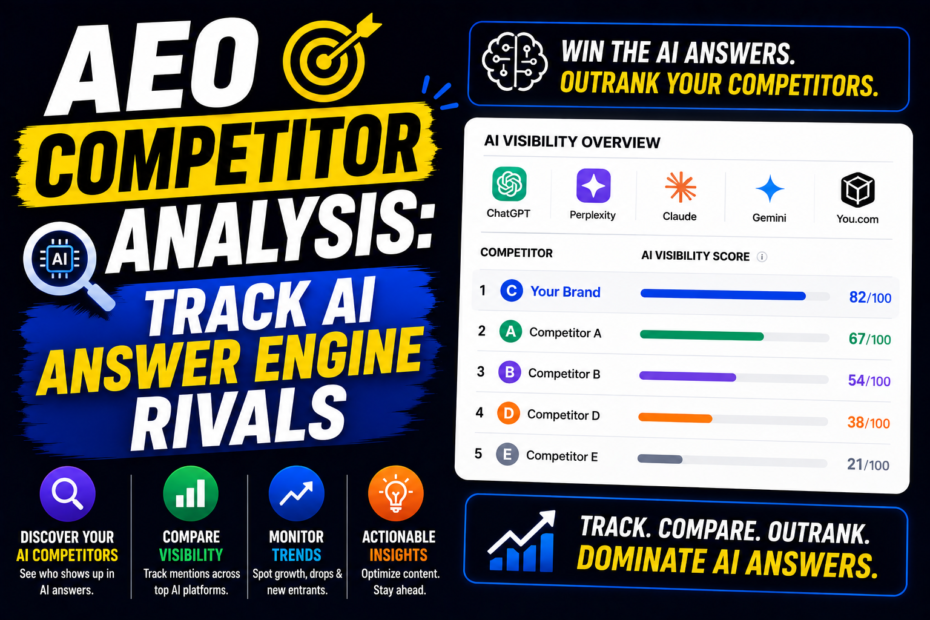
Looking to dominate AI-powered answer engines? AEO competitor analysis isn’t just about who ranks first—it’s about understanding how rivals shape user intent, content formats, and trust signals. In this guide, you’ll find practical steps, real-world tactics, and actionable insights to outperform rivals in AI answer ecosystems while keeping your blog and marketing optimized for search, social, and conversion.
Quick Summary
- Identify top AEO players and their unique answer formats
- Map user intent and tailor your content to capture featured snippets
- Use a repeatable 5-step process for ongoing competitor monitoring
- Leverage 7 practical experiments to improve rankings and CTR
- Choose the right tools to automate data and reporting
AEO Competitor Analysis: Track AI Answer Engine Rivals
In today’s search environments, AI answer engines don’t just rank pages—they curate and present answers directly. If you want to win click-throughs and build lasting authority, you must understand how competing AI experiences fetch, format, and surface content. This isn’t speculation; it’s a repeatable process that blends SEO basics with modern AI search signals, user intent mapping, and real-world content optimization.
What exactly is AEO—and why should you care?
AEO stands for AI Experience Optimization. It’s about tweaking your content so AI answer engines not only find it but also present it as a clear, trustworthy response. Think of it as the intersection of traditional SEO, structured data, and dynamic content that answers questions succinctly. For bloggers and marketers, AEO means focusing on the narrow, high-confidence moments where a user has a concrete question and is ready to take action.
Start with a clear snapshot of rivals
Begin by listing your direct and indirect competitors. Direct rivals are sites that often appear in the same types of AI-curated boxes; indirect rivals may be general publishers that still win attention through quality answers, even if not always in the same engine. Create a simple grid to track:
- Top AI answer sources and the formats they prefer (short answer boxes, paragraph-based snippets, numbered steps, or lists)
- Question clusters they dominate (e.g., “how to write meta descriptions,” “best tools for SEO in 2024”)
- Content formats they use (FAQ-style, how-to guides, case studies, tool comparisons)
- Strengths and gaps in their answer quality, citations, and trust signals
The anatomy of an AI answer box
AI answer boxes aren’t random. They pull from structured data, high-quality on-page content, clear intent signals, and often, user engagement metrics. The main components to watch are:
- Question framing: How do rivals phrase the query?
- Answer brevity and clarity: Do they provide a concise, actionable response?
- Evidence and trust: Do they cite sources, show expertise, and use author bios?
- Content format: Short paragraph, bullets, steps, or a numbered process?
- Link strategy: Do they drive users to deeper content or convert directly?
5-pronged competitive audit you can run monthly
Frame your audit around these five pillars. It’s simple, repeatable, and you can scale it as you grow:
- Question discovery: Find the 20–30 questions your audience is asking that trigger AI boxes.
- Format mapping: Note the formats competitors use (bullets, steps, FAQs, compact paragraphs).
- Outreach signals: Assess competitor authoritativeness via citations, author bios, and cross-links.
- Content gaps: Identify questions customers ask that current leaders don’t fully answer.
- Optimization actions: Create a prioritized to-do list with quick wins and long-term bets.
Real-world example: How to outrank with a better answer
Imagine you run a blog about digital marketing. You notice a competitor consistently dominates a snippet for “how to run a successful Facebook Ads A/B test.” You review their answer and see:
- A concise 5-step process
- Clear, numbered actions
- One high-quality source cited at the end
- A brief case study included to illustrate impact
Your move: craft a more authoritative version by adding:
- A 7-step process with practical tips
- Inline mini-case studies and real-world numbers
- Structured data markup for steps and FAQs
- Author bios with credentials and links to related analyses
Within a few weeks, you might see improved visibility, including a stronger chance of earning your own featured snippet because you’re not just matching format—you’re elevating depth and trust.
Step-by-step Guide to AEO Competitor Analysis
Follow this actionable blueprint to track, learn from, and outpace rivals in AI answer engines.
Step 1 — Define your target questions and topics
Start with your core topics, then branch into related sub-questions. Create a master list of 50–100 questions that your readers would search to get a quick answer. Use tools like Google People Also Ask, Answer the Public, or your site search data to identify common intents. Group them by intent clusters: informational, navigational, transactional, and educational. This helps you tailor content formats to the user’s needs.
Step 2 — Analyze rivals’ answer formats
Go beyond “they rank high.” Look at the exact format used in the AI box: short paragraph, numbered steps, bullet lists, or a combination. Note the presence or absence of:
- Clear, direct answer in the first sentence
- Step-by-step instructions
- Evidence like case studies or data
- Citations and author credentials
- Internal links to deeper content
Step 3 — Map trust signals and authority
Trust is a major factor for AI engines. Evaluate how competitors establish authority:
- Author bios with credentials
- References to reputable sources
- Documented case studies or experiments
- Consistency across related content areas
Step 4 — Audit on-page signals and structured data
Check where competitors use schema markup, FAQs, HowTo, and Article schemas. Verify:
- Proper use of FAQPage, HowTo, and WebPage schemas
- Schema-driven features like sitelinks search box or breadcrumb
- Internal linking depth and anchor text variety
Step 5 — Prioritize content updates and new formats
From your audit, pick 5–7 high-impact opportunities. These could include:
- Rewrite existing pages with clearer first sentences and structured steps
- Publish a new comprehensive guide that answers multiple related questions
- Incorporate video or visual assets to address the same questions
- Develop a mini FAQ section for the exact questions that trigger AI boxes
Common pitfalls to avoid in AEO analyses
Even with a solid plan, a few mistakes pop up often. Here are the ones to sidestep:
- Focusing only on rankings instead of intent and user value
- Copying formats without improving depth and credibility
- Ignoring mobile experience and voice-search readability
- Underutilizing structured data or FAQ formats
- Over-optimizing for snippets at the expense of full articles
Best Tools for AEO competitor tracking (and why they matter)
Tools help you automate the discovery process, collect data, and accelerate decision-making. Here are the must-haves for an efficient AEO workflow:
- Rank tracking and SERP insight tools to monitor snippet appearances
- Competitive analysis platforms that reveal formatting trends and content gaps
- On-page SEO crawlers to audit internal linking, schema usage, and content depth
- Content analytics for engagement, dwell time, and conversion signals
- Voice-search and mobile-first testing to ensure readability and quick answers
Real-world tool combos work best. For example, pair a SERP tracker with a structured data tester and a content editor that can enforce schema markup and readability guidelines. Automate weekly checks so you never miss a new competitor tactic.
How to craft content that earns AI answers (practical tactics)
These tactics are designed to help you capture AI-driven visibility and improve user outcomes, not just chase rankings.
1) Answer questions in the first 1–2 sentences
Lead with a direct answer. Then add context, the “why,” and practical steps. This structure helps AI engines surface precise, actionable information fast.
2) Use step-by-step formats for process-based topics
People love procedural clarity. A numbered sequence (e.g., 7 steps) is highly scannable and AI-friendly. Include a brief description under each step with concrete actions.
3) Add micro-cases and data points
Short-case examples or data-backed statements increase perceived credibility. Where possible, quote metrics, outcomes, or benchmarks.
4) Leverage structured data and FAQs
Schema is your friend. Use FAQPage, HowTo, and Article schemas. An FAQ section that answers five to eight common questions can expand your chances of being chosen for an AI snippet.
5) Build authoritative signals
Invest in author bios that reflect real-world credentials. Include links to related analyses, case studies, or research to reinforce authority.
6) Optimize for voice search and natural language
Voice queries tend to be longer and question-based. Create content that mirrors natural language, with concise answers suitable for spoken delivery.
Pro tips for sustainable AEO success
- Focus on topic clusters. Don’t chase one-off snippets; build a web of interlinked, high-quality content.
- Test formats with a content grid. swap in FAQs, listicles, and HowTo guides and measure impact.
- Keep content up-to-date. AI engines trust freshness and current data, especially for tool recommendations and benchmarks.
- Balance length and utility. Short, precise answers win in some snippets, but longer, well-structured content wins in others.
- Monitor intent shifts. As algorithms evolve, audiences change; adapt your content to evolving needs.
Step-by-step plan you can implement this week
Here’s a concrete, no-fluff plan you can execute in seven days to start outranking and winning AI answers.
- Identify 20 critical questions in your niche that trigger AI boxes
- Audit top 5 competitors for each question’s answer format
- Publish 3 new content pieces with strong, direct answers and step-by-step formats
- Implement FAQPage and HowTo schema on new and updated pages
- Enhance author bios and include 2–3 credible cross-links per piece
- Launch a micro-infusion of case studies or data points into those pages
- Track rankings, snippets, and traffic changes for the next 4 weeks
Common mistakes that kill AEO momentum
A few missteps can slow you down or even hurt performance. Watch out for:
- Overpromising in the first sentence without delivering depth later
- Forgetting to include multiple formats (not just paragraphs)
- Neglecting page experience signals like CLS, LCP, and FID
- Underutilizing internal linking to guide readers deeper
- Relying on a single competitor’s tactic without testing in your own context
Best Tools for AEO: quick-start recommendations
These tools help you implement, monitor, and optimize for AI answer engines. Pick a core trio that fits your stack and budget:
- SERP and snippet tracking tool to identify when competitors surface in AI boxes
- Structured data tester and schema generator to validate FAQPage and HowTo schemas
- Content editor or CMS plugin that enforces readability, schema, and internal linking
For affiliates, these tools can also uncover opportunities to promote related services and software that align with your niche. Always test tools with a 14–21 day trial period to confirm results before committing long-term.
FAQ
What is AEO, and how is it different from SEO?
AEO, or AI Experience Optimization, focuses on how AI-powered answer engines surface content. It goes beyond traditional SEO by prioritizing how content is formatted, cited, and structured for AI systems to extract and present directly in answer boxes.
How long does it take to see AEO results?
Typically, you’ll start noticing improvements in 4–8 weeks, but some signals can appear sooner if you win a high-quality, well-structured snippet. Sustainable growth comes from ongoing optimization and fresh content.
Do I need to publish new content daily to succeed in AEO?
Nope. Consistency matters more than frequency. A steady cadence of high-quality content, updated formats, and structured data typically beats bursts of low-quality posts.
Should I focus on long-form content for AEO?
Long-form content works well when it’s focused, well-structured, and backed by data. Pair it with concise answer boxes and FAQs to maximize AI visibility while providing real value to readers.
How do I measure AEO success?
Track snippet appearances, visibility in AI answer boxes, organic CTR, time on page, and conversions from pages that win AI snippets. Use a dashboard that ties rankings, traffic, and engagement to specific AI results.
Internal links
To deepen your SEO and blogging knowledge, explore related strategies:
- Advanced on-page SEO for AI-driven search — learn how structured data and formatting impact AI surfaces
- Content clustering for better search authority — build topic hubs that reinforce expertise
- Keep improving your internal links and anchor text patterns to help search engines understand content relationships
Voice-friendly snippet: one-paragraph answer
AI answer engines surface concise, direct answers in response to specific questions. To win, your content should begin with a clear, actionable answer, followed by organized steps, evidence, and trusted sources. Use structured data to highlight this format, and ensure your content covers the core question in a single, easily digestible block.
Featured Snippet Paragraph (40–60 words)
To win AI answer boxes, craft a precise, one-sentence answer followed by a structured set of steps and credible sources. Keep it clear, cite data where possible, and format with schema markup so robots can easily extract the answer. Consistent structure helps AI engines deliver your content quickly.
List Snippet: 7 quick steps to outrank in AEO
- Identify top questions triggering AI boxes
- Audit rivals’ answer formats and formats used
- Publish clear, actionable answers with steps
- Implement FAQPage and HowTo schema
- Enhance author credibility with bios and citations
- Use internal links to related content
- Monitor AI snippets and iterate weekly
Step-by-step Guide: Summary for quick reference
Here’s a compact, repeatable process you can implement right away:
- Step 1: Discover 20–30 high-impact questions
- Step 2: Analyze 5 competitors for each question
- Step 3: Create 2–3 new content pieces with strong answer formats
- Step 4: Add structured data and FAQs
- Step 5: Strengthen authority with author bios and relevant citations
Proven formats that work in AEO
While there’s no one-size-fits-all, these formats consistently win AI answers across niches:
- Short, direct answer + 5–7 steps
- Bulleted or numbered lists with clear outcomes
- Mini case studies or data-backed points
- Interactive components like calculators or checklists (if feasible)
- FAQs with 5–8 common questions
Best practices for internal linking in AEO content
Internal linking supports authority distribution and helps AI engines understand content structure. Use descriptive anchor text, link to related guides, and avoid over-optimizing anchor density. A healthy pattern might include a main pillar page with 2–3 related subpages linked from each article, plus a few contextual links within the body that point to deeper resources.
Common questions about AEO you might still have
Here are extra clarifications that readers often ask after skimming through an AEO strategy:
- How often should I update AEO content?
- What kinds of data signals boost AI trust in answers?
- Can social signals influence AI answer engines?
Final take: building a durable AEO strategy
Competitor analysis in AI environments isn’t a one-off audit. It’s a living playbook. You track how rivals present information, test your own formats, and continuously improve your content with a data-driven approach. By prioritizing clear, reliable answers and strong authority signals, you can capture meaningful AI visibility, higher CTR, and more loyal readers who come back for trusted guidance.