
Quick Summary
- What AEO prompt tracking is and why it matters for marketing teams
- How to set up a practical AEO prompt tracking workflow
- Key metrics to monitor for better SEO, content quality, and social impact
- Real-world step-by-step guide to implement, measure, and optimize
- Tools, pitfalls, and optimization tips to boost ranking and engagement
AEO Prompt Tracking for Marketing Teams: What It Is and Why It Matters
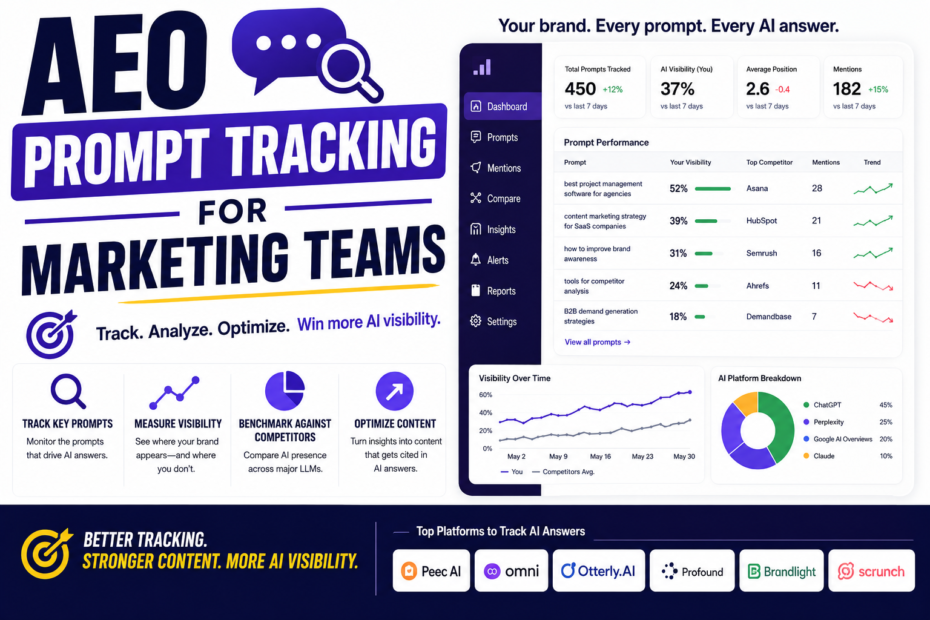
If you’re steering content, SEO, and social media at scale, you’ve probably heard of AEO prompt tracking in some form. In plain terms, it’s the practice of logging, testing, and optimizing the prompts that guide AI-assisted content creation and optimization. The goal? Ensure outputs align with brand voice, SEO objectives, and measurable business outcomes. For marketing teams, this means fewer guesswork moments, faster iteration, and clearer visibility into what actually moves rankings and engagement.
Think of AEO prompts as the map you give to your AI writing partner. When the prompts are precise, you get consistent, high-quality content that’s easy to optimize for search engines, skimmable for readers, and friendly for voice search. When prompts are vague, results drift, SEO signals get noisy, and you end up rewriting more than you ship. AEO prompt tracking keeps that map refined, shared, and actionable across the whole team.
Why AEO Prompt Tracking Should Be Part of Your SEO & Content Playbook
For marketing teams, a structured prompt-tracking system reduces friction between strategy and execution. It helps you:
- Maintain content consistency across channels (blogs, landing pages, social),
- Scale content production without losing quality or SEO focus,
- Document what works so future prompts can be improved faster,
- Bridge the gap between writers, editors, and SEO specialists with a shared reference
- Provide audit trails for content decisions during product launches or campaigns
Step-by-step Guide to Set Up AEO Prompt Tracking
Here’s a practical blueprint you can start applying today. It’s designed to be simple enough to implement in a week, but robust enough to scale as your needs grow.
1) Define clear goals and prompts scope
Begin with the end in mind. Decide the content types you’ll cover (blog posts, landing pages, social posts, email copy) and the SEO goals (rank target, search volume, intent coverage, conversion). Create a prompt library that includes:
- Goal statement for each content type
- Voice and tone guidelines
- Target keywords and LSI themes
- Content structure templates (H2s, sections, CTAs)
2) Create a prompt template kit
Standardize prompts to reduce drift. A strong template includes:
- Context: audience, purpose, and product
- Constraints: word count, tone, brand guidelines
- SEO signals: primary keyword, secondary terms, meta hints
- Output format: headings, bullet lists, callouts
3) Build a tracking cockpit
Set up a single source of truth where prompts and results live. This could be a content ops board, a Notion page, or a lightweight database. Include:
- Prompt version number
- Date of creation and last update
- Content type, topic, and target URL
- Quality signals: readability score, SEO score, internal linking strength
- Performance signals: traffic, rankings, conversions
4) Implement testing and feedback loops
Treat prompts like experiments. Use A/B tests where feasible, or multivariate checks within a single piece. Collect:
- Before-after metrics (rank, clicks, dwell time)
- Quality signals (grammar, coherence, engagement)
- Editorial feedback (clarity, accuracy, usefulness)
5) Align with editorial workflow
Integrate prompt tracking into editorial calendars. Assign owners for prompts, establish review stages, and lock in approvals before publishing. Keep a changelog so you can trace decisions that influenced results.
6) Measure, learn, and iterate
Dive into the numbers weekly. Compare current prompts against baseline. Look for signals like higher organic CTR, better dwell time, or fewer corrections after publication. Use these insights to refine prompts and update the library.
Key Metrics to Track in AEO Prompt Tracking
Measuring the right things is where the magic happens. Here are metrics that truly matter for SEO, content quality, and social impact.
- Ranking velocity: how quickly pages climb in SERPs for target keywords
- Click-through rate (CTR) from search results
- Time on page and scroll depth as engagement indicators
- Content quality signals: readability, grammar, factual accuracy
- Internal link density and topical authority
- Social signals: shares, comments, saves (where trackable)
- Prompt variance: how many effectively distinct prompts produced a given result
- Prompt-to-output consistency: variance in tone, structure, and quality
- Cost of production per piece (time, editor hours, tooling)
How to Use AEO Prompt Tracking for SEO, Content, and Social Media
You can deploy AEO prompt tracking across three core areas: SEO-driven content, brand storytelling on social, and landing pages for campaigns. Let’s break down practical approaches for each.
SEO-driven content: building a scalable pipeline
When SEO is your backbone, prompts should enforce keyword coverage and content depth. Practical steps:
- Define intent clusters: informational, navigational, transactional. Tailor prompts to each cluster
- Mandate heading structures that mirror user questions
- Incorporate schema and meta hints in prompts where appropriate
- Require internal links to cornerstone pages and related topics
- Track performance deviations after updating prompts and refine
Social media and brand storytelling
Prompts for social content should be punchy, scannable, and on-brand. Best practices include:
- Short-form prompts with a clear hook within the first sentence
- Callouts for social proof, benefits, and value propositions
- Adapt prompts to platform nuances (short-form on X, visual prompts for Instagram)
- Track engagement and tie back to blog or landing pages
Campaign landing pages and paid content
Prompts here must drive conversions while keeping SEO intact. Focus areas:
- Value propositions above the fold and keyword-rich headers
- Clear benefits, social proof, and strong CTAs
- A/B variants of headlines and meta descriptions
- Consistent updating plan for seasonal campaigns
Pro Tips for Sharper AEO Prompt Tracking
- Keep prompts human-centric: aim for clarity, not just keyword stuffing
- Version every prompt; small changes can produce big results
- Use a multi-user review process to catch biases and gaps
- Maintain a “lessons learned” section after each campaign
- Leverage templates for different content types to reduce time-to-publish
- Document edge cases: prompts that produced unexpected but valuable outputs
- Incorporate accessibility checks into the prompt constraints
Common Mistakes in AEO Prompt Tracking (and How to Avoid Them)
- Failing to define success criteria before starting prompts — set a KPI baseline
- Overloading prompts with too many instructions — keep it concise and specific
- Ignoring editorial alignment — prompts must align with brand voice and policy
- Not tracking outputs over time — establish monthly review rituals
- Forgetting to test SEO signals in prompts — always include keyword intents and meta hints
Best Tools for AEO Prompt Tracking
Choosing the right tools helps you scale without sacrificing quality. Here are popular options, with a quick sense of what they’re best at.
- Content ops platforms (Notion, Airtable) for prompt libraries and versioning
- SEO tooling (Ahrefs, Semrush, Surfer SEO) to benchmark keyword coverage and on-page signals
- Editorial workflow (Asana, Trello, Monday) for task management and approvals
- AI-assisted writing tools (ChatGPT, Claude, Jasper) with prompt templates
- Analytics dashboards (Google Analytics, Search Console, data viz tools) to monitor impact
If you’re looking to level up on the tool side, you might explore a setup that blends a seeded prompt library with an analytics layer. Quick take: define prompts, run outputs, measure impact, refine prompts, repeat. Simple in concept, powerful in practice.
Step-by-step Case Study: A Real-World Example
Company X, a mid-sized software provider, wanted to scale blog output while lifting organic rankings for product-related queries. They implemented AEO prompt tracking in four weeks and saw measurable gains:
- 30% increase in organic traffic to product pages within 60 days
- 25% higher average position for targeted product keywords
- 50% faster content-creation cycle due to template-driven prompts
How did they do it? They started with a tight prompt library aligned to buyer intent, built a review cadence with editors, and integrated monthly performance reviews. They also added a quick “question-to-answer” prompt pattern to capture FAQs that often drive voice-search and featured snippets.
Featured Snippet Paragraph (Answer to a Common Question)
AEO prompt tracking is the disciplined process of logging, testing, and refining the prompts that guide AI content creation to meet SEO, engagement, and conversion goals. By standardizing prompts, measuring outputs, and iterating based on results, teams can consistently deliver high-quality content that ranks well and resonates with readers.
Question-Based Snippets and Voice-Search Optimization
Q: How can I implement AEO prompt tracking quickly?
A: Start with 3 content templates, build a small prompt library, and set a simple KPI like target keyword rankings and monthly output. Track results in one sheet and review weekly to adjust prompts.
FAQ
1. What is AEO prompt tracking in simple terms?
It’s the practice of recording the prompts used to generate content, measuring the results, and adjusting the prompts to improve SEO, engagement, and conversions.
2. How often should prompts be updated?
Update prompts whenever you notice a dip in performance, after major algorithm changes, or after a campaign launch. A monthly review is a solid baseline, with quarterly deep-dives for major topics.
3. What metrics matter most for AEO prompt tracking?
Ranking velocity, organic traffic, CTR, time on page, internal linking quality, and the efficiency of production. Also track prompt-level variations to avoid drift.
4. Can AEO prompt tracking help with voice search?
Yes. By designing prompts that answer direct questions, include concise summaries, and use natural language, you increase the chances of earning featured snippets and voice results.
5. How do I start if I’m overwhelmed by tools?
Pick 1-2 core tools for the library (like Notion or Airtable) and 1 SEO tool for keywords (like Semrush or Ahrefs). Create a simple prompt template, and run a one-month pilot to learn what works before expanding.
Internal Linking: Strengthen Your SEO Ecosystem
Smart internal linking boosts topical authority and helps search engines understand your site structure. Here are two natural spots to weave internal links into this post:
Learn more about effective content optimization strategies to power up your blog’s rankings.
For a deeper dive into building a scalable SEO workflow with prompts, check out our guide to scalable content systems.
Best Practices for Maintaining a Healthy AEO Prompt Library
- Document every prompt with a purpose statement and success criteria
- Maintain a changelog and version numbers for all prompt updates
- Keep prompts readable and free from overly technical language that might bias outputs
- Periodically audit outputs for factual accuracy and brand alignment
- Coordinate with SEO, content, and social teams to ensure alignment across channels
Want to Dive Deeper? Quick Actions to Implement Today
- Audit your current content library for prompt consistency and SEO coverage
- Draft 3 prompt templates for a high-priority topic cluster
- Set up a simple tracking sheet with columns for prompt version, output quality, and performance metrics
- Schedule a 60-minute weekly review with SEO and content leads to discuss findings
Conclusion-ish: AEO Prompt Tracking as a Team Sport
While the term AEO prompt tracking might sound technical, the practice is human at its core. It’s about clear goals, repeatable processes, and regular learning so your team can publish content that ranks, resonates, and converts. With the right prompts, a tight library, and a disciplined review rhythm, you’ll turn AI-assisted writing into a reliable engine for growth.
Best Tools (Affiliate-Friendly Quick Picks)
These tools are popular in marketing teams and integrate well with content workflows. They’re listed to help you pick without drowning in options.
- Notion or Airtable for prompt libraries and version control
- Semrush or Ahrefs for keyword tracking and competitive insights
- Surfer SEO for on-page optimization checks tied to prompts
- Asana or Trello for editorial workflows and approvals
- Google Analytics and Search Console for performance feedback
Internal Link Spotlight
To stay aligned with broader SEO topics, read more about how to create scalable content systems and the role of editorial processes in SEO.