
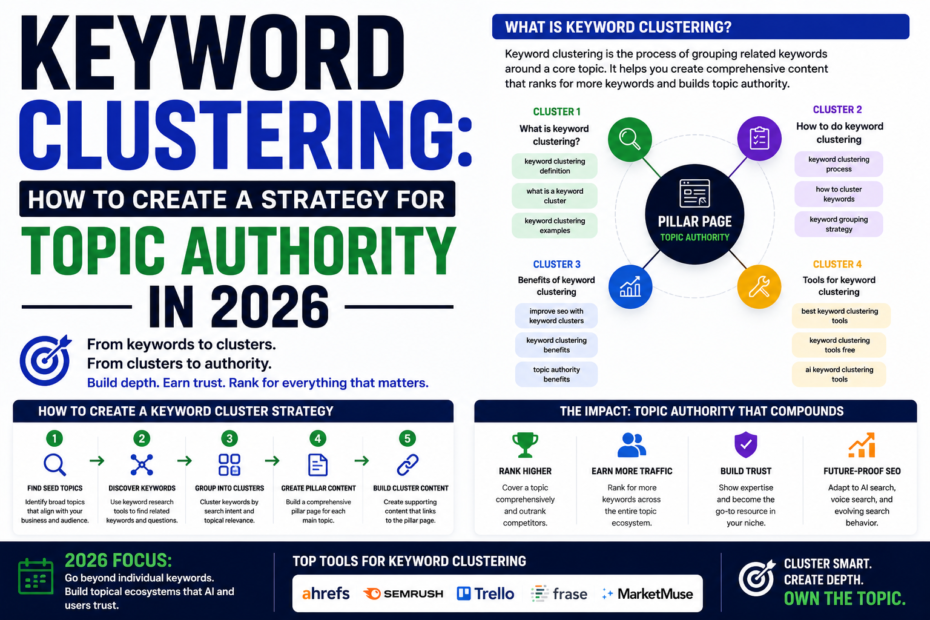
Keyword clustering is how you build topic authority by grouping related search terms into meaningful sets, then creating content that answers intent across those clusters. In 2026, a smart clustering strategy pairs semantic relevance with user intent signals, helping your site rank higher for broader topics while preserving depth. If you want to dominate topic authority without chasing every single keyword, this guide is for you.
- Understand search intent for your audience and map it to clusters that cover a topic comprehensively
- Create a scalable process to discover, group, and prioritize keywords
- Plan content that links within clusters to signal topical authority to Google
- Use data to test, refine, and expand your topic authority over time
- Leverage tools and workflows that fit your team size and speed
Featured snippet style takeaway: Keyword clustering is the process of grouping related terms into themes so you can create interconnected content that answers user intent across a topic. By building clusters around core topics, you signal authority, improve internal linking, and capture more search real estate over time.
Why keyword clustering matters in 2026
Search engines have moved beyond single keywords toward understanding topics, concepts, and intent. Clustering helps you signal comprehensive coverage of a subject, which is what Google values for topic authority. If you want to rank for “content marketing strategies” you don’t just write one article. You build a cluster: foundational pillar content, then narrower posts that answer sub-questions, case studies, tutorials, and tools. When done well, readers stay longer, pages per session rise, and your site gains trust signals that boost rankings across the cluster.
Think of keyword clustering as building a library around a topic rather than chasing isolated search terms. The benefits are real:
- Better internal linking and crawl efficiency
- More precise content briefs and faster production cycles
- Improved relevance for voice search and featured snippets
- Higher opportunities for long-tail conversions via guided content journeys
Step-by-step Guide
Step 1 — Start with a core topic and user intent map
Pick a broad topic your audience cares about. For example, if you run a marketing blog, your pillar topic could be “Digital Marketing Strategy.” Map common user intents within that topic: educational (how to start), navigational (tools and platforms), transactional (consulting services), and informational (case studies and benchmarks). This intent map becomes your clustering framework.
Step 2 — Discover keyword families that fit the topic
Rather than chasing a long list of keywords, look for keyword families that share intent and semantics. Use search term research tools to gather terms related to “digital marketing strategy,” then group them by subtopics such as audience research, channel mix, budgeting, measurement, and experimentation. Don’t forget semantic synonyms and related questions people actually ask in forums and Q&As.
Step 3 — Create your cluster structure (pillar + satellites)
Build a pillar page that provides a comprehensive overview of the core topic, with sections that link out to satellite posts. Each satellite post targets a subtopic or a specific user question. The internal link structure should guide readers through the topic in a logical flow and signal to Google that your site holds subject authority.
Step 4 — Align content with intent and optimize on-page signals
For each satellite piece, align the content with the user intent you identified. Use clear headings, answer the question early, and cite data or case studies when possible. Optimize for on-page signals: title tags, meta descriptions, headers, image alt text, and structured data where relevant. Maintain a consistent voice and format across the cluster to improve user experience.
Step 5 — Build internal links and anchor strategies
Anchor text should be descriptive and help users navigate logically. Link from the pillar to satellites and between satellites where relevant. Use contextual links that demonstrate how subtopics connect to the bigger topic. A strong internal linking structure can dramatically boost crawlability and topical authority signals.
Step 6 — Prioritize content quality and refresh cadence
Quality matters more than quantity. Create comprehensive, well-researched, and frequently updated content. Set a cadence for refreshing pillar content and updated satellites so your cluster stays relevant as industry standards shift and new subtopics emerge.
Step 7 — Measure impact and optimize iteratively
Track rankings, traffic, dwell time, and engagement by cluster. Look for opportunities to expand into related subtopics or to consolidate underperforming posts. Use findings to refine your cluster strategy and content calendar.
Real-world example: Building a “Content Marketing Strategy” cluster
Imagine you run a marketing blog. You decide to build a cluster around “Content Marketing Strategy.” Your pillar page covers the framework: goals, audience personas, messaging, content formats, distribution, and measurement. Satellite posts might include:
- Persona-driven content planning: how to map content to audience segments
- Channel mix for content distribution: owned, earned, and paid strategies
- Content formats that work in 2026: video, short-form, interactive tools
- Content calendar templates and workflow for teams
- Case studies: successful campaigns with metrics
- Measurement and attribution models
Each satellite post links back to the pillar and to each other where relevant. If a new trend arises—say, AI-assisted content creation—you create a satellite post or a new mini-cluster that links into the pillar. This keeps you ahead without rewriting every piece.
Pro Tips
- Design your cluster with user journeys in mind. Map how a reader might move from a high-level article to deeper subtopics and eventually to a conversion action.
- Use schema markup where it fits. FAQ sections, How-To blocks, and product/service schemas can help with rich results and voice search.
- Combine data-driven insights with human storytelling. Numbers attract attention, but clear narratives keep readers engaged.
- Keep content evergreen when possible. Update data points, not just the words, to maintain long-term relevance.
- Audit competitors’ clusters to identify gaps you can own. Look for questions they miss or angles they underperform on.
Common Mistakes
- Over-fragmenting topics into too many tiny posts that don’t clearly connect.
- Killing the cluster with weak or duplicate content that confuses readers and search engines.
- Ignoring internal linking opportunities that would reinforce topic authority.
- Creating satellites without clear intent alignment to the pillar.
- Neglecting regular updates and performance reviews of the cluster as trends shift.
Best Tools (and why they matter for affiliates)
Choosing the right tools makes keyword clustering scalable. Here are a few categories and quick picks you’ll likely see as valuable in 2026:
- Keyword discovery and clustering tools: Ahrefs, Semrush, or SEO Tools like LongTailPro for initial keyword families and competitiveness. Look for features that auto-cluster by topic and show topic overlap signals.
- Content planning and collaboration: Airtable or Notion for shared content calendars, briefs, and task assignments. A clean workflow saves weeks of back-and-forth.
- Internal linking planning: Screaming Frog or Ahrefs’ Site Audit to map existing links and identify gaps for future cluster interconnections.
- Analytics and experimentation: Google Analytics 4 for user journeys, plus experimentation with content variants to refine messaging and format preferences.
- Voice search and schema testing: Answer the Public for questions, plus schema markup validators to ensure proper implementation.
For affiliates, pick tools that offer transparent pricing, clear data exports, and robust support. You’ll rely on these for ongoing optimization and reporting to clients or internal stakeholders.
Step-by-step Checklist (snappy version)
- Define the pillar topic and audience intent
- Research keyword families and semantic relationships
- Structure pillar + satellite posts with clear links
- Align satellites with user intent and optimize on-page signals
- Build a solid internal linking plan
- Publish with a quality-first mindset and a consistent voice
- Track performance, iterate, and expand the cluster
FAQ
What is keyword clustering and why does it work?
Keyword clustering groups related search terms into themes so you can create comprehensive content that satisfies varied user intents around a topic. This approach signals topical authority to search engines and helps your pages rank for multiple related queries.
How many posts should a cluster have?
There’s no perfect number. Start with a solid pillar piece plus 4–12 satellites that cover core subtopics. You can expand over time as you uncover new questions or angles.
How do I measure the success of a cluster?
Key metrics include organic traffic to cluster pages, time on page, bounce rate for relevant posts, internal link depth, average position for target terms, and converson or engagement metrics tied to your business goals.
Should I refresh pillar content more often than satellites?
Yes. Pillars should be refreshed to maintain broad topical authority, while satellites can be updated on a schedule or as new data and trends emerge.
Can I use content audits to guide clustering?
Absolutely. Content audits reveal gaps, overlap, and opportunities. They’re perfect for identifying which satellites should be created or merged to strengthen the cluster.
Voice search optimization and question-based headings
People speak differently than they type. Use natural, question-based headings to capture voice queries and featured snippets. For instance, you might frame a satellite post as: “What is a Content Marketing Strategy and how do you build one?” This mirrors how people ask in voice searches and helps you appear in short-answer results.
How to scale your topic authority over time
Scaling is about repeatable processes and disciplined execution. Start with a well-defined cluster architecture, then automate as much as possible without sacrificing quality. Train your team on the clustering framework so new writers can contribute quickly while maintaining consistency. Reserve time for quarterly cluster audits to prune underperforming content and discover new subtopics driven by audience questions and market shifts.
Internal linking examples
Within your cluster, internal links should feel natural and helpful. Examples:
- From pillar: Comprehensive guide to digital marketing strategy — links to satellites like Content formats that win in 2026 and Measuring content marketing success.
- From satellite to pillar: a sentence close to the end of a satellite post links back to the pillar, reinforcing the big picture.
- Between satellites: link related satellites to show topic connections, e.g., a satellite on “audience research” links to “persona-driven content planning.”
Best Practices for 2026 and beyond
As search evolves, your clustering strategy should adapt. Embrace semantic SEO, focus on intent, and keep content experiences human. Here are a few practical habits:
- Prioritize user-centric content briefs that answer real questions and provide practical steps.
- Use data to drive topic discovery—what questions are people asking? What gaps do competitors leave?
- Maintain a healthy content rhythm—don’t let clusters stagnate. Refresh, expand, and prune as needed.
- Invest in visual content and interactive elements within satellites to boost engagement and shareability.
- Think beyond pages: consider topic hubs, resource pages, and tools that reinforce authority.
Quick Summary
- Start with a strong pillar and clear user intents
- Group related keywords into meaningful families
- Publish satellites that answer subtopics and questions
- Link thoughtfully to build a strong internal network
- Measure, learn, and iterate to maintain topical authority
What to do next
If you’re ready to start a keyword clustering project, begin by selecting a core topic that aligns with your audience’s needs. Draft an intent map, run a quick keyword family analysis, and sketch a pillar page outline with 4–6 satellites. Then, set up your internal linking plan and a content calendar for the next 90 days. You’ll be surprised how quickly you can build authority when your content speaks clearly to user intent and your site links everything together thoughtfully.
Best Tools (revisited for quick decisions)
Again, a quick list to keep handy:
- Keyword discovery and clustering: Ahrefs, Semrush
- Content planning & briefs: Notion, Airtable
- Internal linking and site audits: Screaming Frog, Ahrefs
- Analytics & testing: Google Analytics 4, Google Search Console
- Voice search and schema: Answer the Public, Schema Markup validators
Featured snippet paragraph (for quick capture)
Keyword clustering groups related search terms into topical themes so you can create interconnected content that covers a subject comprehensively. This approach signals authority to search engines, boosts internal linking, and helps you capture more search real estate across a topic over time.
List snippet (fast steps)
- Define pillar topic and user intents
- Identify keyword families and semantic relations
- Build pillar + satellite structure with clean internal links
- Optimize satellites for intent and standard on-page signals
- Measure, refine, and expand the cluster
Internal links included for ongoing SEO strategy:
Explore related guidance on the ultimate guide to keyword clustering for SEO and deepen your plan with a practical content strategy framework for 2026.