
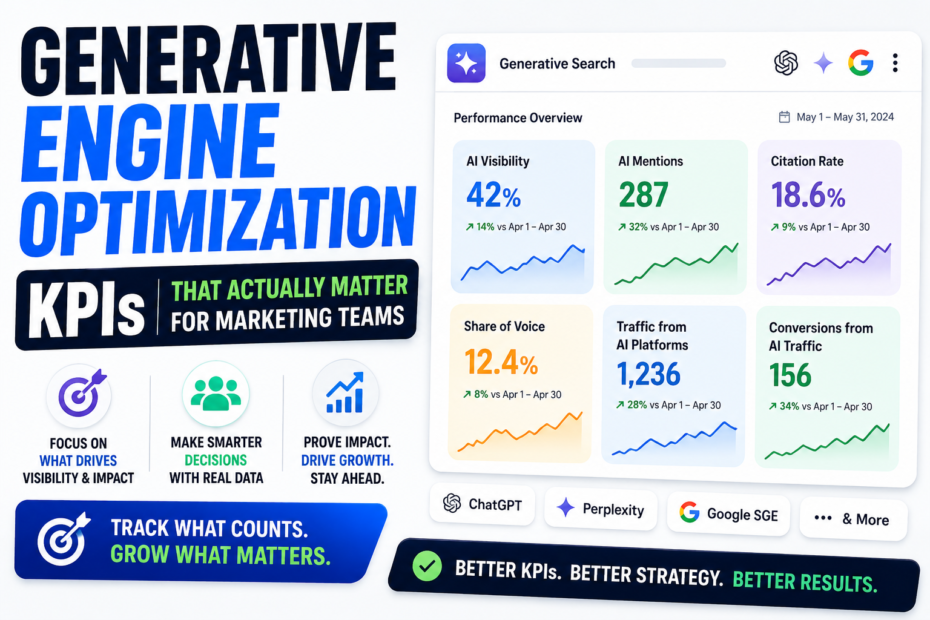
Generative engine optimization KPIs that actually matter for marketing teams start with clarity: you don’t measure noise, you measure impact. If you’re investing in AI-assisted content, prompts, and automation, you need metrics that reflect real business outcomes, not vanity signals. This guide breaks down the KPIs that move the needle, shows you how to track them in practical terms, and gives you a repeatable approach you can implement this quarter.
Quick Summary
- Focus on outcome KPIs: traffic quality, conversions, revenue, and customer value, not just pageviews.
- Track AI-specific signals: prompt success rate, content relevance scores, and generation efficiency.
- Link content goals to funnel stages: awareness, consideration, and decision with measurable milestones.
- Use real-world benchmarks and be ready to iterate: data-driven experiments, fast wins, and long-term bets.
- Prioritize governance: explainable AI prompts, audit trails, and ethical considerations for content.
What are Generative Engine Optimization KPIs?
Generative engine optimization (GEO) KPIs are the metrics you use to evaluate how AI-assisted content creation, optimization, and distribution influence search visibility, user engagement, and business outcomes. Think of GEO KPIs as a bridge between what the AI does well (speed, consistency, variation) and what your marketing teams care about (leads, signups, revenue). You’re not just chasing more content; you’re chasing smarter content that resonates with people and ranks well in search engines.
Core GEO KPIs for Marketing Teams
1) Traffic Quality and Relevance Signals
Not all traffic is created equal. With generative content, you want readers who engage, convert, and return. Track:
- Engaged sessions per user: how many meaningful interactions post-click (scroll depth, time on page, repeats).
- Topical relevance score: a composite metric using content alignment to target intents, keyword coverage, and user satisfaction signals.
- SEO click-through rate (CTR) by page: improvement after optimizing titles, meta descriptions, and snippets.
- Organic session quality: bounce rate, exit rate, and dwell time on pages produced or enhanced by AI.
Real-world tip: run a test where you rewrite a low-performing post with AI to improve relevance and measure changes in dwell time and conversions over the next 4–6 weeks. If quality improves, scale similar updates across related content.
2) Prompt Effectiveness and Generation Efficiency
Your AI toolset should deliver consistent outputs with minimal human revision. Measure:
- Prompt success rate: percentage of prompts that produce content meeting predefined quality criteria on first pass.
- Turnaround time per piece: how long from prompt to publish, including review rounds.
- Average revisions per piece: how many cycles are needed to reach publish-ready quality.
- Content consistency index: alignment across pieces in tone, voice, and branding.
Practical tip: create a “golden prompt” library for common content types (blog intros, meta descriptions, FAQ sections) and track improvements as you refine prompts.
3) Search Visibility and Ranking Momentum
GEO should boost your organic presence. Track:
- Rank changes for target keywords: track 10–20 core terms monthly, with an emphasis on intent-driven long-tail keywords.
- Impression share for AI-optimized pages: how often your pages appear in search results within the target queries.
- New content indexation rate: time from publish to indexed by search engines.
- Snippet performance: number of rich results/featured snippets earned by AI-driven content.
Real-world insight: combine AI-generated content with structured data and schema to improve chances of rich results, which often boosts CTR and rankings faster than text alone.
4) Conversion and Revenue Metrics
Ultimately GEO should lift conversions. Focus on:
- Lead velocity: rate of new qualified leads generated by AI-created content campaigns.
- Cost per lead (CPL) and cost per acquisition (CPA) for AI-assisted assets.
- On-page conversions: form fills, newsletter signups, downloads, product trials tied to AI content.
- Average order value (AOV) influenced by content-driven pages or guides.
Tip: tie a content asset to a specific funnel stage and measure its influence on the downstream revenue path with UTM tagging and attribution windows that reflect your sales cycle.
5) Engagement and Experience Signals
Engagement matters as much as rankings. Watch:
- Scroll depth and attention metrics for AI-generated pages.
- Social shares and back-links acquired by AI content.
- Comment and user-generated content volume and sentiment on AI-driven assets.
Human touch still matters. Encourage comments, questions, and user feedback to fuels signals that engines love and users appreciate.
Step-by-step Guide: How to Set Up GEO KPIs
Here’s a practical, repeatable process you can apply starting today. It’s designed to be simple enough for beginners, but robust enough for teams that ship regularly.
Step 1: Define business outcomes and mapping to content goals
Start with a clear line from business goals to content outcomes. For example:
- Goal: Increase qualified leads by 20% in 6 months.
- Content outcome: AI-generated long-form guides that capture intent, plus optimized landing pages.
- KPIs: lead velocity, CPL, and conversion rate on AI-optimized pages.
Tip: write down 3–5 target outcomes per quarter and map each to one or two GEO KPIs.
Step 2: Create a measurement blueprint
Decide your data sources, definitions, and dashboards. Include:
- Core metrics: traffic quality, prompt effectiveness, rankings, conversions.
- Attribution windows: ensure you account for long sales cycles with appropriate windows (e.g., 30–90 days).
- Quality thresholds: define what counts as “success” for AI-generated content (e.g., readability score, factual accuracy checks).
Good practice: maintain a living document that describes what each metric means, where the data comes from, and how often you review it.
Step 3: Build a governance and review cadence
Set up a monthly GEO review with stakeholders from SEO, content, and growth. Include:
- Wins: which AI-driven assets performed best and why.
- Risks: content quality issues, alignment gaps, or over-optimization.
- Actions: optimizations, new prompts, and experiments for the next sprint.
Include guardrails: random spot checks for factual accuracy, style consistency, and compliance requirements.
Step 4: Run iterative experiments
Adopt the test-and-learn mindset. Examples:
- Prompts: A/B test 2–3 prompt variants for the same content type and compare quality and speed.
- Structures: test different article formats (listicles vs. how-tos) for the same topic.
- Distribution: try AI-optimized meta descriptions vs. human-written ones and compare CTR.
Document outcomes and scale what works. If a variant improves a KPI by at least 10–15% consistently, consider broader deployment.
Step 5: Integrate with the content calendar and distribution plan
Incorporate GEO into your planning cycles. Schedule AI-generated assets to align with seasonal topics, product launches, and evergreen themes. Pair content with distribution channels (email, social, partnerships) to maximize impact.
Pro Tips for Practical GEO Success
- Be explicit about intent in prompts. The more context you provide, the better the output. Include audience, purpose, tone, and required sections.
- Use data-backed prompts. Feed the AI with a concise outline, target keywords, and a few high-quality examples to tailor the output.
- Prioritize accuracy checks. Build a lightweight fact-check workflow or use AI-assisted verification tools for numbers and dates.
- Combine AI with human editors. Let humans handle nuance, ethics, and brand voice to keep content trustworthy and authentic.
- Leverage structured data. Schema markup, FAQ pages, and Q&A sections boost voice search and snippet chances.
- Monitor semantic drift. Regularly audit content to ensure it stays aligned with evolving user intent.
- Focus on funnel-fit content. Create assets that address top-of-funnel awareness and bottom-funnel decision-making with clear CTAs.
Common Mistakes with GEO KPIs
- Chasing volume over quality. More pages don’t equal more conversions if relevance is missing.
- Ignoring attribution. Without proper attribution, you’ll blame or reward the wrong channels.
- Over-optimizing for AI metrics. Content that ranks but doesn’t resonate won’t convert or sustain rankings.
- Not validating factual accuracy. AI content can get facts wrong; this hurts trust and rankings.
- Failing to close the loop. You need a clear path from AI content to revenue; otherwise, the effort is wasted.
Best Tools for GEO: A Practical Toolkit
Choosing the right tools accelerates your GEO efforts. Here’s a practical starter kit that’s friendly for teams and friendly for affiliates:
- AI content generation and editing: AI-assisted content creation platforms with prompt libraries and tone controls.
- SEO analytics and ranking tracking: a trustworthy SEO suite that tracks keyword rankings, traffic quality, and SERP features.
- Content governance and workflow: collaborative editors, version control, and approval workflows to maintain quality and compliance.
- Structured data and rich results tools: schema generation and testing to boost snippet potential.
- Attribution and analytics: robust UTM tagging, multi-touch attribution, and funnel analysis to connect content to revenue.
Step-by-step Guide: Quick Wins You Can Implement This Week
- Audit 5 AI-generated pages for relevance and accuracy; update or rewrite with a human-in-the-loop check.
- Improve meta descriptions and title tags on 10 pages to increase organic CTR; measure results over 4 weeks.
- Run a prompt optimization sprint: create 3 variants per content type and compare outputs on quality and speed.
- Publish a structured data FAQ for a high-traffic topic and monitor featured snippets over the next 2–3 months.
- Set up a monthly GEO dashboard with the 5 core KPIs and a 1-page executive summary for leadership.
FAQ: Quick Answers for Common GEO Questions
What is the most important GEO KPI for a new AI-driven blog?
Traffic quality and engagement are usually the best early indicators. If readers stay, interact, and convert, you know the content resonates and the AI system is producing value beyond just volume.
How do I measure prompt effectiveness reliably?
Define a quality rubric (tone, accuracy, usefulness) and track the percent of prompts that meet the rubric on the first draft. Use post-publish performance as a secondary check to see if the content remains strong after real-world use.
Can GEO impact paid channels too?
Yes. Better organic visibility often reduces paid friction. If AI-generated content captures intent well, paid campaigns can leverage higher-quality landing pages, improving Quality Score and lowering CPC.
Should I worry about AI-generated content harming authority?
Only if you skip fact-checking and brand governance. Combine AI outputs with human review, add citations, and maintain a consistent brand voice to preserve trust and authority.
How do I scale GEO without losing quality?
Build a library of golden prompts, set up automated checks for factual accuracy, and create a small team to validate outputs during peak periods. Then gradually scale up while maintaining guardrails.
Internal Linking: Deepening SEO Value
Internal links help search engines discover related GEO content and keep readers in the funnel. Consider linking from cornerstone SEO guides to AI-focused posts and from AI-driven assets to conversion pages.
Examples:
- How to craft AI prompts for SEO — AI prompts for SEO
- Measuring content quality at scale — content quality measurement
Featured Snippet Paragraph
Generative engine optimization KPIs are the metrics you use to prove AI-created content actually moves people toward your business goals. Focus on traffic quality, prompt effectiveness, and conversion-ready SEO signals to align AI output with revenue, not just pageviews.
List Snippet: 5 Steps to Implement GEO KPIs
- Define business outcomes and map them to clear GEO KPIs.
- Build a measurement blueprint with data sources, thresholds, and dashboards.
- Establish governance and a regular review cadence with cross-functional stakeholders.
- Run iterative experiments on prompts, content formats, and distribution channels.
- Integrate GEO into your content calendar and attribution framework.
Best Tools (Expanded for Affiliate Value)
- Promopt optimization and AI content platform: partner tool with robust prompts library and tone controls.
- Rank tracking and SERP analytics: reputable SEO suite for keyword rankings, impressions, and click data.
- Content governance and workflow: collaboration and versioning to keep content consistent.
- Structured data and schema tools: ensure pages can earn rich results and enhanced snippets.
- Attribution and analytics: robust dashboards for multi-channel attribution and ROI.
Conclusion: Guiding Principles for GEO Success
Generative engine optimization is not a magic wand. It’s a disciplined approach that blends AI efficiency with human judgment to create content that ranks, resonates, and converts. Start with clear outcomes, build a measurement framework, and run short, controlled experiments. Over time, you’ll uncover which prompts, formats, and distribution tactics are most aligned with your audience and your business goals.
Common Questions About GEO: Quick Answers
How do I justify GEO investments to leadership?
Show a simple ROI model that ties AI-generated content to conversions, cost-per-lead, and incremental revenue. Use before/after comparisons for at least two assets and track improvement in core KPIs over a 90-day window.
What content types work best with GEO?
Long-form cornerstone guides, practical how-tos, and FAQ-rich pieces tend to perform well when generated or enhanced with AI, especially when supported by structured data and internal linking.
How often should I refresh AI-generated content?
Refresh cycles depend on topic stability and search intent shifts. A good baseline is 3–6 months for evergreen topics, with quarterly reviews for trending or rapidly evolving subjects.
How can I measure AI content’s accuracy reliably?
Pair AI outputs with human editors who verify facts, include citations, and check for outdated information. Use automated checks for dates, numbers, and sources, and maintain a living FAQ for ongoing accuracy.
What makes GEO different from standard SEO?
GEO focuses on the performance and governance of AI-assisted content, including prompt design, generation speed, and automated quality checks, while aligning content outcomes directly to business metrics like leads and revenue.
Our Social Presence:
Website- https://chandanmaxi.com/
Website – https://www.bedforsell.com/
Facebook link – https://www.facebook.com/Chandanmaxi/
Instagram link – https://www.instagram.com/chandanmaxig/
Youtube link – https://www.youtube.com/@chandanmaxig
Linkedin- https://www.linkedin.com/in/chandanmaxi/
Quora – https://chandanmaxi.quora.com/
WhatsApp Channel- https://whatsapp.com/channel/0029Va5oE4l2ER6fAHBu692X