
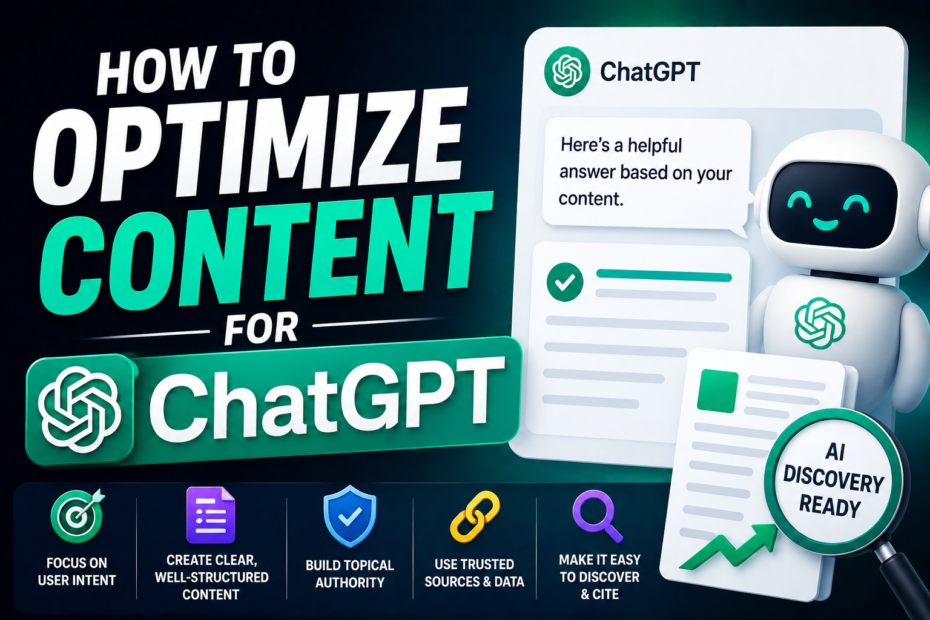
Quick Summary
– Discover practical, human-friendly ways to tailor content for ChatGPT and similar AI tools.
– Learn a step-by-step workflow that blends SEO, readability, and AI discovery signals.
– Find real-world examples, common pitfalls, and tools that speed up AI-ready content creation.
– Get ready-to-use prompts, formatting tips, and voice-search friendly structure to boost visibility.
How to Optimize Content for ChatGPT: An AI Discovery Guide
ChatGPT and other AI discovery systems aren’t just about keyword stuffing or fluffy prompts. They want content that’s clear, structured, and genuinely useful. This guide shows you a practical, human-friendly path to optimize your content for AI engines while keeping it natural for real readers. You’ll walk away with a repeatable process that fits into your normal blogging routine, not some spooky AI gymnastics.
What makes content discoverable to AI like ChatGPT?
First, let’s cut through the hype. AI systems don’t “read” in the same way we do, but they do look for patterns: clearly defined topics, logical structure, concise answers, and signals that your content is authoritative and helpful. They favor content that can be easily surfaced in a Q&A format, that includes explicit steps, and that speaks with a human voice. Think of it as a balanced blend of strong SEO signals and user-first clarity. If your content helps someone solve a problem quickly and then offers deeper context, you’re already on the right track.
Key signals AI looks for
- Clear topic signaling in the opening paragraph and headings
- Explicit answers to common questions (featured snippet readiness)
- Well-structured sections with scannable subheadings
- Practical, actionable steps and real-world examples
- Consistent terminology and defined concepts
- Accessible formatting for both text and voice interfaces
Step-by-step Guide
This is the core framework you can apply to almost any content project. It’s designed to be easy to follow, adaptable, and friendly to both readers and AI crawlers.
1) Define the exact reader intent
Before you write a word, answer: What problem am I solving? What will readers do after they finish this article? For ChatGPT, you’ll want to anticipate questions like “How do I optimize content for AI?” or “What steps boost AI discoverability?” Draft a short purpose statement and use it as your North Star. This keeps your content focused and helps you generate AI-friendly answer blocks later.
2) Map a content outline with AI in mind
Create a simple outline that mirrors how a human would explain things. Use a question-driven structure: What, Why, How, Examples, Best Practices. Each section should answer a specific user question. This scaffolding helps AI extract precise information and makes it easier for readers to skim.
3) Write for clarity and usefulness first
Nice prose matters, but clarity wins. Use short sentences where possible, explain jargon, and define terms on first use. Use active voice, concrete verbs, and tangible numbers. If you can quantify something, do it. If you can show a quick example, show it. The goal is content that feels like a thoughtful guide from a human expert, not a marketing brochure.
4) Structure for AI discovery and user experience
Structure your content so it’s easy to parse. Use one idea per paragraph, bullet lists for steps, and numbered lists for processes. Place the most important answer in the first sentence of a paragraph. Use descriptive subheads that include the question you’re answering. For example: “What is AI content optimization?” and “How to structure an AI-friendly blog post.”
5) Create a featured snippet-ready paragraph
Include a concise, direct answer to a common question early in the article. This is your candidate for a featured snippet. The paragraph should stand on its own and be discoverable without requiring readers to scroll. For example: “AI content optimization focuses on clarity, structure, and actionable steps that help AI systems understand and surface your content quickly. Start with a clear topic, use question-based headings, and provide step-by-step guidance.”
6) Add practical, real-world examples
People connect with case studies and concrete numbers. Include 2–3 mini-case studies showing how a blog post was optimized for AI discovery. Include before/after snippets, key metrics, and what changed in structure, prompts, or formatting. Real-world examples turn abstract tips into actionable patterns.
7) Optimize for voice search and long-tail questions
Voice queries tend to be natural-language questions. Structure content to answer direct questions succinctly. Include “how to” and “why” questions, and consider adding a short FAQ section near the end with 3–5 questions and crisp answers. This helps with voice-enabled devices and AI assistants that pull direct responses.
8) Balance SEO signals and human readability
AI discovery isn’t a trap; it’s a bridge. You still need meta descriptions, alt text, internal links, and keyword-aware copy. But you shouldn’t stuff keywords. Instead, weave them naturally into a coherent narrative that solves reader needs. That balance boosts both rankings and user satisfaction.
9) Create a robust internal linking plan
Internal links help AI understand site structure and pass link equity. Link from your content to related posts that deepen understanding and answer additional questions. Use natural anchor text that reflects the linked content. This supports both SEO and the AI’s ability to surface related topics.
10) Iterate and test
Optimization isn’t a one-and-done task. Check analytics for how readers engage, monitor keyword performance, and adjust. If you spot a section that underperforms, rewrite it with clearer questions and steps. Run small A/B tests on headings or prompts to see what resonates best with readers and AI.
Pro Tips
These practical tips help you squeeze more value out of every post and make it easy for AI to surface your content.
Tip 1: Use question-based headings
Turn headings into questions that readers and AI can latch onto. For example, “How do you optimize content for ChatGPT?” or “What are the five steps to AI-friendly blogging?” This nudges AI toward exact answers and improves snippet chances.
Tip 2: Include an AI-friendly glossary
Add a short glossary near the top with definitions of key terms (AI discovery, prompt engineering, semantic SEO, etc.). This helps AI engines align with your terminology and improves understanding for readers new to the topic.
Tip 3: Add a concrete CTA for AI-related actions
End with a clear call-to-action that invites readers to apply the steps, download a checklist, or try a prompt. A simple CTA helps with engagement metrics that indirectly influence discoverability.
Tip 4: Use consistent formatting and emphasis
Bold important terms, use bullet lists for steps, and keep paragraphs concise. Consistency makes it easier for AI to parse your content in longer sessions and helps with readability for humans too.
Tip 5: Optimize images with descriptive alt text
Alt text should describe the image function, not just its appearance. This improves accessibility and gives AI another signal about page content, which can indirectly aid discovery.
Tip 6: Leverage schema where relevant
Structured data isn’t always essential for blog posts, but when appropriate (e.g., how-to guides, FAQs), it helps AI systems understand the content. Use relevant schema blocks like HowTo, FAQPage, or Article where it makes sense.
Common Mistakes
Avoid these pitfalls that hurt AI discovery and reader experience alike.
Mistake 1: Overloading with keywords
Stuffing keywords into every sentence doesn’t help AI or readers. It creates awkward prose and can reduce trust. Focus on natural language that answers real questions.
Mistake 2: Skipping the FAQ or Q&A signals
If you miss the chance to answer common questions, you lose opportunities for snippet results. Build a compact FAQ section with direct answers.
Mistake 3: Poorly structured content
Long walls of text without headings, lists, or subpoints alienate readers and confuse AI. Break content into scannable chunks with descriptive headings.
Mistake 4: Inconsistent terminology
Switching between synonyms for the same concept without clarification confuses both readers and AI crawlers. Pick terms and stick with them, then explain any alternatives.
Mistake 5: Ignoring accessibility
Bad contrast, missing alt text, and inaccessible design hurt humans and can hinder AI ability to interpret your content. Accessibility is part of good optimization.
Best Tools
This section helps you pick tools that save time and improve output. They’re not required, but they’re incredibly helpful for consistency and scale.
Content planning and SEO
- Semrush or Ahrefs for topic research and keyword intent
- Surfer SEO for on-page optimization alignment with search intent
- Answer the Public for identifying common questions
Writing and editing
- Grammarly or Hemingway for readability and tone
- Grammarly Business or ProWritingAid for advanced style checks
- Readable or Grammarly for readability scoring aligned with audience
AI-friendly content helpers
- ChatGPT (various models) for drafting and polishing content
- Co writing assistants that help with structured prompts
- Canva or similar for accessible, alt-text-ready images
Accessibility and structure
- Wave or AXE for accessibility checks
- Schema.org testing tools to validate structured data
FAQ
What is AI content optimization for blogs?
AI content optimization is the process of shaping blog content so AI systems can understand, index, and surface it effectively. It combines clear structure, precise answers, helpful steps, and readable language to improve both AI discovery and user experience.
How do I structure a blog post for ChatGPT?
Start with a clear intent, use question-based headings, include a concise featured snippet paragraph, add a practical step-by-step guide, and finish with actionable takeaways. Use lists, short paragraphs, and a simple glossary to help AI parse the content.
Can I optimize images for AI discovery?
Yes. Ensure images have descriptive alt text, are accessible, and contribute to the topic. Alt text should explain the image’s purpose and relation to the content, not just describe appearance.
Is there a checklist I can follow?
Absolutely. You can keep a lightweight checklist handy: define intent, outline with questions, write clearly, format with headings and lists, add a FAQ, include internal links, optimize meta and images, and test with analytics. Small checks add up to big gains.
How do I measure success of AI-focused optimization?
Track metrics like time-on-page, bounce rate, scroll depth, social shares, organic rankings, and the rate at which your content appears in featured snippets or voice search responses. Also monitor the frequency of users asking new questions that your content answers.
Step-by-step Guide Recap
To keep this practical, here’s a condensed, repeatable sequence you can follow for any post:
Step 1: Clarify intent
Define the problem, the target reader, and the primary action you want readers to take.
Step 2: Draft an AI-friendly outline
Question-led sections: What is X? Why it matters? How to do Y? Real-world examples. End with a short FAQ.
Step 3: Write with clarity and brevity
Long sentences get trimmed. Replace jargon with plain language. Provide at least one concrete example per major idea.
Step 4: Add a crisp featured snippet paragraph
Include a standalone answer to a common question early in the post—this is your snippet potential.
Step 5: Include actionable steps
Provide a numbered list of steps readers can follow to implement what you explained. This improves both usability and AI extraction.
Step 6: Enhance with FAQs and internal links
Answer 3–5 common questions and link to one or two related posts to deepen user engagement and guide AI understanding of your site.
Step 7: Optimize for voice and accessibility
Craft concise answers for voice queries. Add alt text, accessible formatting, and schema when relevant.
Step 8: Review and iterate
Check readability, AI signals, and analytics. Tweak headings, prompts, and examples based on data and feedback.
Common Snippet-Friendly Paragraph (Featured Snippet)
AI content optimization centers on making information clear and quickly accessible. Start with a precise topic, answer the core question in plain language, and support with 2–3 concrete steps. This approach helps AI engines surface your content fast and improves reader comprehension at a glance.
Snippet List: Quick Actions to Boost AI Discovery
- Define intent and craft a question-based outline
- Write 1–2 crisp sentences that answer the main question
- Use numbered steps to guide readers and AI alike
- Incorporate 3–5 relevant FAQs with direct answers
- Add internal links to related posts for context
Internal Linking
Internal links should feel natural and helpful. They guide readers to deeper topics and help search engines discover related content. Here are a couple of examples you can adapt:
For a post about AI metadata strategies, you might link to AI-driven content optimization techniques within the body of a paragraph about on-page signals. If you discuss human-readable prompts, you could reference Prompt design best practices to offer readers a broader toolkit.
Putting It All Together: A Practical Example
Let’s walk through a quick hypothetical example so you see how the pieces come together. Suppose you’re writing about “Optimizing Blog Posts for AI Discovery.” The outline might look like this:
Introduction: Answer the question directly—ChatGPT can surface high-quality blog posts when content is clear, structured, and actionable. This guide shows a repeatable method to achieve that.
What is AI discovery in blogging? Explain the concept in 2–3 sentences with a simple analogy people can remember.
Why it matters: Short paragraph on potential visibility gains, faster indexing, and better user satisfaction.
How to structure a post: A numbered list of sections—Intent, Outline, Write Clearly, Snippet, Steps, FAQs, Internal Links, Accessibility.
Step-by-step execution: Provide a real mini-case study showing before/after optimization, including example headings, a featured snippet paragraph, and a small FAQ block.
FAQs: 3–5 concise questions with direct answers.
Conclusion: A friendly wrap-up that invites readers to apply the steps to their own topics, with a CTA to download a checklist or view related posts.
Final Thoughts
Optimizing content for ChatGPT isn’t about gaming the system. It’s about respecting readers and helping AI systems understand your material quickly and accurately. When you combine clear intent, accessible structure, practical steps, and helpful FAQs, you create content that shines for humans and AI alike. The result: higher engagement, better discoverability, and content that truly serves your audience’s needs.
Our Social Presence:
Website- https://chandanmaxi.com/
Website – https://www.bedforsell.com/
Facebook link – https://www.facebook.com/Chandanmaxi/
Instagram link – https://www.instagram.com/chandanmaxig/
Youtube link – https://www.youtube.com/@chandanmaxig
Linkedin- https://www.linkedin.com/in/chandanmaxi/
Quora – https://chandanmaxi.quora.com/
WhatsApp Channel- https://whatsapp.com/channel/0029Va5oE4l2ER6fAHBu692X