
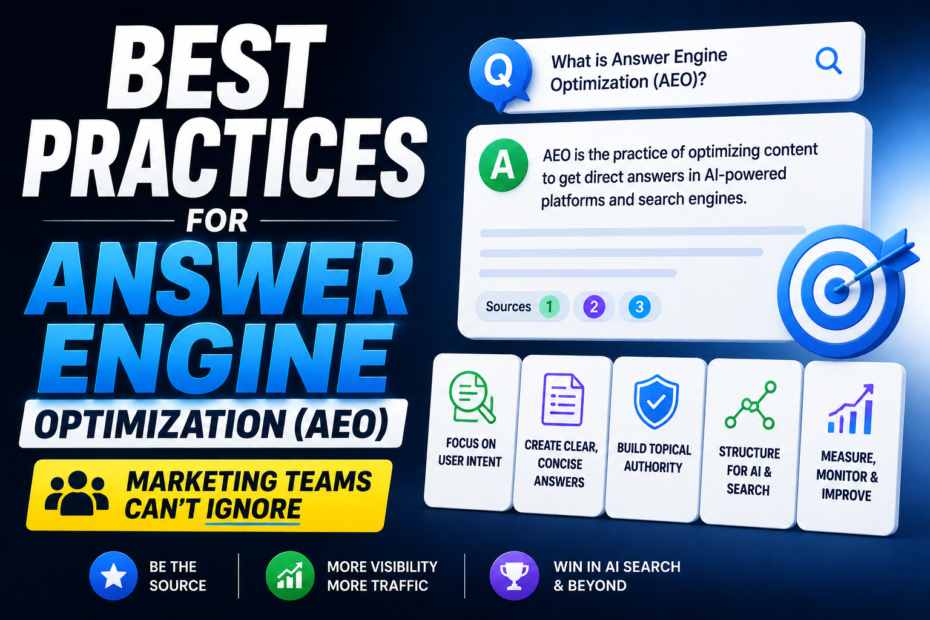
Answer engine optimization (AEO) is the unseen engine behind search-driven interactions. If your team isn’t optimizing for how people ask questions and receive optimized, actionable answers, you’re leaving traffic on the table. This guide breaks down practical, battle-tested AEO tactics that marketing teams can implement today to win voice, chat, and traditional search alike.
- Fast, clear answers that satisfy user intent
- Structured data and clear question-focused content
- Voice-search friendly content that’s easy to digest
- Measurement that ties direct questions to real business outcomes
- Internal linking that guides readers to deeper value
What is AEO and why should marketing teams care?
Answer engine optimization is all about shaping content so search engines can surface precise, concise, and useful responses to user questions. It’s not just about ranking; it’s about being the trusted source when a user asks, “How do I implement X?” or “What’s the best way to Y?” AEO sits at the intersection of SEO, content strategy, and product marketing. When done right, it powers voice assistants, chatbots, and traditional SERPs with the same authoritative voice.
Featured snippet: a quick, clear answer to a common question
Q: How can we optimize content for AEO without sacrificing readability?
A: Build content around user questions, use structured data to signal intent, keep answers direct and scannable, and verify usefulness with real user interactions. Combine concise answers with deeper context in linked sections to support longer queries.
Effective AEO content architecture: make every answer count
AEO thrives when content is organized around questions and actionable steps. Think of your pages as little answer hubs: a primary question, an immediate answer, followed by deeper context, and then related questions. This helps search engines understand the intent and makes it easier for users to find the exact snippet they need.
How to map questions to content
Start with a question brainstorm. Use customer support logs, product FAQs, forum threads, and keyword tools to surface real user questions. For each question, craft a concise, plain-language answer (one to three sentences) and then back it up with deeper explanations, examples, and links to related resources. This structure helps you win both quick snippets and longer-form ranking.
Structure your pages for clarity
– Use a clear hierarchy: main question as a header, direct answer in the first paragraph, followed by expanded sections.
Step-by-step Guide
- Identify high-value questions: Look at what your audience asks in support tickets, reviews, and comments. Use tools like Google Questions, YouTube auto-suggest, and social listening to expand the list.
- Craft crisp answers: For each question, write a one-sentence answer that’s easily scannable. This is your featured answer for the snippet.
- Expand with context: Add a short paragraph that explains the answer, then a bulleted list of steps, caveats, and examples.
- Use schema markup: Implement FAQPage, QAPage, and HowTo structured data where appropriate. This signals intent clearly to search engines and accelerates eligibility for snippets.
- Optimize for voice: Prefer natural, conversational phrases and short sentences. Anticipate follow-up questions and provide quick answers to those as well.
- Internal linking strategy: Connect each Q&A to deeper resources on your site to boost dwell time and authority.
- Measure and iterate: Track performance on featured snippets, voice search visibility, and user engagement metrics. Adapt based on what works.
Pro Tips
- Lead with the question in page headings. Use question-based headings like How to…, What is…, Why does… to align with Google SGE and AEO expectations.
- Make every answer skimmable. Use bold for key phrases, short sentences, and bullets for steps.
- Leverage micro-moments. Be ready to answer “I want to know…,” “How do I…” and “Where can I…” within a few lines.
- Test short vs. long snippets. Some queries prefer a 40–60 word answer; others benefit from a longer, step-by-step explanation.
- Voice search readiness. Phrase answers as direct responses that could be spoken aloud, avoiding dense paragraphs.
- Content freshness. Regularly update Q&As to reflect current features, pricing, or best practices.
- Use real-world examples. Case studies or mini-templates make answers more actionable and memorable.
Common Mistakes
- Forgetting the user intent behind the question. You might answer something technically correct but irrelevant to what the user asked.
- Overloading a single answer with jargon. Simplicity wins in answer snippets and voice queries.
- Neglecting structure data. Without proper schema, your chances of a featured snippet shrink.
- Ignoring internal links. Readers leave after the snippet if there’s no next step or deeper resource.
- Paying attention only to rankings. AEO is about satisfaction and task completion, not just search visibility.
Best Tools for AEO (and why they matter)
The right set of tools makes AEO scalable across teams. Here’s a practical toolkit you can start using today, with rationale for each choice.
Keyword and question discovery
- Answer the Public — great for question ideas and long-tail prompts
- Semrush or Ahrefs — for search volume, related questions, and competitive gaps
- ChatGPT-like prompts for internal QA teams to generate draft answers quickly
Content optimization and structure
- Surfer SEO or Clearscope — helps tune content around intent and structure for snippets
- Schema testing tools — Google’s Rich Results Test and the Schema Markup Validator
- CMS with easy header and schema management — enables fast iteration
Measurement and iteration
- Google Search Console — monitor impressions, clicks, and featured snippet performance
- Google Analytics or GA4 — track on-page engagement and conversion paths from AEO-driven pages
- Voice search emulation tools — verify how content performs in voice contexts
If you’re building a proper AEO program, you’ll want to align every tool with a single objective: deliver fast, accurate, useful answers that move users forward. For affiliate-friendly choices, these tools also help you demonstrate ROI by showing explicit impact on traffic and conversions. For deeper integration, consider linking to a few relevant posts like the ultimate guide to on-page schema and crafting conversion-focused FAQ pages.
FAQ: questions that frequently appear in AEO conversations
- What is the difference between AEO and SEO?
- AEO focuses on answering questions quickly and clearly, often with structured data and voice-readiness, while traditional SEO emphasizes broader rankings, traffic, and conversions across generic search results.
- How do I measure AEO success?
- Track featured snippet wins, voice query visibility, bounce rate from answer pages, time to first answer, and downstream conversions tied to those pages.
- Should I optimize every page for questions?
- No. Prioritize high-intent pages and pages with common questions. AEO works best when you connect direct answers to meaningful actions on your site.
- How do I optimize for voice search?
- Use natural language, direct answers, short sentences, and explicit steps. Structure data helps voice assistants pick up the exact snippet you want.
- Can AEO hurt SEO if done poorly?
- Yes. If answers are misleading, too long without value, or cannibalize other pages, you can harm user trust and performance. Clarity and accuracy are essential.
Internal Linking: guiding readers to deeper value
Internal links should feel natural and be purposeful. After delivering a concise answer, point to a deeper resource that expands on the topic, or to a product page that demonstrates practical application. For example, within an AEO page, you might include:
Explore our in-depth guide on FAQ schema and structured data to ensure your pages are eligible for rich results. Or read this step-by-step playbook for creating conversion-focused Q&A to maximize engagement.
Step-by-step Guide: actionable playbook you can start this week
- Audit your top-performing content for question-based opportunities. Identify the exact questions your audience asks and map them to your pages.
- Rewrite or create a concise answer first. Use one to three sentences that satisfy the user’s immediate need.
- Add a structured context with 3–5 bullets that outline steps, caveats, and outcomes. Include micro-examples where possible.
- Implement FAQPage and HowTo schema where applicable. Validate with Google’s tools and fix any errors promptly.
- Test and refine. Monitor snippet performance and adjust wording, structure, and internal links to improve click-through and dwell time.
- Scale across the site. Repeat the pattern for new questions and keep older answers fresh and accurate.
List Snippet: quick actionable tips for AEO
- Answer first, explain second — keep the core answer in 1–2 lines.
- Use numeric steps (e.g., 5 steps) to boost scannability and snippet potential.
- Target both short-tail and long-tail questions with tailored, crisp responses.
- Incorporate schema markup to improve eligibility for rich results and voice results.
- Measuring impact with conversions tied to the answer page ensures ROI clarity.
Best Practices Checklist for AEO-ready Content
- Question-first content framing: start with the exact user question in your heading.
- Concise direct answers: provide a clear answer in the opening lines.
- Structured expansion: follow with steps, examples, and nuances.
- Voice-ready phrasing: write as you’d speak to a colleague in a clarifying moment.
- Schema and accessibility: implement FAQ, HowTo, and QAPage where relevant; ensure readability for screen readers.
- Practice iterative optimization: use data to refine your Q&As and remove underperformers.
- Link equity to conversions: map readers from the answer to a relevant action path (demo, pricing, or contact).
Real-world examples and practical insights
Example 1: An ecommerce retailer wants to capture voice queries about product returns. They create a Q&A page with questions like “How do I return my order?” and “What is the return window?” The direct answer sits in the opening paragraph, followed by a step-by-step return process, eligibility notes, and links to the returns portal and policy. They implement FAQ schema and track snippet performance. Within weeks, they see improved voice search visibility and a noticeable uptick in return-portal clicks.
Example 2: A software-as-a-service company targets “How to set up X in Y” questions. They publish HowTo guides with numbered steps, short code blocks, and a troubleshooting section. Schema marks up the steps, and each guide links to a pricing or trial page. Traffic to the HowTo pages increases, and users complete the onboarding journey at a higher rate.
Example 3: A health and wellness brand answers common questions about a supplement. They craft a simple, accurate answer, then provide safety notes, usage tips, and a link to a buyer’s guide. They also add a short video snippet on the page. The combination of a clear answer, multimedia, and a trusted voice leads to more featured snippets and longer dwell times.
Voice search optimization: simple rules that work
Voice queries tend to be longer and more conversational. People speak in natural language and expect quick, actionable results. To optimize for voice, keep sentences short, answer directly, and provide structured steps. Use natural phrases that people would actually say when asking a friend for help. Include an FAQ or short answer section that a voice assistant can read aloud without needing to parse complex paragraphs.
Featured Snippet and Snippet Section (one-paragraph and list)
Featured snippet paragraph (40–60 words): Craft a concise, direct answer that can be read aloud or scanned quickly. Ensure it stands on its own, with no ambiguous references, and ends with a natural lead-in to deeper content on the page.
Snippet list (steps or tips): Present a numbered or bulleted list of steps, ensuring each item is a complete thought that can be read as a stand-alone item in a snippet. This increases the likelihood of being pulled as a list snippet for suitable queries.
Internal linking: how to do it well for AEO
Internal links help search engines understand how content topics relate and guide users to more value. Use natural anchor text that matches the target page’s intent. Place links in the answer body where they fit, not just in a “See more” line at the bottom. Some smart placements:
In the answer body: “For a complete approach, see our guide to structured data for FAQ pages.”
Within related sections: “If you’re exploring how to craft conversion-focused FAQs, check this step-by-step FAQ playbook.”
CTR optimization: turning readers into engaged visitors
Curiosity-driven subheadings help. Use numbers and concrete outcomes in headings, e.g., “5 steps to set up X in 30 minutes.” Keep headings scroll-stopping and human. Your aim is not just clicks, but meaningful engagement: longer sessions, more questions asked, and more actions taken.
FAQ roundup (extra questions you can answer now)
Q: How often should AEO pages be updated?
A: Regularly—at least quarterly or when product features, pricing, or policies change. Fresh content signals relevance and helps maintain snippet eligibility.
Q: Can AEO improve conversion rates on landing pages?
A: Yes. When you pair direct, helpful answers with a clear next-step link (demo, trial, or guide), you reduce friction and increase confidence to convert.
Q: What role does user feedback play in AEO?
A: Feedback shows real user intent, uncovers gaps, and validates whether your answers actually help. Use it to refine questions, add new ones, and remove outdated content.
Q: Should images be used in AEO content?
A: Yes, visuals like diagrams, flowcharts, and short videos can illustrate steps more clearly and improve comprehension, which supports snippet quality and user satisfaction.
Q: How do I balance AEO with evergreen content?
A: Prioritize high-impact questions that recur and remain relevant, while also building evergreen resources that support long-term traffic and authority.
Conclusion: practical, human-centered AEO that scales
While AEO might sound technical, the heart of it is simple: answer people’s real questions clearly, quickly, and usefully. Structure content so that it’s easy for readers to find the exact answer, and then give them a path to deeper value. With the right mix of questions, structured data, and thoughtful internal linking, you turn ordinary queries into trusted moments of usefulness. Start small, measure often, and iterate. Your future self will thank you for it—and so will your readers.
Our Social Presence:
Website- https://chandanmaxi.com/
Website – https://www.bedforsell.com/
Facebook link – https://www.facebook.com/Chandanmaxi/
Instagram link – https://www.instagram.com/chandanmaxig/
Youtube link – https://www.youtube.com/@chandanmaxig
Linkedin- https://www.linkedin.com/in/chandanmaxi/
Quora – https://chandanmaxi.quora.com/
WhatsApp Channel- https://whatsapp.com/channel/0029Va5oE4l2ER6fAHBu692X