
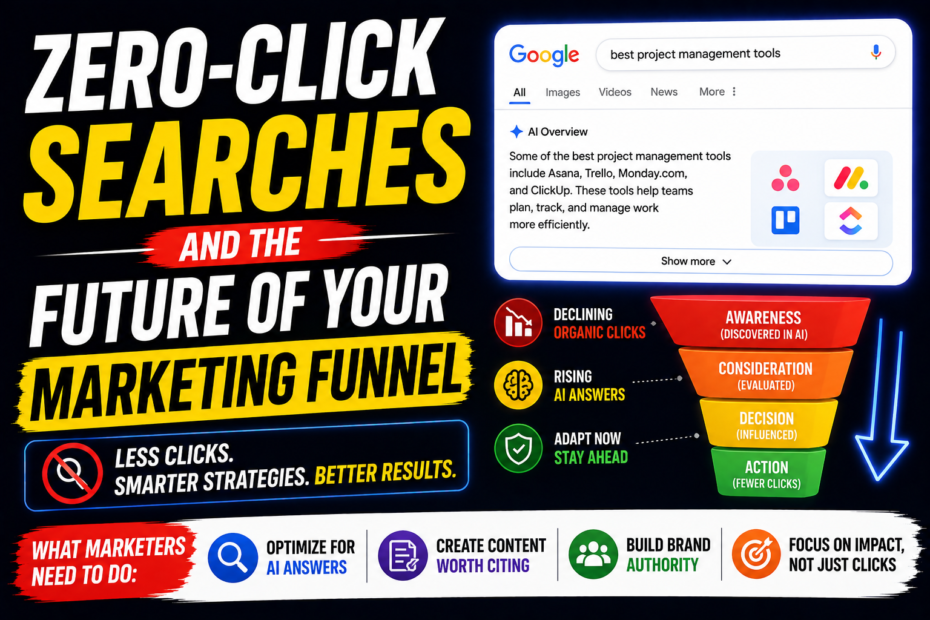
Zero-click searches are reshaping how marketers think about the funnel. People want answers now, not clicks, and search engines are delivering them directly. If your marketing strategy still relies on heavy keyword chasing and long-tail posts alone, you’re missing a big shift. This post shows how to adapt your funnel to zero-click reality—without losing depth, traffic, or conversions.
Quick Summary
- Zero-click searches pull the intent data straight to search results, reducing traditional click-throughs but increasing visibility and top-of-funnel authority.
- Structured data, featured snippets, and Q&A content are key to capturing zero-click visibility.
- Your funnel should focus on creating value in on-page content, optimizing for voice search, and mapping micro-conversions like email opt-ins and social follows.
- Content formats that perform well include how-to articles, answer boxes, product comparison snippets, and “best of” lists with concise answers.
- Measurement shifts: track intent signals, snippet impressions, direct traffic, and micro-conversions alongside traditional metrics.
Zero-click searches aren’t a bug in the system; they’re a feature. They force you to rethink the entire funnel—from discovery to decision—so you capture value even when users don’t click through to a page. This guide breaks down practical steps, real-world examples, and fast wins you can apply today.
What Zero-Click Means for Your Marketing Funnel
At first glance, a zero-click world can feel like a threat: fewer clicks, lower pageviews, and potentially less ad revenue. But the truth is more nuanced. Zero-click searches compress the funnel. People get answers instantly, and brands must meet them where they are: in the search results, voice assistants, and on snippets that sit above the fold. The funnel becomes a continuum rather than a funnel with strict handoffs.
Think of zero-click as a signal you must convert differently. You still want to guide users toward your real assets—newsletter signups, product pages, cases studies, or a consult. The trick is to design content that earns visibility in search features and shapes intent, even when someone doesn’t click.
Key shifts you’ll feel
- Content ownership shifts from “drive traffic to a page” to “be the fastest, clearest answer.”
- Structured data and on-page optimization become central to visibility in SERPs that show snippets, carousels, and knowledge panels.
- Voice search becomes a primary channel for early-stage intent capture.
- Micro-conversions (newsletter signups, app installs, trials) gain more strategic weight as early engagement signals.
- Monitoring becomes more about snippet impressions, average position in the snippet, and question intent coverage rather than just page rankings.
Let’s identify practical moves you can start applying today across stages of the funnel—from awareness to conversion.
Step-by-step Guide: Building a Zero-Click Ready Marketing Funnel
- Audit your current content for snippet-worthy potential. Find existing pages that answer common questions in your niche and map them to likely search-intent queries. Create concise, authoritative answers with 40–60 words that can be used as snippet content. Update with structured data.
- Create a robust FAQ and Q&A ecosystem. Build structured Q&As around buyer personas, product categories, and common objections. Use header questions that align with what people ask in search and on voice assistants.
- Optimize for featured snippets and knowledge panels. Use clear, direct sentences, break content into small blocks, and include data points, bullet lists, and stepwise processes. Ensure your schema markup is thorough (FAQPage, HowTo, Product, Organization).
- Focus on micro-content for top-of-funnel authority. Short, helpful answers on blog posts, social channels, and landing pages. These should be easily discoverable via search and shareable in social feeds.
- Map content to micro-conversions early. Place opt-ins, trials, or demos in or near snippet-friendly blocks. Don’t rely solely on gatekeeping; offer value first, then request contact details.
- Leverage voice search and conversational intent. Write in natural language that mirrors how people speak. Use long-tail question formats that map to voice queries.
- Build a “zero-click-first” content calendar. Schedule content that targets high-frequency questions, comparison queries, and how-to queries that could appear as snippets or quick answers.
- Improve on-page signals for local and product queries. Local packs and product knowledge panels rely on structured data, reviews, and proximity signals. Ensure consistency across NAP data and reviews.
- Measure what matters beyond clicks. Track snippet impressions, average position for featured snippets, direct navigations, newsletter signups, and product demos triggered from SERP exposure.
- Iterate with experimentation. Run A/B tests on snippet-focused content, test different formats (lists, steps, tables), and monitor how your changes affect visibility and micro-conversions.
Pro Tips: Make Zero-Click Work for Your Brand
- Use a “snackable” content approach: answer the question in 40–60 words, followed by a direct link to a deeper resource for users who want more details.
- Prioritize structure: questions in headers (h3) and concise answers improve chances of snippets. Include bullet lists and numbered steps in HowTo and FAQ content.
- Own the answer with credibility signals: include data, sources, and quotes. Citations can improve snippet trustworthiness and click-through when users want more.
- Combine snippet strategy with content that drives value beyond the snippet: a strong internal link to a deeper guide or product page converts the curious into customers.
- Audit your images and video content for rich results: video FAQs, how-to clips, and step-by-step visuals help appear in video carousels and knowledge panels.
- Optimize for mobile and voice: ensure fast load times, readable typography, and natural language headings. Voice searches favor concise, direct answers.
Common Mistakes to Avoid
- Overlooking snippet optimization in long-form content. You can miss high-value opportunities if you don’t tailor some sections for direct answers.
- Neglecting schema markup. Without proper structured data, search engines may struggle to identify the intent and context of your content.
- Forgetting about the user journey after a snippet. If you capture attention with a snippet but fail to guide the user to a meaningful next step, you squander potential micro-conversions.
- Relying solely on rankings. Snippet visibility can happen even if your page ranking isn’t at the top; you still need quality signals for long-term trust.
- Ignoring local intent. For many brands, local intent queries are a big chunk of zero-click opportunities; ensure local data, reviews, and citations are solid.
Best Tools for Zero-Click Marketing and Snippet Optimization
- Schema markup tools: JSON-LD generators and dedicated plugins for WordPress help implement HowTo, FAQPage, and Product schemas.
- Snippet monitoring: tools that track your presence in featured snippets, knowledge panels, and position changes for target queries.
- Content optimization suites: platforms that help you craft concise, answer-first content and test variations for snippet suitability.
- Voice search optimization tools: keyword hearing aids for conversational queries and long-tail question formats.
- Analytics with snippet-ready metrics: dashboards that reveal snippet impressions, click-through when you are in snippets, and micro-conversions tied to SERP exposure.
Best tools aren’t just software; they’re a process. Start with a baseline content audit, then layer in schema and snippet-focused content. Over time, your engine becomes better at appearing in the exact places users are looking—even if they don’t click.
Content Structure That Captures Featured Snippets
Think in modular content blocks. Each block should be able to stand alone as a quick answer, but also link to deeper material for those who want more. This modular approach makes it easier to repackage content for different formats—blog posts, FAQ pages, video descriptions, and social posts—all while preserving the core answer.
Real-world example: If you sell a project management tool, you could create a HowTo article titled “How to Set Up a New Project in 5 Simple Steps.” Break it into steps with a concise introductory paragraph, a 5-step list, a quick troubleshooting FAQ, and a CTA to a free trial. This structure is highly snippet-friendly and nudges readers toward a micro-conversion.
Voice Search: Practical Steps for a Friendly, Conversational Brand
Voice search continues to rise, especially for quick questions. People talk differently than they write, so adapt your content to spoken language. Use questions as headings, write like you’d answer a person in a real conversation, and deliver direct, actionable responses.
Tip: create a dedicated “Voice Help” page that compiles common voice queries with crisp answers. Include short, one-sentence responses suitable for voice assistants, followed by links to deeper resources for users who want more.
Step-by-step Guide (Bonus): Quick Wins You Can Implement This Week
Create 20 direct FAQ blocks, each with a 40–60 word answer and an accompanying deeper resource link. Implement FAQPage, HowTo, and Product schemas where relevant to boost snippet chances. Convert long-form pieces into modular blocks that answer common questions in each section. Schedule weekly updates of snippet-friendly posts and FAQs tied to product launches, updates, or seasonality. Add opt-in forms or demos in snippet-friendly sections, ensuring the next step is obvious and frictionless.
FAQ: Zero-Click Searches and the Future of Your Marketing Funnel
What exactly is a zero-click search?
A zero-click search is when the search engine provides an answer directly in the results page, and the user doesn’t click through to a website. Snippets, knowledge panels, and quick answers appear at the top, or in rich results, answering the query without requiring a visit.
Why should I care about zero-click if my traffic relies on clicks?
Zero-click visibility increases brand awareness and trust. It also captures early-intent users who might convert later or through other channels. It’s not about losing clicks; it’s about owning the answer so your brand is associated with reliable, quick information.
How can I optimize for featured snippets and knowledge panels?
Focus on concise, direct answers, use structured data (FAQPage, HowTo, Product), break content into digestible blocks, and align with common user questions. Include lists, steps, and data points, and ensure your pages are fast and mobile-friendly.
What role does voice search play in the modern funnel?
Voice search often returns snippets or direct answers. Optimizing for conversational queries, questions, and natural language increases the chance your content is read aloud by devices, expanding reach beyond traditional text search.
What metrics should I track in a zero-click world?
Track snippet impressions, average position for snippet-target queries, direct navigations from SERP when users click after seeing a snippet, and micro-conversions like signups or trials that originate from SERP exposure. Also monitor overall brand lift and share of voice in SERPs.
Internal Linking Deep Dive
Internal links help guide readers from zero-click surfaces to richer experiences. Here are two natural placements that feel seamless and relevant:
For broader authority on SEO topics: anchor text—this could be a post about structured data and snippets. For practical optimization tactics: anchor text—a guide on how to implement FAQPage and HowTo schemas.
Real-World Case Study Snippets
A mid-sized software company rewrote a few product support pages into concise, question-driven FAQ blocks with HowTo schema. They added an CTA to a free trial after each snippet-friendly answer. Within 8 weeks, they saw a higher share of voice for common support questions and a noticeable uptick in trials initiated from SERP impressions, even when click-throughs remained steady.
Common SEO Pitfalls When Going Zero-Click
- Over-optimizing for snippets at the expense of user value. Snippet content should be genuinely helpful and accurate, not manipulative.
- Underestimating the importance of ongoing updates. Snippet-friendly content can decay; keep FAQs fresh and reflect changes in products or services.
- Ignoring accessibility. Ensure content is readable, with alt text for images, descriptive headings, and keyboard navigability.
Best Practices for Long-Term Ranking Health
- Keep a strong content core with evergreen, high-quality resources that respond to frequent questions.
- Maintain a diverse content mix: snippets, how-to guides, product pages, and case studies.
- Preserve a human voice. Even as you optimize for snippets, content should read naturally, be helpful, and feel trustworthy.
- Use A/B testing for snippet blocks. Test question phrasing, answer length, and layout to find what resonates with your audience.
Conclusion (Not a Conclusion, a Practical Path Forward)
Zero-click searches aren’t a trend you chase; they’re a new speed of discovery. You adapt by delivering fast, trustworthy answers, guiding users to meaningful actions without forcing clicks. It’s about owning the space in search results—the snippets, the knowledge panels, the voice answers—and using that visibility to drive micro-conversions and long-term loyalty. Start with a simple, repeatable process: identify common questions, craft crisp answers, add schema, and measure snippet performance. Do that, and your funnel won’t shrink; it will become smarter and more resilient in a world where answers arrive before a click.
FAQ: Quick Reference
- What is the difference between a snippet and a knowledge panel?
- How can I measure the impact of zero-click optimization?
- Should I prioritize snippets over traditional page optimization?
- How do I scale zero-click content across multiple product lines?
- Can zero-click strategies work for B2B and enterprise brands?
Feature snippet paragraph:
Zero-click searches change where visibility lives. By delivering concise, reliable answers directly in search results, your brand becomes a trusted source, boosting recognition and guiding users toward micro-conversions even when they don’t click through to your site.
List snippet (steps):
- Identify top questions with high search volume.
- Craft clear 40–60 word answers with structured data.
- Map to deeper resources and micro-conversion opportunities.
- Publish and monitor snippet impressions and micro-conversions.
- Iterate based on performance data and evolving user intent.
Internal link example in context: For more on how to structure data for snippets, see our guide on HowTo schema best practices. To deepen your understanding of topic authority and SERP features, check our post on building trust with FAQ pages.