
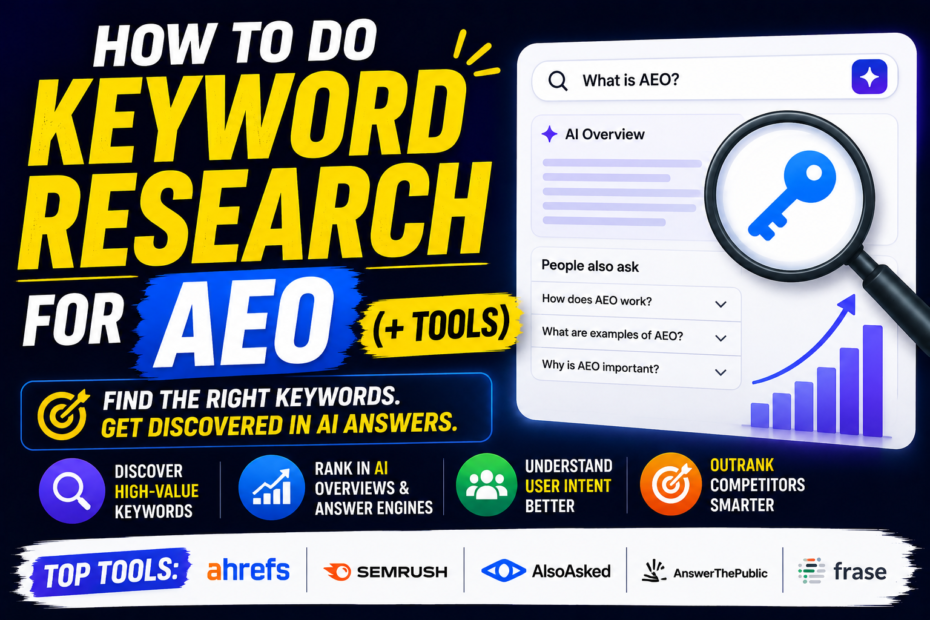
Quick Summary
– Learn how to do keyword research for AEO (Answer Engine Optimization) with practical, beginner-friendly steps.
– Discover real-world techniques to find intent-driven keywords, optimize content for voice search, and boost featured snippets.
– Get a proven framework, a list of best tools, common pitfalls, and actionable tips you can apply today.
– Includes step-by-step guide, pro tips, common mistakes, best tools, and a concise FAQ section for quick answers.
What is AEO keyword research and why it matters for your content strategy
If you’ve heard of SEO and wondered how to tailor content for people’s questions, you’re in the right place. AEO, or Answer Engine Optimization, is all about aligning your content with the exact questions people ask and the answers search engines want to surface. It goes beyond keywords as an isolated idea and focuses on intent, context, and the structure that helps search engines deliver fast, useful responses—especially for voice search and featured snippets.
Think of AEO as a practical extension of SEO tailored for questions. People aren’t just typing “best running shoes” anymore; they’re asking, “What are the best running shoes for flat feet in 2024?” They want an answer, not a brochure. Your job is to anticipate those questions, provide clear, concise answers, and structure your content so a search engine can grab that exact snippet and show your page to the right person at the right moment.
In real terms, AEO keyword research helps you:
- Identify question-driven keywords that match user intent
- Uncover long-tail variations you can answer quickly
- Structure content to target featured snippets and voice queries
- Improve your on-page elements so your content is skimmable and authoritative
How to approach AEO keyword research like a pro
Let’s build a practical method you can follow step by step. The goal isn’t to crank out a thousand keywords but to assemble a focused set of questions and answers that fit your niche and audience. You’ll mix research with content planning and some light optimization. Ready? Let’s dive in.
Step 1 — Define your audience and core topics
Start with who you’re writing for and what problems they’re trying to solve. Don’t chase keyword fruitlessly; map topics that cover those problems comprehensively. Create a short list of core topics (e.g., “running shoes for beginners,” “foot pronation,” “trail running gear”). For each topic, write a short audience persona and note common questions you think they’d ask. This becomes your North Star for the rest of the process.
Practical tip: Use existing content you’ve published to see what questions it answers well. If you have evergreen guides, you’ll often find adjacent questions you can target with a single, well-structured page.
Step 2 — Harvest questions from real sources
Now the fun part: gather questions people actually ask. You want to surface natural language, not invented terms. Some easy sources:
- People also ask (PAA) boxes from Google results
- Voice search query logs if you have access to them
- FAQ sections on competitor sites
- Related searches and “People also search for” suggestions
- Community questions from forums, Reddit threads, and Q&A sites
Capture questions verbatim as much as possible. If you’re unsure about intent, look at the top results for the same query and see what kind of answer the page provides. If the page is a how-to or a list of steps, that tells you the intent is practical, not purely informational.
Step 3 — Turn questions into keyword angles with intent tags
For each question, identify the underlying intent: informational, navigational, transactional, or commercial investigation. A simple tagging approach works well:
- Informational: “How to,” “what is,” “tips for,” etc.
- Navigational: looking for a specific product or brand
- Transactional: ready to buy or compare prices
- Commercial investigation: evaluating options before purchase
Transform questions into keyword targets by combining the exact question with a modifier if needed. For example, “What are the best running shoes for flat feet in 2024?” becomes a target. Don’t force the exact question; use it as a seed to craft a natural headline and subheadings for your article.
Step 4 — Expand with synonyms, long-tails, and intent-aligned variations
Once you have a list of core questions, expand with variations that preserve intent. Short variations capture voice or quick answers; longer variants capture specifics. Examples:
- What are the best running shoes for flat feet
- Best running shoes for overpronation 2024
- How to choose running shoes that help with flat feet
- Flat feet running shoe recommendations for beginners
Use a mix of single-word modifiers (best, top, affordable) and longer phrases (in 3–5 words). The key is to keep intent clear and provide value right away in the opening lines of your content.
Step 5 — Prioritize based on potential impact
Not every question deserves a page. Use a simple scoring system to decide where to invest time:
- Search volume: how many people ask this?
- Keyword difficulty: how competitive is this space?
- Click potential: would a compelling answer encourage a click?
- Content gaps: do competitors answer this well, or is there room to improve?
- Strategic fit: does this topic align with your product, service, or expertise?
Rank your topics by total expected impact, then build content that answers the top inquiries first. This helps you win featured snippets and voice search opportunities sooner.
Step 6 — Map content to the user journey
Think in terms of awareness, consideration, and decision. AEO content should address questions that appear at each stage. For awareness, you might answer “What are flat feet?”; for consideration, “Best running shoes for flat feet under $100 with wide toe boxes”; for decision, “Where to buy the best running shoes for flat feet online.” Each piece should have a clear CTA and a strong, helpful answer in the opening paragraph.
How to structure AEO content for maximum impact
The best AEO pages aren’t just long blocks of text. They’re scannable, helpful, and designed to be pulled into snippets. Here’s a practical structure you can reuse for most question-based posts.
Featured snippet-ready opening
Lead with a crisp, direct answer to the main question in 1–2 sentences, followed by a short summary. This format increases the odds of earning a featured snippet because search engines often grab the first clear, concise answer they can find.
Question-driven subheadings
Use question-based headings (h3) for each section. For example:
- What makes a shoe good for flat feet?
- How to test if a shoe fits your foot properly
- What are the best value options in 2024?
This approach helps search engines associate sections with precise queries and signals that your content is structured to answer specific questions.
Answer-first paragraphs
Under each subheading, start with a direct answer, then add context, details, and examples. Short paragraphs help readability and assist in voice search where users want quick, actionable guidance.
Clear, actionable steps and lists
Whenever possible, include numbered steps, bullet lists, and checklists. People love scannable content that they can follow with minimal friction. This is especially important for “how-to” questions and product recommendations.
Visuals that support the answer
Include a few high-quality images, diagrams, or a short comparison chart. Visuals help explain complex concepts and improve dwell time and satisfaction, which can indirectly boost rankings.
Step-by-step Guide to executing AEO keyword research
Here’s a practical, repeatable workflow you can implement in a single afternoon or stretch over a week, depending on your capacity. The goal is a ready-to-publish content map with a handful of highest-potential AEO pages.
1) Audit your current content and assets
Start with a quick inventory of existing pages that already answer questions around your core topics. Identify gaps—questions you’ve left unanswered or only partially covered. Note opportunities for updates, new angle content, or internal linking enhancements.
2) Build a seed list of questions
From your sources (PAA, competitors, forums), assemble a seed list of 30–50 questions. Don’t worry about perfect phrasing yet; you’ll refine later. This seed will drive your content map and help you see common threads across topics.
3) Validate intent and refine targets
For each seed, confirm the intent and ensure you can provide a clear, credible answer. If a question is too broad or not aligned with your expertise, either rephrase or deprioritize it. Your aim is to own a few well-defined intents rather than chasing every possible variation.
4) Research search metrics and competitiveness
Use your favorite keyword tool to pull metrics for your targets. Look for:
- Search volume (helps gauge potential reach)
- Keyword difficulty or competition score (tells you how tough it will be to rank)
- Related questions and SERP features (snippets, image boxes, videos)
Keep in mind that for AEO, a modest search volume with high intent can outperform a high-volume, low-intent keyword. A well-crafted answer to a niche question can earn you featured snippets and solid traffic.
5) Create a content map and assign formats
For each target, decide the correct format: long-form guide, quick answer page, comparison post, or product page with Q&A sections. Map internal links to related questions and to your broader topic hub pages. This helps search engines see authority and relevance across your site.
6) Draft, optimize, and test
Draft content with the rule: answer first, then elaborate. Use the target keyword in the opening sentence and headings, but avoid stuffing. Optimize for on-page factors:
- Title tag and meta description with the main question
- Primary keyword in the first 100 words
- Structured data where applicable (FAQ schema for Q&A sections)
- Alt text for visuals describing the content
- Internal links: match anchor text naturally to your related pages
After publishing, monitor performance and iterate. If a page isn’t winning a snippet after a few weeks, tweak the opening answer, add a targeted FAQ section, or rework the subheads to align more tightly with user intent.
Pro tips for beating the competition with AEO
- Target user questions that competitors miss or answer poorly. Your unique angle is your leverage.
- Use concise, direct Q&A snippets and ensure the opening lines satisfy the query instantly.
- Keep content fresh. Revisit seasonal questions and update stats, examples, and product recommendations yearly.
- Leverage FAQ structured data to boost chances of appearing in rich results and voice search answers.
- Publish multiple formats: a quick answer page for speed and a deeper guide for depth; both can coexist and cross-link effectively.
Common mistakes to avoid in AEO keyword research
- Jumping to broad “best” keywords without checking intent or relevance
- Forgetting to map content to specific questions or user intents
- Over-optimizing for a single keyword without supporting context or alternatives
- Ignoring voice search nuances like natural phrasing and shorter answers
- Neglecting internal linking and content hubs that connect related questions
Best tools for AEO keyword research and optimization
Tools help you surface questions, analyze intent, and organize your content plan. Here’s a curated list that balances price, power, and practicality. I’ll mention what each tool is best for and give you a practical use-case for each.
Keyword discovery and intent insights
- AnswerThePublic — Great for finding question-based angles and natural language patterns
- Ahrefs / SEMrush / Moz — Comprehensive keyword databases, difficulty scores, and topic explorers
- Ubersuggest — Budget-friendly option with helpful keyword ideas and traffic estimates
Question-focused and PAA analysis
- AlsoAsked — Excellent for long-tail question clusters and variations
- QuestionDB or AnswerThePublic’s “questions” view — Visualizes common questions around a topic
- Google’s People Also Ask data (via SERP scraping or a tool that captures PAA) — Real-world queries
Content planning, outline, and optimization
- Surfer SEO — Helps build content outlines aligned with SERP signals and density patterns (useful, but be mindful of over-automation)
- frase.io — Focuses on answer quality and content optimization by aligning with user intent
- Clearscope / MarketMuse — Focused on content quality and topic coverage to rank for intent-rich phrases
Technical and structured data support
- Google Structured Data Testing Tool (or Rich Results Test) — Validate FAQ schema and other structured data
- Yoast SEO / Rank Math — On-page optimization guidelines and schema blocks for FAQs
Best practice: mix free and paid tools to cover discovery, intent, and optimization. Start with one or two core tools, then expand as you validate results and scale your content program.
Visual and voice search optimization for AEO
Voice search is a major avenue for AEO because people tend to ask questions in a natural, conversational way. Your content should be friendly to voice queries and provide crisp, direct answers. Here are practical moves:
- Use natural language in your opening lines and subheads that mirror how people speak
- Answer questions in a concise 1–2 sentence blurb at the top of each section
- Include a dedicated FAQ section with direct, short answers to common questions
- Format content to be easily read aloud by voice assistants
For featured snippets, focus on the exact questions and ensure your answer is genuinely useful. The snippet often pulls from the first 40–60 words that directly address the question, so make those words count.
Internal linking strategy to reinforce AEO topics
Internal linking helps search engines discover your content and understand topic relationships. Use natural anchor text and connect related questions to topic hub pages. Here are a few practical ideas:
- From a topical guide, link to specific Q&A posts that answer each sub-question
- Link from product comparison pages to “best for X” questions you’ve answered
- Create a central “AEO for [Your Niche]” hub and cluster related posts around it
Two natural internal links you might include:
Example anchor text choices could be “best running shoes for flat feet” or “how to test shoe fit” based on your content.
Step-by-step Guide
Here’s a compact, repeatable blueprint you can reuse for each new AEO topic. It’s practical and fast enough to fit into a busy content calendar.
- Identify a core question in your niche you want to own (main target)
- Fetch 10–15 variations and related questions using your favorite discovery tool
- Validate intent and choose 3–5 top targets with clear coverage opportunities
- Draft a brief outline with question-based subheadings and an answer-first structure
- Write a concise 800–1,200 word post per target, optimized for the snippet
- Add 4–6 FAQ entries that answer common branches of the main question
- Include a short hero image or diagram and 1–2 supporting visuals
- Publish and monitor performance, then iterate after 4–6 weeks
FAQ — answers to common AEO questions
What is the fastest way to find AEO opportunities?
Start with your core topics, pull related questions from PAA and forums, then validate intent and potential impact. Focus on a handful of high-quality targets rather than chasing dozens of low-value terms.
How do I optimize for featured snippets?
Lead with a concise, direct answer in your opening, structure content with clear question-based headings, and include a properly formatted FAQ section with short, precise responses.
Can I use the same content for SEO and AEO?
Yes, but tailor it to the audience. AEO content is often more question-driven and structured for quick, direct answers, which also helps with SEO rankings and featured snippets.
What role does internal linking play in AEO?
Internal links help search engines establish topic authority and guide users through related questions. It strengthens the content cluster and improves dwell time and crawlability.
Which tools are essential for a beginner?
A good starting set includes AnswerThePublic or AlsoAsked for questions, Google SERPs for real PAA data, and a primary keyword tool like Ahrefs or SEMrush for volume and difficulty, plus a content optimization tool or plugin to structure your pages.
Best practices for ongoing AEO success
- Maintain a living content map that evolves with new questions and emerging trends
- Publish in small, frequent batches to test which formats and angles perform best
- Prioritize user experience: fast loading, clean layout, accessible design
- Regularly update facts, stats, and product recommendations to stay current
- Monitor featured snippet performance and refine snippets to improve capture
Pro tips for content creators and marketers
- Use numbers and concrete outcomes in headings to create scroll-stopping titles (e.g., “5 Proven Ways to…”, “7 Questions to Ask…”)
- Incorporate micro-moments: short, helpful answers that satisfy quick queries
- Test different answer lengths and see which paragraphs are most frequently used in snippets
- Keep a running library of question templates you can reuse across topics
- Balance evergreen relevance with timely updates to stay current in search results
Internal linking example section
For illustration, if you’ve written a post about “best running shoes for flat feet,” you might link to a follow-up post titled “How to test running shoe fit at home” with anchor text “how to test shoe fit.” This keeps readers in your ecosystem and helps search engines map your content around a central topic.
Real-world example: applying AEO to a running gear blog
Let’s run through a concrete scenario. Say you run a blog about running gear. You start with the core topic “running shoes for flat feet.” You gather questions like:
- What are the best running shoes for flat feet?
- How do I tell if a shoe fits my flat feet?
- Are there affordable options for flat feet runners?
- What features matter most for overpronation?
You create 4 targeted posts, each answering one question with a snappy opening, subheads that mirror the question, and a brief FAQ section. You add internal links to your “best running shoes for flat feet” hub and to related “shoe comfort testing” and “pronation control” posts. You set up FAQ schema for each post and track performance. After a couple of weeks, you notice a featured snippet showing up for “best running shoes for flat feet.” You refine the opening sentence to align even more with the exact query and improve the surrounding content to increase snippet retention. The result? Higher click-through rates and more qualified traffic.
Best practices for affiliates
When you’re building posts with affiliate intent, accuracy and transparency matter. Be clear about recommendations, disclose affiliations where required, and emphasize the user benefit. Use AEO to surface legitimate questions and offer value first. Your affiliate links should be contextually relevant to the answers provided and placed where they add practical value to readers.
Internal links to reinforce SEO and content strategy
Here are two sample internal link placements you can adapt naturally within your posts:
Anchor suggestion: best running shoes for flat feet
Anchor suggestion: how to test shoe fit at home
Final take: your practical AEO playbook
AEO keyword research isn’t about chasing the loudest keyword; it’s about delivering precise, helpful answers your audience wants, in a format search engines prefer. Start with intent, questions, and structured answers. Build a few topic clusters that you can own, optimize for featured snippets and voice search, and maintain a steady cadence of updates and improvements. With the right plan, you’ll see more qualified traffic, better engagement, and content that earns recognition from both readers and search engines.
Best Tools — quick picks for quick wins
Here’s a compact list you can keep on hand as you start or scale your AEO efforts. Pick 1–2 from each category as a starting point, then grow as needed.
- Questions and ideas: AnswerThePublic, AlsoAsked
- Core keywords and competition: Ahrefs, SEMrush, Moz
- Content optimization: Clearscope, Surfer SEO, Frase
- Structured data and schema: Google Rich Results Test, Schema.org guidance
- Internal linking and content planning: Notion or Airtable for content maps, Google Sheets for keyword tracking
FAQ — quick answers for fast readers
How do I start with AEO if I’m a complete beginner?
Begin with one core topic, gather 10–15 relevant questions, and draft a short page that answers the main question with a crisp, direct opening. Expand with a few related questions and related internal links. Repeat with another topic once you’re comfortable.
What makes for a great AEO headline?
Headlines should be question-based, emotional enough to spark curiosity, and specific about what the reader will learn. Example: “What Are the Best Running Shoes for Flat Feet? 5 Real-World Picks for 2024.”
Is AEO only about Q&A pages?
No. AEO works across formats, but Q&A-driven content shines for voice search and snippets. You can blend how-to guides, product comparisons, and FAQ sections to answer a core question comprehensively.
How do I measure AEO success?
Track metrics like organic traffic to the target pages, click-through rate from SERP to page, ranking position for primary targets, featured snippet appearance, and time on page. You should also monitor bounce rate and engagement signals to ensure readers find real value.
Can I reuse content across multiple AEO targets?
Yes, but tailor each piece to the specific question and intent. Reuse core insights, but adjust the opening answer, subheadings, and examples to fit the exact query. Internal links help you connect the pieces into a strong topic cluster.