
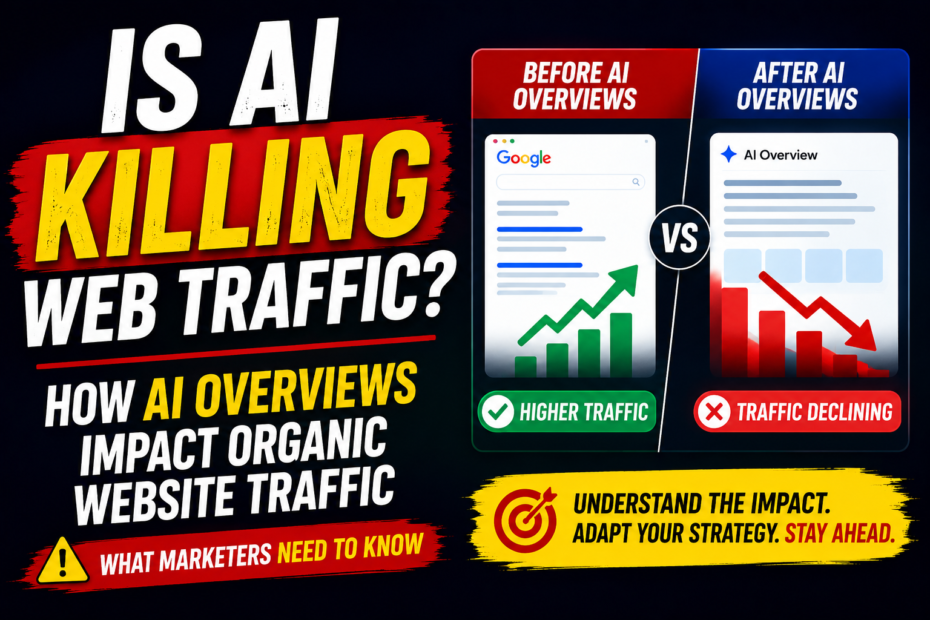
Quick Summary:
- AI can reshape how visitors find your site, but smart optimization keeps you visible rather than hidden.
- AI-derived insights tend to shift traffic toward intent-first pages, not erase overall demand.
- Best results come from blending human expertise with AI analytics, not relying on AI alone.
- Practical steps include optimizing for user intent, refining content quality, and strengthening technical SEO.
Will AI Overviews Kill Your Web Traffic? Practical truths about AI, rankings, and organic reach
Yes, AI changes the way people discover content, but it doesn’t automatically kill your web traffic. Think of AI as a new layer in how search engines interpret intent, surfaces, and relevance. When you adapt your strategy to align with how AI understands queries, you actually improve your chances of showing up for the right people at the right time. In this guide, we’ll break down what AI overviews are, how they influence organic traffic, and what you can do to stay competitive without chasing every new algorithm rumor.
What exactly are AI overviews and why do they matter?
AI overviews are concise, AI-generated summaries or structured results that sit atop or alongside traditional search results. They bubble up frequently asked questions, quick answers, and key data points. For users, these snippets feel like a fast pass to the information they want. For site owners and marketers, AI overviews signal a shift in how visibility is earned: it’s no longer enough to publish great content; you must craft reliable, authoritative, well-structured content that AI can easily summarize and verify.
When you see your content featured in an AI overview or highlighted as a quick answer, it often means your content is considered topically relevant and trusted. The upside is obvious: higher click-through rates when your snippet appears and more visibility. The caveat is simple: if your pages aren’t genuinely helpful, well-structured, and aligned with user intent, AI may choose other sources with clearer signals. So the goal becomes clear: build content your audience trusts and train your pages to answer questions succinctly and accurately.
Real-world signs AI is shifting, not shrinking, organic traffic
In 2023 and 2024, several big shifts appeared in search results. You’ll notice more “zero-click” moments—where the answer is provided directly in the SERP or in an AI-generated overview. That can reduce the immediate need to click through to a page. But that doesn’t mean no traffic; it means traffic becomes more intent-driven. People who still click through tend to be more qualified, and those pages that deliver real value quickly often see higher engagement and conversion rates. The trick is to structure content so that it can serve those quick insights and still deliver deeper value once a user dives in.
Take a real-world example: a how-to article about “how to optimize Shopify storefronts for mobile.” If your page answers the exact question in the snippet and also provides a link to a deeper guide, you can capture both the quick answer and interested readers who want more. If a competitor skims the surface but your page offers a robust, actionable plan, you’re more likely to retain the traffic and convert it into signups or purchases. This is where long-tail content shines—AI may surface broad queries, but niche, expert content wins credibility and sustained traffic.
Step-by-step: how AI insights change your content strategy
- Audit current pages for intent alignment: Are you answering the user’s question in a clear, direct way?
- Upgrade on-page structure: Use clear headings, concise meta descriptions, and optimized schema to help AI summarize and verify your content.
- Prioritize E-E-A-T signals: Experience, Expertise, Authority, and Trust. This isn’t trendy—it’s fundamental for AI-driven ranking signals.
- Develop a content hub: Create pillar pages with deeper, expertly linked subpages to cover a topic comprehensively.
- Optimize for featured snippets: Structure content in Q&A formats, list formats, and concise paragraphs so AI can extract clean answers.
- Improve internal linking: Guide both users and AI through a logical content path that reinforces authority in a niche.
- Monitor user intent signals: Watch bounce rates, time on page, and scroll depth to ensure your content satisfies users and AI alike.
Featured snippet: quick answer
AI overviews don’t erase organic traffic; they change how it’s earned. When you publish clear, well-structured content that answers common questions and offers deeper value, your pages can appear in AI-driven snippets and still attract visits from users who want more detail. In short, adapt your content to be both snippet-friendly and richly informative, and you’ll keep traffic steady or even grow it.
How to craft content that thrives with AI-driven search
First, understand the user journey. People begin with broad questions, then narrow down to specifics. Your job is to meet them at each stage. Create content that answers the “what, why, when, how, and where” in succinct formats, but also provides deeper value for those who want to learn more. Here are practical moves that work well in real life:
- Answer common questions in a dedicated FAQ section with precise, source-backed responses.
- Break complex topics into easily scannable sections—bullets, numbered steps, and short paragraphs.
- Use consistent, structured data (schema) to help AI parse your content’s meaning and context.
- Embed behind-the-scenes content, case studies, and data-driven insights to demonstrate authority.
- Leverage multimedia: well-produced videos and diagrams can reinforce AI summaries and improve dwell time.
Where AI overviews meet practical SEO tactics
Think about the core elements of SEO—technical health, content quality, and user signals. AI overviews feed on the same bedrock, but they reward you for a few extra practices:
- Technical SEO groundwork: fast loading times, mobile-friendly design, accessible content, and clean crawl paths.
- Content quality and clarity: precise answers, correct data, and no fluff.
- Structured content: consistent headings, tables, and defined sections that AI can summarize reliably.
- Authoritativeness: recognizable expertise and good reputation signals—backlinks, citations, and credible sources.
Common questions about AI, rankings, and traffic
How do AI overviews affect click-through rates?
They can increase CTR when your page provides a strong snippet and a compelling title. If your answer is shown directly in the snippet, a user may click through to learn more on your site for deeper insights.
Will AI hurt long-tail traffic?
Not necessarily. Long-tail queries often map to niche, highly specific content. If you’ve built targeted, well-structured pages for those topics, you can still win traffic even if a snippet appears for more generic queries.
Is this the end of keyword optimization?
Keywords still matter, but the way you use them shifts. Focus on intent, semantic relevance, and how your content answers questions users ask, not just matching a single keyword phrase.
Step-by-step: future-proofing your traffic strategy
- Build a content strategy anchored in user intent, not just search volumes.
- Consolidate content into topic hubs with clear pillar and cluster pages.
- Enhance your content with data, case studies, and actionable takeaways.
- Improve page experience: speed, accessibility, and mobile usability.
- Experiment with schema markup and FAQ snippets to increase chances for AI overviews.
Pro tips for staying visible in an AI-influenced search landscape
- Focus on clear, helpful answers above the fold. If you can hit a user’s question in 1–2 sentences, you’re likely to win snippet opportunities.
- Use questions as headings. It makes your content easier for AI to extract and answers vocalizable for voice search.
- Test content depth. Create both quick-reference pages and deep-dive guides to satisfy different user intents.
- Track featured snippet visibility. Tools like SERP trackers and search analytics can help you see when your content is shown as a snippet.
- Balance AI-friendly optimization with human-friendly readability. Don’t optimize for bots at the expense of readers.
Common mistakes to avoid
- Packing content with keywords without real value. AI can notice lack of depth and authority.
- Ignoring mobile and speed. If your pages are slow, AI won’t reward them with strong summaries.
- Neglecting internal linking. A weak content network hurts AI’s ability to understand topic breadth.
- Over-optimizing for snippets at the expense of full articles. People still click for more details, and AI rewards depth too.
Best Tools to support AI-aware SEO and content marketing
- Ahrefs, Semrush, or Moz for topic, keyword, and competitive analysis.
- Surfer SEOs or Clearscope for on-page optimization aligned with readability and structure.
- Schema.org markup and Google Rich Results testing tools to verify structured data.
- Google Search Console and Bing Webmaster Tools for visibility insights and indexing issues.
- Content experimentation platforms or A/B testing tools to measure click-throughs and engagement on updated pages.
Internal linking: value anchors for SEO and AI
Internal linking helps AI understand how topics connect and which pages are the strongest signals for a given topic. Here are a few natural linking ideas:
- From a broad guide to specific case studies: anchor text helps search engines see relevance and authority.
- From pillar pages to clustering articles that answer specific questions: anchor text.
Step-by-step guide to implement now
- Audit all top landing pages for intent alignment and snippet potential.
- Reformat pages with clear H2/H3 structure and concise, accurate quotes or data points for AI to summarize.
- Create or update pillar pages and cluster content around core topics you want to dominate.
- Deploy FAQ sections with questions users frequently ask, and provide crisp, citation-backed answers.
- Monitor performance in search consoles and analytics, adjusting for pages that underperform or lose ranking.
Frequently asked questions (FAQ)
Can AI cause my traffic to drop suddenly?
It can feel that way if you ignore updates in search signals. Most drops happen when you don’t adapt to changing user intent or fail to deliver clear value. Modern SEO means continuously updating content to stay relevant.
Should I rewrite all my old content for AI?
Not everything needs a rewrite. Prioritize pages that drive traffic, have strong potential for snippets, or cover evergreen topics where AI summaries add value. Then refresh with updated data, examples, and improved structure.
How do I know if my content is good for AI summaries?
Ask yourself: Is the answer immediately useful? Is it easy to summarize into a few sentences? Does it cite credible sources? If yes, you’re on the right track for AI-friendly content.
What metrics matter most in an AI-driven world?
Beyond standard metrics like organic traffic and rankings, pay attention to featured snippet impressions, average time on page, scroll depth, and click-through rate from SERPs. These reveal how well your content serves readers and AI alike.
How can I improve voice search visibility?
Use natural language and concise, question-based headings. Create content that answers questions directly, as people often speak in full sentences when using voice assistants.
Internal links for further reading
To deepen your understanding of SEO in an AI context, check these related posts:
How to optimize for featured snippets in 2024
Building a content hub: pillar and cluster pages that rank
Conclusion (human-friendly takeaway)
AI isn’t out to kill your traffic. It’s changing how traffic is found and how quickly your content is summarized. The smartest move is to craft content that truly helps users, structure it so that AI can easily extract and summarize key points, and build a robust internal linking system that signals topical authority. When you blend human-centric content with AI-friendly optimization, you don’t just survive; you thrive in an evolving search landscape.